



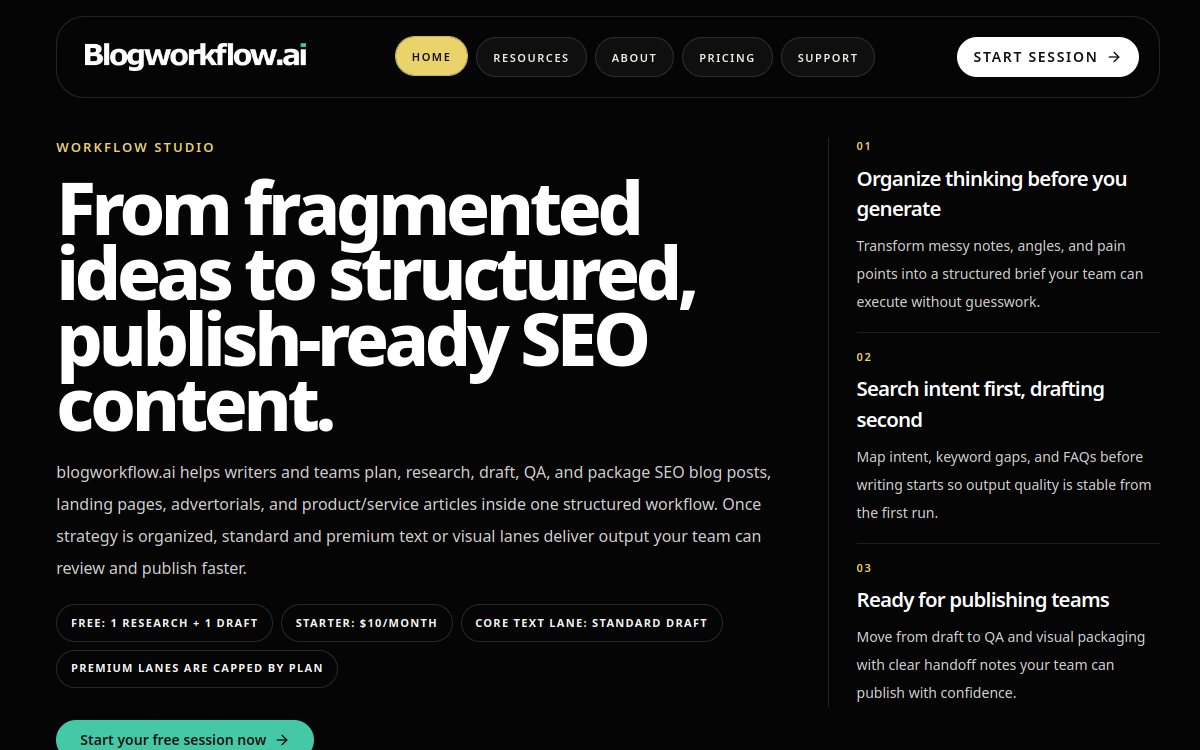
Producing quality SEO content is not just about generating a draft: you need to define an objective, study search intent, map keywords, write, verify quality, and add visuals to the article. This process, often scattered across multiple tools and people, quickly becomes chaotic and hard to reproduce from one article to the next. BlogWorkflow.ai offers a direct answer to this disorder by bringing together all these phases in a single, structured workflow. The tool positions itself as SEO content software for blogs, landing pages, advertorials and product articles. Its principle: transform fragmented ideas into an 8-step workflow that results in content ready to publish. Rather than aiming for pure speed, it emphasizes repeatability and commercial viability of the result. In the sections that follow, we detail how it works, its features, use cases, benefits and pricing model to help you judge whether it matches your editorial needs.
What is BlogWorkflow.ai?
The essentials
BlogWorkflow.ai is SEO content production software built around an 8-step workflow. Where most generators stop at the draft, this tool connects planning, research, writing, quality control and visual direction in a single coherent system. Each publishing cycle becomes repeatable, which stabilizes quality from the first production onward. The process begins by defining the business objective, audience pain point and article promise, before a single line of text is written. Next comes mapping intent, keyword gaps and frequently asked questions. Once the strategy is organized, text and visual lanes, offered in standard and premium versions, deliver a result that the team can review and publish quickly. The tool is designed for content professionals who want a reliable pipeline rather than one-off generation.
Key features
The central feature of BlogWorkflow.ai is its 8-step workflow, which breaks content creation into distinct, ordered phases. Everything starts with defining the expected outcome: business objective, target audience and article promise. The tool then moves on to mapping search intent, identifying keyword gaps and preparing FAQs, which secures SEO relevance upfront. Writing builds on this structured brief to produce text aligned with the strategy. The system distinguishes between several lanes: a standard text lane for routine needs and a premium text lane when content requires finer reasoning, tighter narrative logic or conversion-focused wording. On the visual side, standard and premium lanes let you choose between supporting graphics and high-value hero assets. The transitions from draft to QA to visual formatting come with clear handoff notes, designed so the team can publish with confidence. Search quotas, standard drafts, premium activations and visual generations are set by the plan chosen, which aligns usage with actual publishing volume.
Use cases
BlogWorkflow.ai shines in several concrete editorial situations. A content agency managing multiple clients can standardize its output through an identical workflow from one project to the next, guaranteeing consistent quality levels. An in-house marketing team uses it to produce optimized blog articles without starting from scratch each time, leveraging built-in keyword mapping. For a product launch, premium lanes help draft landing pages and advertorials with strong conversion intent, complete with polished hero visuals. Freelance SEO writers benefit from the process to deliver publication-ready articles with clear handoff notes, making collaboration with clients easier. Finally, editorial managers who need to scale up appreciate being able to calibrate each step based on budget and target quality level, arbitrating between standard and premium lanes.
Advantages
The main benefit of BlogWorkflow.ai is consistency: by enforcing the same path for each article, it reduces oversights and stabilizes quality from the first iteration. Separating steps also makes review and refinement simpler, since each phase is isolated and identifiable. Keyword research and intent mapping done upfront directly improves content’s positioning potential, whereas writing launched without preparation remains fragile. The distinction between standard and premium lanes offers useful financial flexibility: you reserve the most powerful resources for high-stakes content and keep costs controlled on routine articles. Finally, handoff notes smooth collaboration within teams and speed the path to publication, a precious time gain for anyone publishing in volume.
Pricing
BlogWorkflow.ai offers a free plan limited to 1 search and 1 draft, ideal for testing the approach and judging workflow quality. The Starter plan starts at $10/month and gives access to the core text lane with standard draft. Premium lanes, whether for text or visuals, are capped based on the plan you subscribe to. Concretely, each package controls the number of searches, standard drafts, premium text lane activations and standard or premium visual generations included. Plan choice is therefore based on monthly publishing volume and the quality level you want to compete at. This quota-based logic aligned with usage lets you adapt cost to your actual production pace.
Conclusion
BlogWorkflow.ai is for those who see SEO content as a process to industrialize rather than a simple text to generate. Its 8-step workflow, from strategy to visuals, brings rare structure among assisted writing tools, and its standard and premium lanes offer real flexibility to balance cost and quality. It’s a relevant ally for agencies, editorial teams and SEO writers who publish regularly and want publication-ready results. If you’re looking for a quick text generator or your needs go beyond written SEO, other solutions will be better suited. For structured, repeatable editorial production, the tool deserves to be tested through its free offering.