



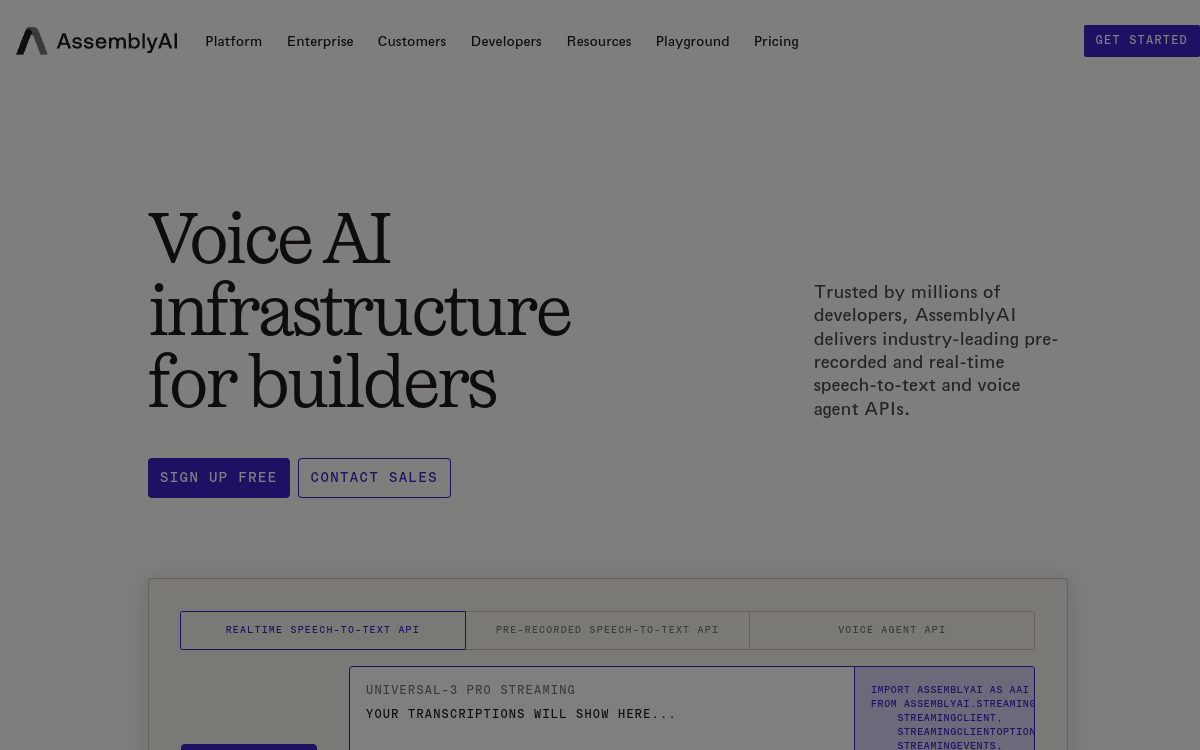
AssemblyAI provides a suite of speech-to-text and voice understanding APIs used by startups and Fortune 500 companies to build voice AI products. The Universal-3 models cover real-time transcription, speaker identification, punctuation, audio event detection, code-switching and over 99 languages. The platform also includes advanced building blocks like an LLM Gateway, Guardrails and a Voice Agent API that simplifies creating conversational agents. Designed for developers, AssemblyAI bets on transcription quality, low latency and clear documentation to move quickly from prototype to production.
What is AssemblyAI?
The essentials
AssemblyAI is a suite of APIs specialized in voice. It includes accurate transcription models, speech understanding functions like audio event detection, speaker identification, punctuation, emotion or keyword detection, and recently a Voice Agent API that simplifies creating real-time conversational agents. The platform covers both batch mode for recorded audio files and real-time streaming for live conversations. Over 99 languages are supported, with transcription quality praised by public benchmarks. AssemblyAI targets developers and provides SDKs, documentation, examples and admin console to make direct integration straightforward.
Key features
The Universal-3 models form the backbone of the product. Universal-3 Pro Streaming handles real-time transcription with disfluencies taken into account, contextualized punctuation, detection of audio events like beeps or laughter, and fine speaker identification. Universal-3 standard covers batch transcription with high quality and very broad multilingual coverage. The Voice Agent API adds a conversational layer that orchestrates transcription, reasoning and voice synthesis to build agents in weeks rather than months. The LLM Gateway lets you connect the audio pipeline to third-party language models while managing token handling, retry and observability. Guardrails serve to apply moderation and filtering policies to model output. On the side, the platform includes keyword detection, automatic redaction of sensitive information, thematic classification and conversational insights like extraction of key moments. All of this is exposed by a simple REST API, accompanied by SDKs for major languages, plus a self-hosted mode for organizations with strong requirements.
Use cases
Use cases take multiple forms. In contact centers, AssemblyAI powers near-real-time call transcription, sentiment analysis and compliance, reducing tickets and improving customer satisfaction. In healthcare, the API enables accurate transcription of consultations with fine terminology management and accent handling, complementing human review. In audiovisual, podcasts and meeting platforms use it to produce auto captions, summaries and chapter breakdowns. Note-taking tools like some meeting assistants use AssemblyAI to transcribe and structure conversations in real time. Voice agents, whether for e-commerce, teleassistance or personal assistants, leverage the Voice Agent API for faster time-to-market. Finally, conversation intelligence platforms dedicated to sales coaching or quality provide AssemblyAI with audio streams to then deliver fine analyses to managers.
Advantages
Benefits span multiple levels. Transcription quality is the first differentiator, with results regularly tested on public datasets and real-world cases. Streaming latency is low enough to enable smooth real-time experiences, a prerequisite for a performant voice agent. Broad multilingual coverage prevents needing multiple vendors to support international expansion. The richness of auxiliary features like diarization, audio event detection or keyterms enables going beyond simple word-by-word to deliver real understanding. For product teams, the Voice Agent API and Guardrails accelerate production deployment, translating to reduced time-to-market. For data teams, result format is rich, structured and easy to consume in an analytics pipeline.
Pricing
The pricing grid is pay-as-you-go with competitive hourly cost depending on the model used and features enabled. First hours are free to allow prototyping without commitment, and growing volumes automatically unlock discount tiers. For enterprise use with massive volumes or compliance requirements, custom contracts are available, including SSO, dedicated hosting, SLA guarantees and self-hosted option. This structure makes AssemblyAI suitable for both solo founders prototyping a product and large accounts that need to cap spending and security. Transparent pricing and public calculators facilitate comparison with other providers like Deepgram, OpenAI Whisper API and Google Speech.
Conclusion
AssemblyAI offers excellent balance between quality, versatility and developer experience. To build serious Voice AI product, the API is solid foundation covering transcription, understanding and conversational orchestration. The cost is justified by functional depth and reliability, and the self-hosted option expands scope to organizations with strict requirements. If voice is at your product’s core, AssemblyAI clearly deserves a place on the short-list.