


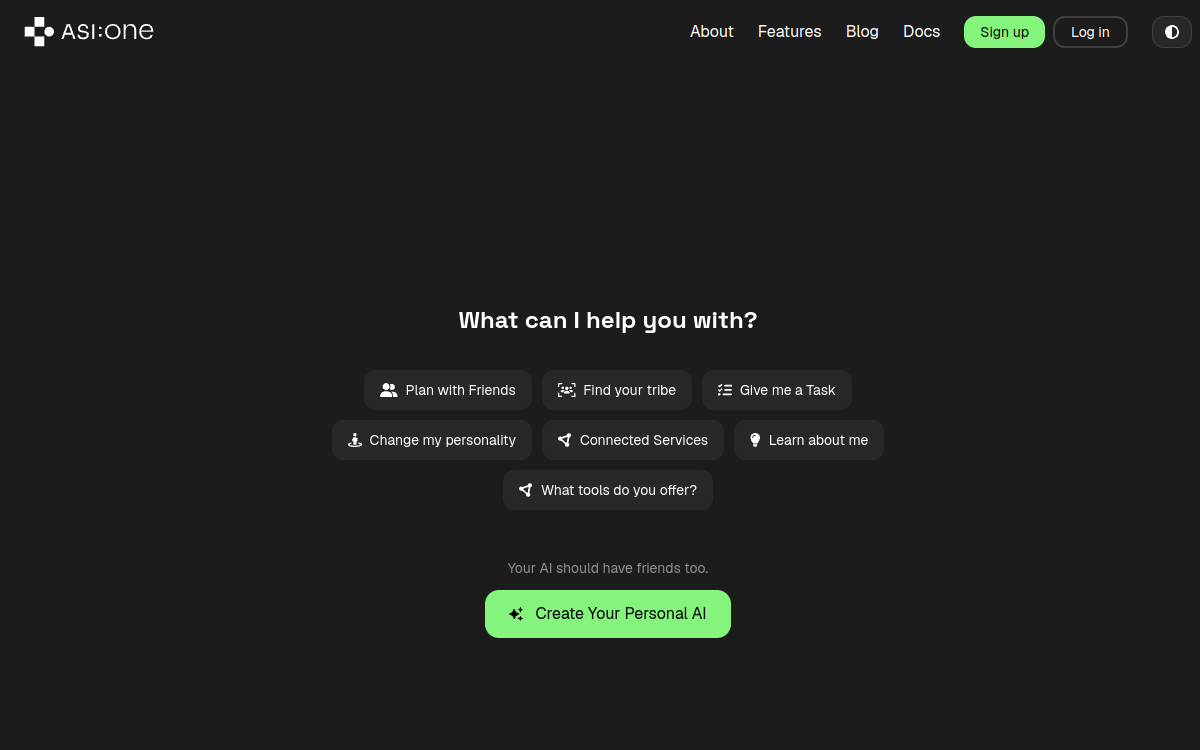
In the world of large language models, most solutions aim for a versatile conversational assistant. ASI:One takes a different path. Developed by Fetch.ai and the ASI Alliance, this platform presents itself as the first LLM designed for Web3 and, more importantly, for agentic workflows. Where a classic chatbot answers a question, ASI:One seeks to discover, coordinate, and orchestrate specialized AI agents to accomplish complex multi-step tasks. This orientation makes it a niche tool, clearly intended for developers and decentralized projects rather than the general public. The platform rests on three models sharing the same OpenAI-compatible API, a broad context window, and native integration with the Agentverse agent marketplace. In this overview, we examine what ASI:One actually offers: its models, agentic features, concrete use cases, its economic model tied to the FET token, and its current limitations. The goal is to understand who this technology really addresses and in what contexts it delivers superior value compared to generalist LLMs like GPT or Claude.
What is ASI:One?
The essentials
ASI:One is an agentic AI platform designed by Fetch.ai and the Artificial Superintelligence Alliance. It offers three models accessible through a single API: asi1, the default balanced model; asi1-mini, optimized for fast chat, voice, and classification responses; and asi1-ultra, dedicated to the deepest reasoning with up to 500 tool calls per turn. All share a 200,000 token context window and streaming support. ASI:One’s distinguishing feature lies in its Web3 anchoring and its ability to function not alone, but by coordinating specialized agents from the Agentverse marketplace. The model handles the selection, orchestration, and execution planning of these agents autonomously. It also offers a stateful Knowledge Graph mode that structures data to enhance memory and personalization.
Key features
The heart of ASI:One rests on agentic reasoning: the platform plans, executes, and adapts its actions according to multi-step objectives without constant intervention. Tool-calling allows you to define custom functions that the models invoke, with asi1-ultra able to chain up to 500 per turn for long agentic sequences. Integration with the Agentverse marketplace enables discovery and coordination of specialized agents. On compatibility, the API follows OpenAI’s Chat Completions standard, allowing you to reuse existing SDKs with minimal adaptation. An MCP server is provided, compatible with clients like Claude Code or Cursor. The platform offers two operating modes: a Classic stateless mode, fast and familiar, and a stateful Knowledge Graph mode that structures data into evolving knowledge graphs to strengthen memory and personalization. Multimodal capabilities are added with a text-to-image API handling formats like 1024×1024 or 1792×1024, as well as image-to-text analysis. Session persistence via a dedicated header maintains context between agent interactions, and a developer dashboard allows you to track usage and manage rate limits. Several multimodal features remain announced as in development.
Use cases
ASI:One primarily targets developers building AI agents capable of collaborating across platforms. A typical use case involves assembling a workflow where multiple specialized agents coordinate automatically to solve a complex task, for example retrieving data, analyzing it, then generating a deliverable. Web3 projects and decentralized applications find in it a native LLM for their ecosystem, capable of integrating with blockchain applications. Teams already leveraging the Agentverse marketplace can connect their own agents to multiple chat interfaces and marketplaces. Thanks to OpenAI compatibility, builders who already have a codebase using the Chat Completions API can test ASI:One without heavy rewriting. The Knowledge Graph mode suits applications requiring structured memory and strong personalization, such as persistent conversational agents or document processing tools in specialized domains (legal, medical, financial, technical).
Advantages
ASI:One’s main benefit is bringing agent orchestration to a single interface compatible with tools developers already know. OpenAI API compatibility greatly reduces the barrier to entry: no need to learn a new request format. The presence of three models lets you fine-tune the balance between reasoning depth, speed, and cost for each use case. The broad 200,000 token window and extended tool-calling make long, coherent agentic sequences possible. Finally, native integration with Agentverse transforms a simple LLM into an orchestrator capable of delegating to specialized agents, opening automation scenarios difficult to achieve with an isolated model. The provided MCP server further eases integration with existing development environments.
Pricing
ASI:One is offered on a freemium model. Free access allows you to test the platform, while premium features and priority access are tied to holding the FET token within the ASI Alliance ecosystem. This access mechanism, tied to a crypto asset, is coherent with the product’s Web3 positioning but remains opaque for those outside that universe. To date, detailed per-token costs for each model are not publicly displayed. Developers must therefore consult the dashboard and official documentation to precisely evaluate rate limits and usage conditions applicable to their project.
Conclusion
ASI:One is not just another generalist conversational assistant, and that is precisely what makes it interesting. By betting on agent orchestration, OpenAI compatibility, and assumed Web3 anchoring, Fetch.ai and the ASI Alliance offer a credible foundation for building autonomous multi-agent systems. For agent developers and decentralized projects, it is an option worth serious study. For general public use or a search for simple, fixed pricing, other LLMs will remain more suitable. Worth watching as its multimodal and agentic capabilities continue to roll out.