



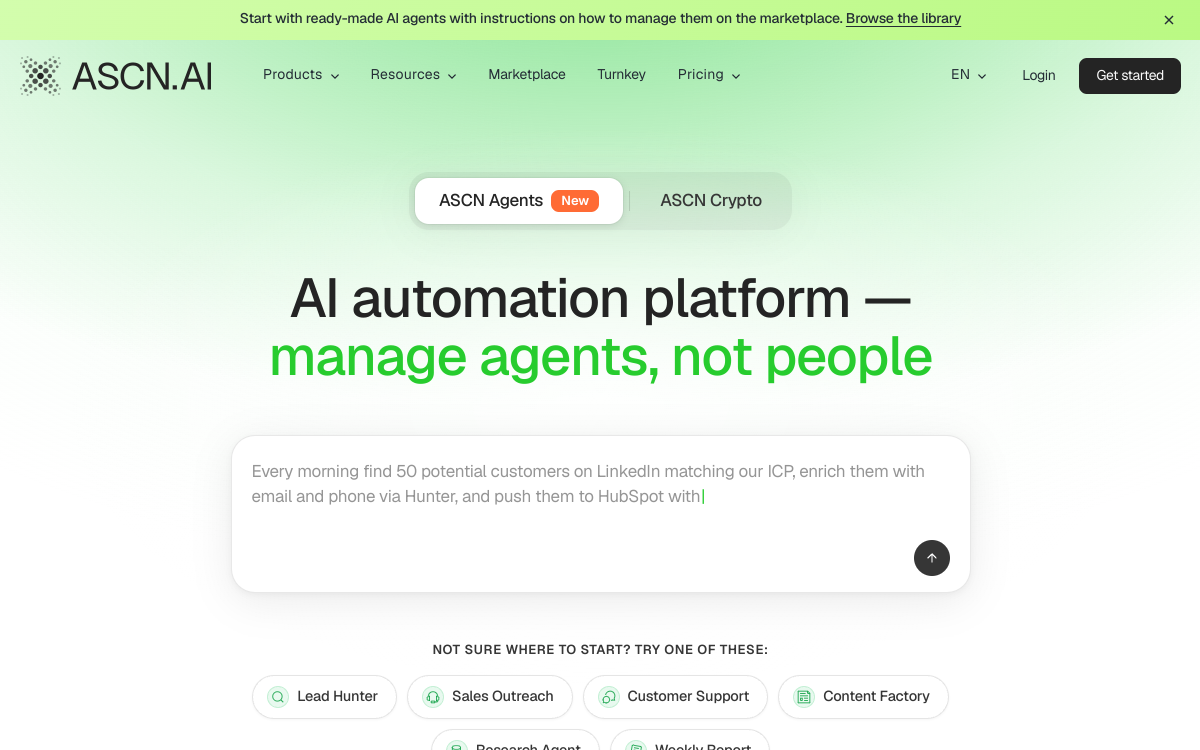
ASCN AI is a no-code platform that allows you to design automated workflows and autonomous agents powered by artificial intelligence. Thanks to a visual editor, you connect your applications, trigger actions and orchestrate complex tasks without technical skills. A marketplace offers pre-built solutions to get started quickly, and a flexible credit system adapts to your volumes. ASCN AI is aimed at SMBs, freelancers and operational teams seeking to automate repetitive business processes while maintaining control over the logic and integrations used.
What is ASCN AI?
The essentials
ASCN AI is a SaaS platform for creating workflows and AI agents in no-code mode. Concretely, you access a visual editor in which you assemble steps, triggers, actions and connectors to your existing tools. The promise is to transform business logic usually handled manually into reproducible automation, executed on-demand or on a scheduled basis. At the heart of the experience are three pillars: a visual canvas for modeling processes, an agent engine capable of making decisions and calling AI models, and a marketplace of pre-built solutions to accelerate launch. ASCN AI thus positions itself between traditional linear automation tools and more technical agent development frameworks.
Key features
ASCN AI’s first strength is its visual editor: you connect blocks representing actions, conditions or calls to AI models, which allows you to build workflows understandable by business profiles. This approach is complemented by an autonomous agent system: instead of simple step sequences, you describe an objective and the agent decides what actions to take to achieve it, leveraging the tools you make available. The platform also offers a marketplace where templates and turnkey automations are shared, which significantly reduces setup time for standard use cases such as lead qualification, email sorting, content generation or syncing between applications. On the integrations side, ASCN AI covers the main productivity, CRM, communications and storage tools, with the ability to use generic API connectors to extend reach. The economic model is based on credits consumed as executions happen, which offers great flexibility but requires monitoring usage to avoid surprises. Finally, the platform includes execution history and tracking features, essential for debugging agents and auditing what they actually do, as well as sharing and collaboration options for teams building their automations together.
Use cases
ASCN AI covers a wide variety of use cases. On the sales and marketing side, there is automatic lead qualification, contact enrichment, personalized messaging or syncing between a CRM and an email tool. For operations, the platform allows centralizing notifications, generating periodic reports, linking customer support tools to knowledge bases or orchestrating repetitive tasks across multiple SaaS. Product and tech teams can use it to prototype internal agents capable of analyzing tickets, summarizing documents or monitoring business indicators. Freelancers appreciate the ability to sell custom automations to their clients without having to develop a back-end. Finally, more exploratory profiles find in ASCN AI an interesting playground to test AI agent architectures, compare different models and iterate quickly.
Advantages
The main benefit of ASCN AI is making accessible a technical complexity that was previously reserved for development teams. An operations manager can build alone a workflow that would have taken several days of specifications and coding. This autonomy reduces the time to production for automations, while decreasing dependence on a centralized IT team. Productivity gains are concrete: tasks repeated several times a day can be delegated to an agent that runs in the background, freeing up team members for higher value-add missions. Strategically, the use of AI agents also allows quickly experimenting with new processes, measuring their impact, then industrializing or abandoning them without heavy investment. Finally, the marketplace of templates reduces the barrier to entry and allows learning by example by drawing inspiration from already proven scenarios.
Pricing
ASCN AI offers a pricing grid structured around credits. The free plan offers 1000 credits, enough to test the editor, create a few simple workflows and get familiar with agents. The $28 per month plan allocates 50,000 credits, which is well suited for a freelancer or small team automating regular tasks. The $94 per month plan goes up to 200,000 credits and is suitable for more active teams, such as an ops or marketing team industrializing multiple scenarios. The $284 per month plan offers 700,000 credits for intensive uses and complex agents. Beyond that, an enterprise offer on quote allows negotiating volumes, support and any compliance constraints. Compared to traditional automation tools, this grid remains competitive for mixed uses of workflows + agents.
Conclusion
ASCN AI deserves attention from any organization wanting to industrialize its internal processes without hiring a dedicated development team. Its no-code positioning, autonomous agents and template marketplace make it both an accessible and powerful platform, suitable for freelancers and SMBs alike. The main limitations come down to a credit model to anticipate and an interface only in English. If these points are not blockers, ASCN AI is an excellent compromise between ease of use and functional depth to confidently enter AI automation.