


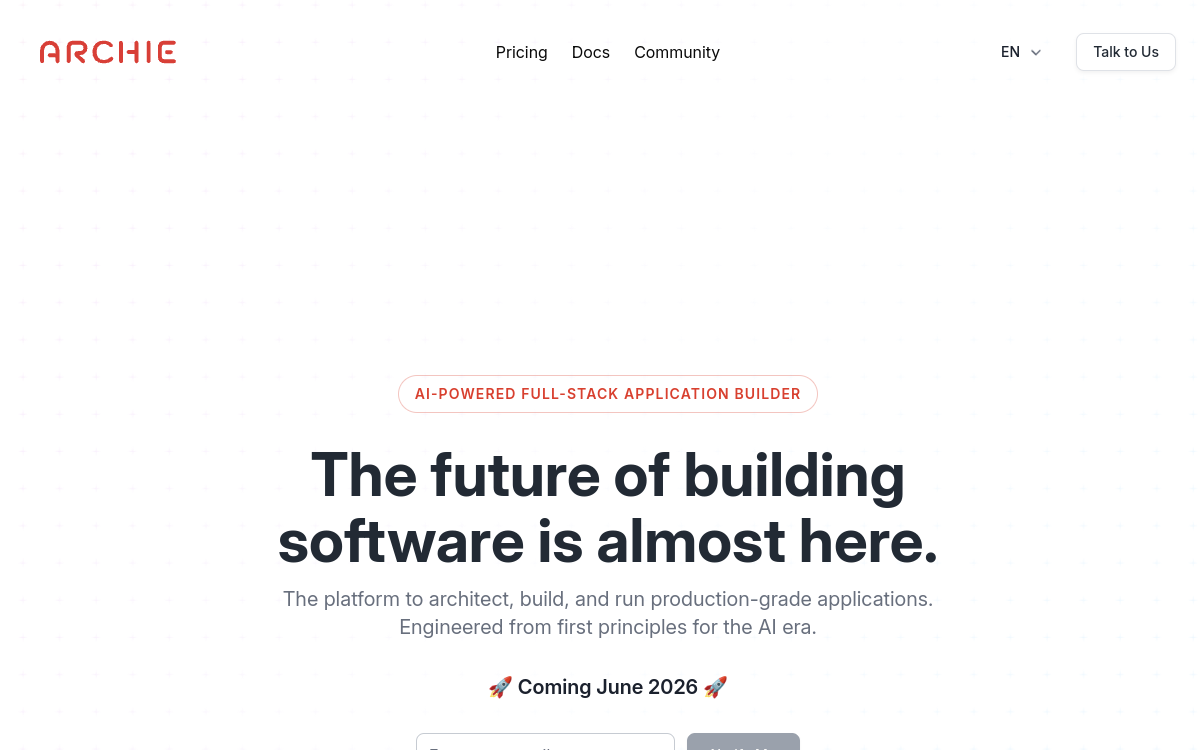
Building a complete application still requires today juggling between a front-end framework, a database, an authentication service, an API layer, and hosting. Archie proposes to bring all these building blocks together within a single AI-powered platform. The idea is straightforward: move from an idea to a truly production-ready application without leaving a single environment and without manually assembling a dozen services. Announced for June 2026, Archie presents itself as a next-generation full-stack builder, designed from the ground up for the age of AI. The platform relies on multiple specialized agents and three ways of working, enabling it to serve both experienced developers and product teams looking to accelerate their cycles. In this overview, we detail what Archie actually is, its main features, use cases, benefits, pricing, and our conclusion, to help you determine whether this tool meets your software creation needs.
What is Archie?
The essentials
Archie is an AI-assisted full-stack development platform. Its promise boils down to one sentence: architect, build, and run production-grade applications. Concretely, the user describes their project, and the platform mobilizes a series of agents to produce the product architecture, design, and then the application itself with its backend. Where many tools stop at the prototype stage, Archie pushes through to production deployment with hosting and CDN. The platform directly integrates the database, API, authentication, and storage, avoiding the need to chain together multiple vendors. Code remains accessible and synchronizable with GitHub, guaranteeing that teams retain full control of their project rather than remaining locked into a proprietary environment.
Key features
The core of Archie rests on its specialized AI agents. Notable examples include a Product Architect agent, a Design agent, and on higher tiers, a DevOps agent, for a total that can reach seven agents covering each layer of the application. The platform also stands out for its three development modalities: prompt mode for natural language description, a visual editor to manipulate the interface directly, and IDE mode for developers who want to intervene in the code. On the infrastructure side, each application comes with a database, an API layer, an authentication system, file storage, and frontend hosting with a global CDN. Archie also offers knowledge import with custom RAG context, scheduled functions, CI/CD pipelines on advanced plans, as well as application versioning and real-time collaboration. GitHub synchronization ensures portability and full ownership of generated code.
Use cases
Archie primarily targets teams that need to transform an idea into a functional product quickly. A startup can use it to build a complete MVP with database and authentication, then deploy it to production without immediately hiring an infrastructure team. An agency can use it to deliver custom applications to its clients, leveraging real-time collaboration and role-based access control. Experienced developers find an accelerator in it: they prototype in prompt or visual mode, then switch to the IDE to refine the code. Product teams benefit from versioning and agents to frame architecture and design before writing a single line. Finally, scheduled functions and CI/CD pipelines open the door to more advanced use cases for products meant to evolve over time.
Advantages
Archie’s main benefit is consolidation: instead of orchestrating a separate database, hosting provider, authentication service, and design tool, everything lives in a single platform. This reduces technical friction and accelerates the move from prototype to production. The presence of multiple AI agents allows you to delegate structuring steps like product architecture or design, while maintaining control through the IDE. Code ownership via GitHub is a reassuring asset for teams worried about vendor lock-in. The three modalities of work make the tool accessible to diverse profiles, from non-technical founders to senior developers. Finally, the free offering allows you to test the entire concept before any serious financial commitment.
Pricing
Archie offers four tiers. The Starter plan is free with 50 credits per month and Product Architect and Design agents. The Pro plan adds full-stack production applications, six AI agents, complete backend, and hosting. The Team plan is billed at $24 per seat per month, with a minimum of five seats, 2,000 shared credits, seven agents including DevOps, and CI/CD pipeline. The Enterprise plan offers custom pricing with SSO, SOC 2, HIPAA and GDPR compliance, and a 99.95% SLA. Additional credit recharges ($15 to $140) and dedicated production backends ($25 to $150 per month) round out the offering.
Conclusion
Archie aims to bring together in a single platform everything required today for modern full-stack application creation. Its combination of AI agents, three development modalities, and integrated complete backend makes it a coherent proposition for teams that want to move fast without sacrificing production quality or code ownership. As the product is very new, a trial through the free offering remains the best way to evaluate whether it precisely meets your needs before any commitment.