


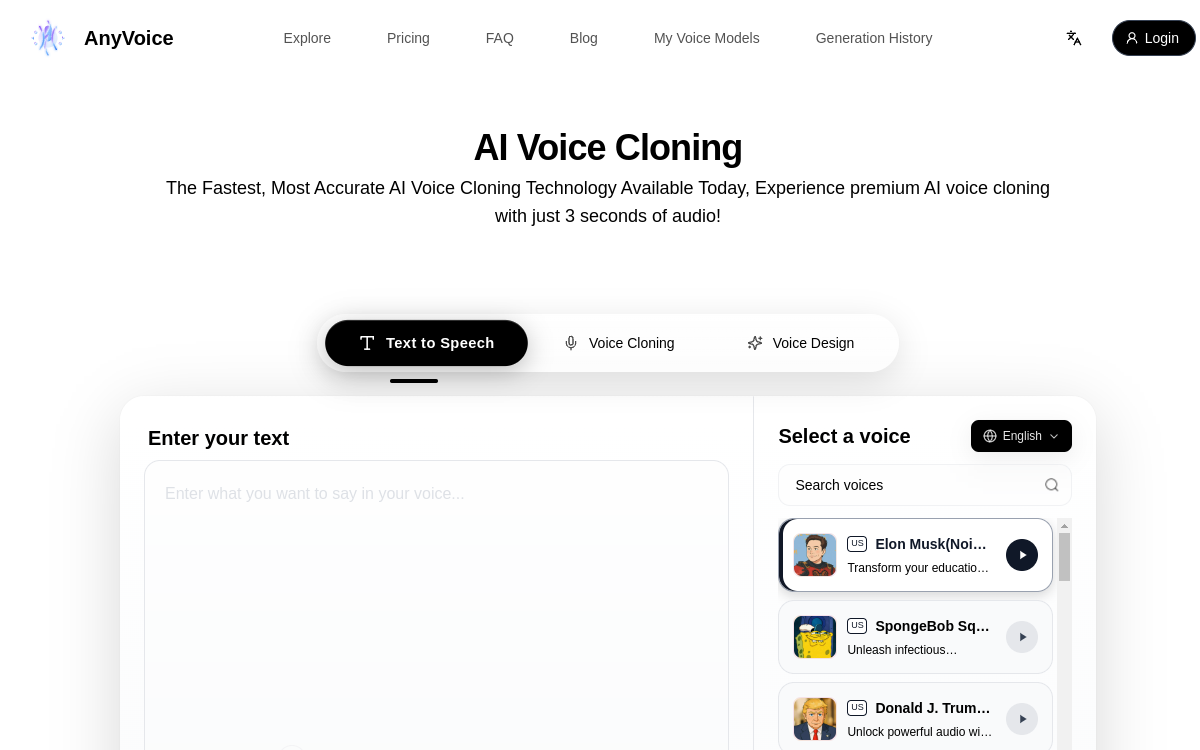
AnyVoice is an online platform dedicated to voice cloning and artificial intelligence speech synthesis. In a landscape where audio production has become central for creators, brands, and publishers, having a solution capable of faithfully replicating any voice in just a few seconds represents a revolution. AnyVoice promises exactly that: from a 3-second audio sample, the platform generates an ultra-realistic synthetic voice capable of pronouncing any text in multiple languages. This capability opens up a range of unprecedented use cases, from the rapid production of voiceovers for YouTube videos to the creation of multilingual audiobooks at scale, as well as narrative podcasts and online training modules. The platform targets a diverse audience: content creators, marketers, podcasters, publishers, and developers. It is part of a broader trend of democratizing audio production, where AI significantly reduces costs and timelines. This presentation details the features, use cases, benefits, pricing terms, and ethical implications of this cutting-edge tool.
What is AnyVoice?
The essentials
AnyVoice is a web platform specialized in instant voice cloning and artificial intelligence speech synthesis. It belongs to the category of advanced text-to-speech solutions, capable of not only generating a voice from written text but also replicating an existing voice from a short audio sample. This dual capability distinguishes it from classic TTS tools, which are limited to a predefined catalog of voices. The user uploads an audio clip of the voice they wish to clone, AnyVoice analyzes the timbral and tonal characteristics, and then generates a personalized voice model that can be used to produce new content. The platform is fully accessible online, without installation, and offers an API for developers wishing to integrate this technology into their own products. It is a modern audio production tool designed for speed, flexibility, and realistic quality.
Key features
AnyVoice provides a set of features centered on automated voice production. The flagship feature is instant voice cloning: a 3-second audio sample is enough to generate a usable voice model. This speed, which is particularly remarkable, relies on neural network models trained on large voice databases. Once the voice is cloned, the user can generate any text with that voice in several languages, including English, Chinese, Japanese, Korean, and others. The text-to-speech feature also offers a catalog of predefined voices covering various tones, accents, and styles, for those who do not need to clone a specific voice. Generation parameters allow adjusting speech rate, intonation, and emotion to produce a rendering adapted to the context. The documented API allows integrating these features into third-party applications, websites, or SaaS products. A dashboard centralizes the management of cloned voices, projects, and downloads. The platform supports multiple input and output audio file formats. Advanced quality options are available in paid plans, ensuring broadcast-quality rendering. The interface is designed to be accessible, with a polished user experience even for beginners in speech synthesis, while still offering professionals the necessary controls.
Use cases
The use cases for AnyVoice are numerous and particularly relevant in the content creation economy. YouTube and TikTok creators use it to quickly produce professional-quality voiceovers without having to record themselves or hire a voice actor. Podcasters explore hybrid narrative formats, mixing human and AI voices for interactive or multilingual content. Audiobook publishers can produce voiced versions at a reduced cost, and even adapt the same book into multiple languages with the same voice. Brands generate multilingual advertising messages at scale, tailored for international campaigns. E-learning platforms create narrated training modules, adaptable into multiple language versions. Developers integrate the API into mobile apps, video games, voice assistants, or accessibility products. Independent studios leverage cloned voices for creative projects such as short films, animations, or documentaries. Community managers personalize voice messages for social networks. Finally, some individuals use the tool for personal projects like birthday messages or original audio keepsakes.
Advantages
Using AnyVoice offers several strategic advantages. First, a considerable time-saving: recording, editing, and cleaning a voiceover normally represents hours of work, which AnyVoice reduces to a few minutes. Second, an economic gain: no need for a voice actor, studio, or expensive audio equipment. The ability to clone a voice in just 3 seconds is a rare differentiating asset on the market, opening up particularly creative use cases. Multilingual support facilitates the international expansion of content without multiplying voice actors. The realistic quality of the generated voices ensures a professional rendering acceptable even in demanding productions. The API allows industrializing voice production and automating complete workflows. The free version offers an accessible entry point, ideal for testing before committing to a paid plan. For brands, it is also a powerful lever for localization and personalization at scale, contributing to a more engaging and inclusive user experience.
Pricing
AnyVoice offers a flexible pricing structure adapted to different user profiles. A free version allows testing the main features, including basic voice cloning and text-to-speech synthesis, within a defined quota limit. Paid plans unlock advanced features: broadcast quality, multiple cloned voices, extended quotas, full multilingual support, and API access. Several tiers target individual needs, from creators to agencies and businesses. Monthly pricing adapts to usage frequency, and annual plans generally offer discounts. For developers, specific API plans allow pay-as-you-go billing, ideal for SaaS products integrating speech synthesis. It is advisable to evaluate your needs in terms of the number of cloned voices, generation duration, and desired languages before choosing the most relevant plan.
Conclusion
AnyVoice is a cutting-edge solution in the world of voice cloning and artificial intelligence speech synthesis. Its ability to replicate a voice in just 3 seconds, combined with the realistic quality of its renderings, makes it an essential tool for anyone producing audio content at scale. Multilingual support, the API, and the free version enhance its appeal to creators, brands, and developers. However, using this technology involves a particular responsibility regarding consent and ethics, which must be taken into account. Used responsibly, AnyVoice represents a powerful lever to democratize professional audio production.