


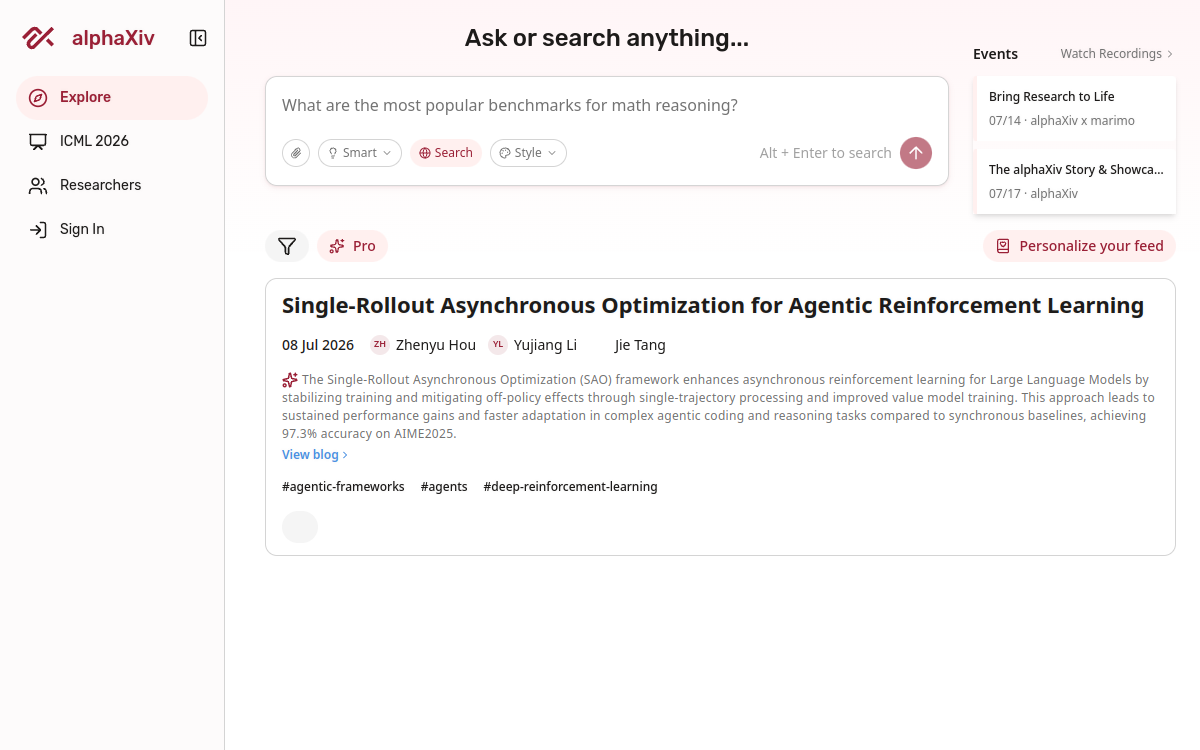
Scientific research is experiencing an unprecedented explosion in the volume of publications, particularly in the fields of artificial intelligence and machine learning, where hundreds of papers are released every week on arXiv. Keeping up with this literature, extracting relevant insights, and participating in community discussions has become a major challenge for researchers, PhD students, and practitioners. alphaXiv offers a modern answer to this challenge by augmenting arXiv with a contextual AI layer and a social dimension. The platform preserves the open spirit of arXiv while adding essential features for the contemporary reader: smart summaries, explanations of complex concepts, collaborative annotations, and public discussions. This approach is part of a wave of open science tools that democratize access to research and facilitate peer-to-peer exchanges beyond traditional institutional or geographical barriers.
What is alphaXiv?
The essentials
alphaXiv is an open scientific paper reading platform that augments arXiv with an AI layer and a social dimension. The tool takes arXiv’s catalog (AI, machine learning, physics, mathematics, quantitative biology, statistics, economics, etc.) and enriches it with several useful features: a contextual AI assistant answering questions about the current paper, automatic AI-generated summaries, hover explanations of complex concepts, private or shared annotations, and public discussion threads around each paper. The platform targets an academic and professional audience: researchers, PhD students, master’s students, R&D engineers, AI and ML practitioners, and more broadly any open science community engaged in the critical reading of research. The tool is free and adopts an open approach, aligned with the values of scientific sharing.
Key features
alphaXiv offers a set of features centered on augmented research reading. The reading interface presents the original PDF with a layer of interactive tools in the margin. The contextual AI assistant answers open-ended questions about the paper: explaining an equation, providing context for a reference, or comparing it with other works in the field. Automatic summaries offer a quick overview of the paper before full reading. Annotations allow users to highlight passages and add private or shared notes with the community. Public discussion threads around each paper open up a space for exchange among readers, complementing traditional peer reviews. A recommendation engine suggests related papers based on interests and history. Integration with arXiv ensures immediate access to the latest publications, without problematic synchronization delays.
Use cases
The use cases of alphaXiv are numerous in the scientific sphere. A PhD student in AI uses the platform to read papers from their weekly monitoring faster, thanks to AI summaries and explanations. A master’s student relies on the assistant to understand complex equations in a difficult paper without having to consult textbooks and professors. A machine learning researcher follows public discussions to identify criticisms and limitations raised by the community on a recent paper. An R&D engineer quickly explores recommendations to map the state of the art on an emerging topic. A laboratory uses shared annotations to organize its journal clubs and collective readings. A science journalist popularizes content more easily thanks to contextual AI explanations. Doctoral schools now encourage the use of alphaXiv to train their students in the critical reading of contemporary scientific literature.
Advantages
Adopting alphaXiv generates significant benefits for the scientific community. The first is faster reading: AI summaries and explanations drastically reduce the time needed to grasp a new paper, allowing for broader monitoring. The second is depth of understanding: the contextual assistant answers specific questions without having to search through external literature. The third concerns the social dimension: public discussions enrich reading with multiple perspectives, breaking the isolation of the solo researcher. The fourth is discovery: AI recommendations help naturally expand one’s reading horizon to related topics. Finally, alphaXiv contributes to the democratization of research by making contemporary science more accessible to students, self-taught learners, and practitioners outside academia, aligned with the core values of open science.
Pricing
alphaXiv is entirely free, fully aligning with the open science approach and the mission to augment arXiv for the benefit of the global scientific community. The platform does not offer a paid plan at this stage, which distinguishes it from other similar, more commercial tools. This open model depends on institutional funding, donations, and community support to sustain its development. Users can contribute by actively participating in discussions, annotating papers, and reporting potential improvements. Account creation is free but required to access social features like shared annotations and personalized recommendations across the entire available arXiv catalog.
Conclusion
alphaXiv is an excellent tool for anyone seriously interested in contemporary research, particularly in AI, machine learning, and computational sciences. Its combination of AI-augmented reading, collaborative annotations, and public discussions makes it a true accelerator of understanding and monitoring. Its free nature and open science spirit are major assets. For researchers and students engaged in scientific literature, the tool is a must-have in 2026 and deserves to be adopted.