


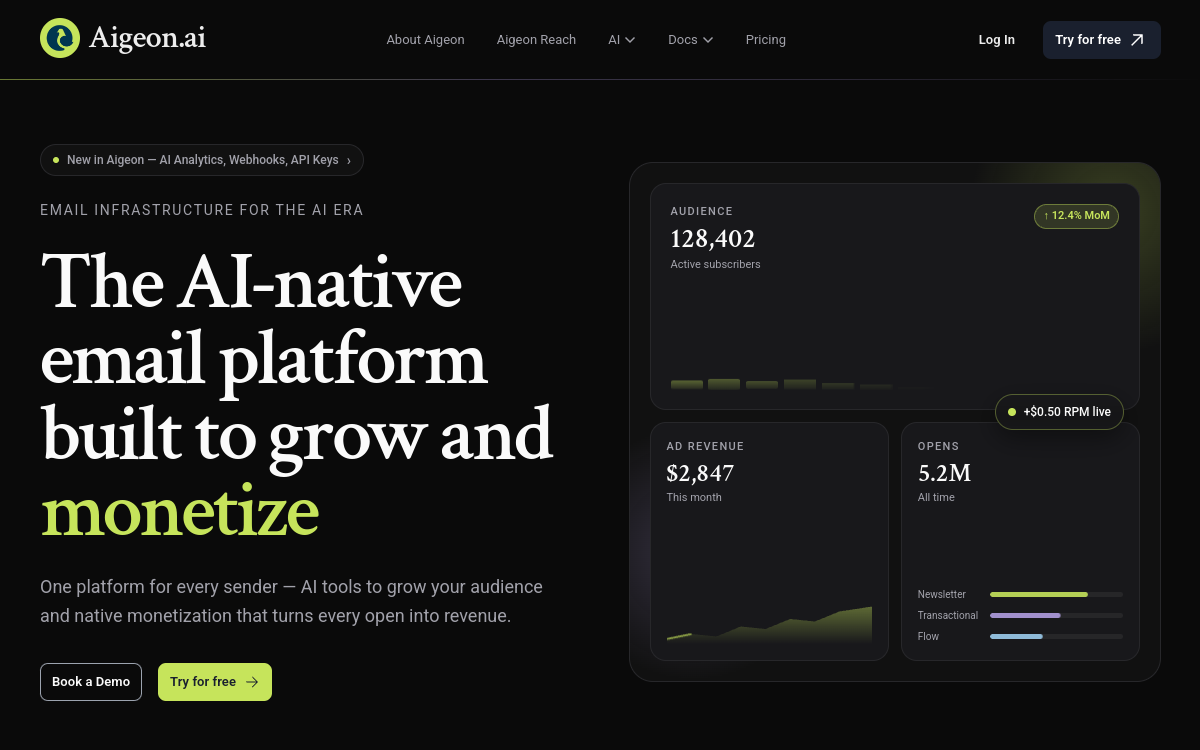
The ecosystem of conversational AI assistants has grown considerably denser in just a few years. Alongside generalist giants like ChatGPT, Claude, or Gemini, a new generation of platforms is emerging with a complementary promise: to offer specialized, customizable assistants capable of acting as real agents within business processes. Aigeon AI fits into this trend by offering an all-in-one platform that combines multiple language models, a modern conversational interface, and an autonomous agent creation workshop. The stated ambition is clear: to enable professionals, freelancers, and teams to automate a significant portion of their repetitive tasks without having to juggle a dozen different tools. In this review, we examine the features of Aigeon AI, its main functionalities, its key use cases, its business model, and the concrete benefits an organization can derive from it. The goal is to help you determine if this platform meets your challenges and if it deserves a place in your AI tool stack in 2026.
What is Aigeon AI?
The essentials
Aigeon AI is a SaaS platform that brings together several conversational AI assistants and an autonomous agent creation workshop within a single interface. Concretely, users can converse with a generic assistant, much like ChatGPT, but also configure specialized agents with precise instructions, a dedicated knowledge base, and access to external tools. The platform relies on several major language models on the market, allowing users to select the engine best suited to their task. Aigeon AI targets a broad audience consisting of independent professionals, small teams, SMEs, and internal departments within larger organizations. Its positioning stands out with an interface accessible to non-technical profiles, while offering a customization layer rich enough to meet targeted business use cases.
Key features
Aigeon AI’s features are organized around three pillars: conversation, agents, and integrations. On the conversation side, the platform offers a modern, multi-model chat interface with history management, pinned conversations, favorite prompts, and a search function for past exchanges. Users can upload documents and obtain analyses, summaries, or structured information extractions. The agent module allows users to define specialized assistants in a few steps: role description, communication tone, customized knowledge base, strict instructions, and any accessible tools. These agents can then be launched on demand or integrated into automated workflows, for example, to periodically process emails, generate reports, or feed a dashboard. On the integration side, Aigeon AI provides a library of connectors to everyday tools such as email, cloud storage, CRMs, or project management tools, as well as an open API for developers wishing to integrate AI into in-house applications. The platform also includes collaborative features, with shared spaces, fine-grained permission management, and the ability to share agents within a team. Additional modules such as image generation, audio transcription, or web search can be activated as needed, transforming Aigeon AI into a true Swiss Army knife of professional AI, capable of addressing a wide variety of scenarios.
Use cases
Aigeon AI’s use cases cover a broad spectrum of professional activities. Marketing teams use it to generate editorial content, write prospecting emails, create creative briefs, or analyze campaign performance by querying imported data. Sales representatives rely on customized agents to qualify prospects, draft sales proposals, or summarize meeting minutes. Human resources leverage the platform to prepare job descriptions, screen applications, or answer recurring questions about internal policy. Consultants find it to be an excellent assistant for structuring their research, synthesizing sources, and preparing client deliverables. Developers and technical profiles use Aigeon AI to generate code, document their projects, or query internal knowledge bases. Finally, SME leaders appreciate the ability to automate small, time-consuming administrative tasks such as drafting letters, analyzing contracts, or conducting competitive intelligence. Its versatility makes it possible to gradually replace a mosaic of tools with a single platform, thereby simplifying software subscription management.
Advantages
Adopting Aigeon AI provides several strategic benefits to organizations. The first lies in the centralization of AI uses: instead of multiplying subscriptions to different specialized assistants, the company can rely on a single platform covering the majority of its needs. The second benefit relates to productivity: by automating repetitive and low-value-added tasks, employees can focus on higher-impact missions. The third advantage concerns the consistency of outputs: thanks to customized agents, it becomes possible to guarantee a consistent tone, structure, and quality level across all productions, which is valuable for the brand. Furthermore, the collaborative dimension makes it possible to capitalize on the best prompts and configurations within a team, gradually creating a true shared library of AI expertise. Finally, the API and connectors pave the way for advanced automations integrated into the existing information system.
Pricing
Aigeon AI offers a classic freemium model. The free plan provides access to essential features with a limited quota of monthly requests, allowing an individual user to discover the platform risk-free. Paid offers start at around 15 dollars per month and unlock access to a larger volume of requests, all available AI models, as well as customized agent features and connectors. Higher tiers target teams and businesses, with advanced collaboration options, administrative controls, priority support, and enhanced confidentiality commitments. A quote-based offer is available for large organizations wanting a guided deployment, custom integrations, or specific contractual guarantees. Overall, the pricing remains competitive given the rich functionality offered.
Conclusion
Aigeon AI presents itself as a versatile and accessible platform for anyone wishing to democratize the use of generative AI within their professional activity. Its combination of a multi-model conversational interface, an autonomous agent workshop, and an ecosystem of integrations makes it a relevant tool for freelancers, SMEs, and business teams who want to save time without complicating their technology stack. Although it operates in a highly competitive market dominated by major players, its value proposition centered on customization and collaboration allows it to carve out a credible path. Testing the free plan remains the best way to concretely assess the relevance of Aigeon AI for your use cases.