


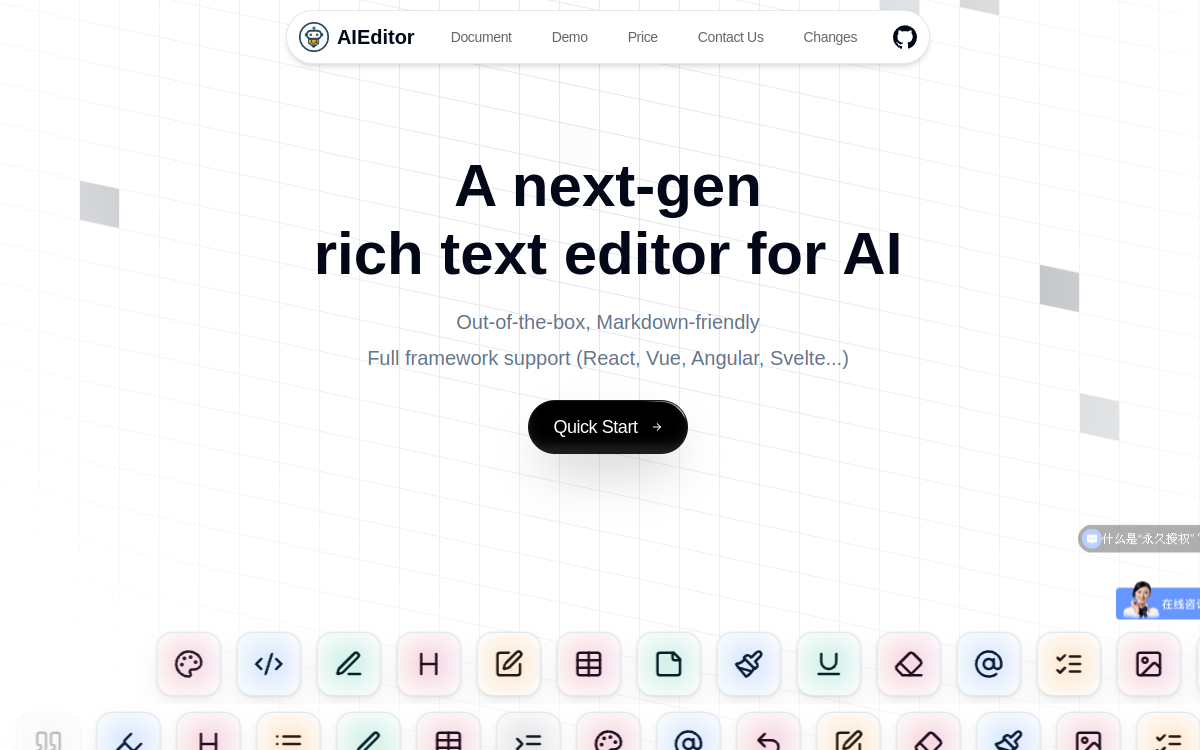
Integrating AI into web applications has become an implicit standard. Users expect to be able to improve a text, translate it or generate a draft directly from any interface. For product teams, the challenge is to add these features without having to reinvent a rich text editor. AIEditor answers precisely this need: an open-source, multi-framework component, ready to be embedded in a SaaS, an internal app or a consumer product, with an AI layer already designed in. In this article, we look at what AIEditor brings, its features, its use cases and its limits.
What is AIEditor?
The essentials
AIEditor is a next-generation rich text editor, designed specifically for AI use cases. It is built on Web Components, which makes it compatible with nearly all front-end frameworks: Vue, React, Angular, Svelte, or even framework-free integration. The component offers the classic features of an editor (formatting, blocks, tables, code) and a very rich AI layer: translation, text improvement, continuation generation, code blocks, automatic documentation. The editor is open source, freely accessible, and also offers a commercial version for uses with no limit on users or applications.
Key features
AIEditor combines a classic editor with a very complete AI menu. Translation lets you switch a text into another language without leaving the editor. Continuation helps extend a paragraph being written, useful for blogs, product sheets or emails. Optimization rephrases a passage to make it clearer, more concise or more engaging. Code blocks support a selection of languages, and the AI can automatically generate comments or explain the role of a portion of code. Documentation can also be generated from existing content. On the collaboration side, several users can work simultaneously on the same document. Import covers Word and Markdown, export includes Markdown, HTML, Word and PDF, covering the vast majority of enterprise use cases.
Use cases
AIEditor is aimed primarily at developers and product teams. A SaaS editor that wants to add an ‘AI improvement’ feature to its interface can integrate AIEditor in a few hours rather than several sprints. A startup building a writing tool can rely on the component to save time while benefiting from a rich AI layer. An internal product team can embed it in a knowledge-management tool to give employees a modern experience. Agencies can use it to deliver custom solutions to their clients faster.
Advantages
AIEditor’s main benefit is removing much of the technical complexity tied to integrating a smart editor. Rather than building from scratch or assembling several libraries, teams embed a proven component. Multi-framework compatibility ensures flexible integration, and the flexible AI layer lets you plug in the LLM of your choice. The commercial version with no limit on users or applications is very attractive for SaaS editors, who can thus keep their costs under control.
Pricing
The open-source version of AIEditor is free. Teams that want to use it in a commercial context without constraints can opt for the commercial version, whose price is generally negotiated based on usage and scope. This open-source / commercial duality makes AIEditor a flexible choice: you can start for free, then switch to the commercial version once the product reaches critical mass.
Conclusion
AIEditor is one of the best open-source editors for teams that want to quickly integrate an AI layer into their application. Its multi-framework compatibility, rich AI features and hybrid open-source / commercial model make it a top choice for developers and SaaS editors. A solid building block for crafting the next generation of writing and productivity tools.