


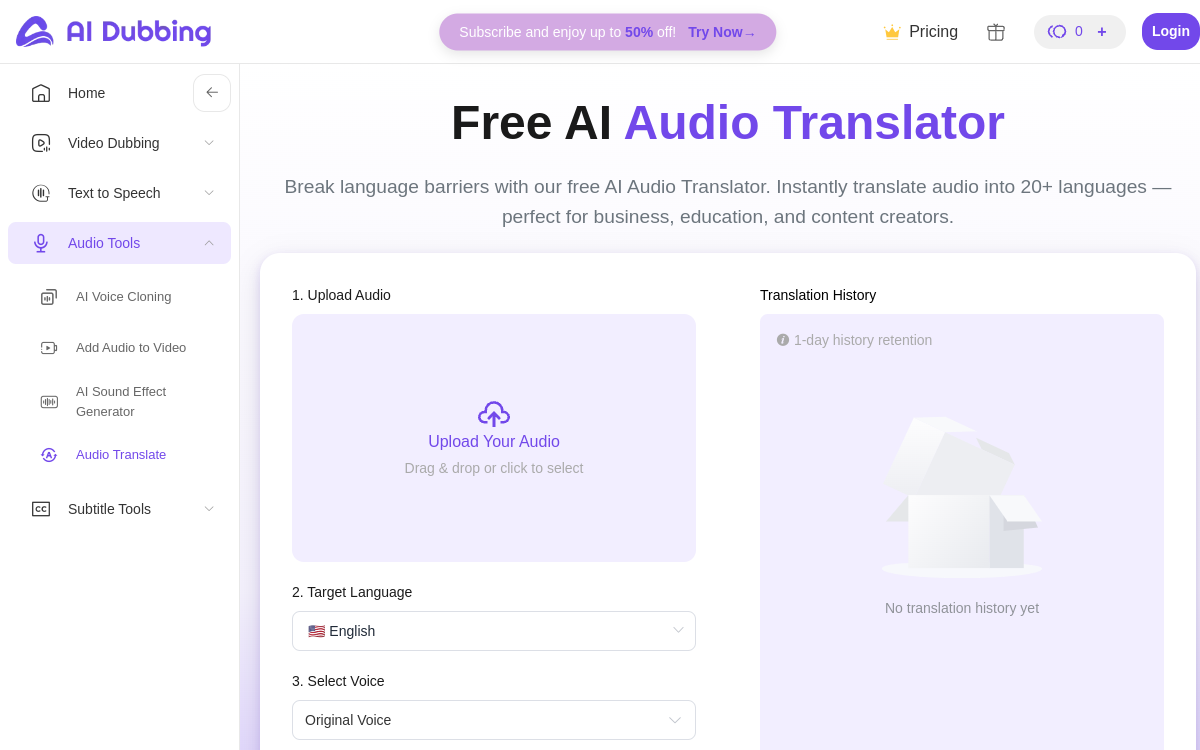
At a time when video content dominates all digital communication strategies, the language barrier remains one of the main obstacles to growing an international audience. Translating and dubbing a video into multiple languages has long represented a considerable investment, requiring recording studios, professional voice actors, and sound engineers over weeks of production. The arrival of generative artificial intelligence has profoundly transformed this equation, making multilingual dubbing accessible to organizations of all sizes. AIDubbing fits perfectly into this new generation of tools, offering a web platform that combines automatic transcription, contextual translation, voice cloning, and lip-syncing. Designed for content creators, marketers, and trainers, the tool promises to transform a source video into several faithful linguistic versions in just a few minutes. In this article, we explore in detail how AIDubbing works, its key features, its most relevant use cases, its pricing structure, and the concrete benefits you can expect for your internationalization strategy.
What is AIDubbing?
The essentials
AIDubbing is a SaaS platform dedicated to the automatic translation and dubbing of audio and video content using artificial intelligence. Specifically, the tool takes a media file uploaded by the user as input, identifies the source language, transcribes the speech, translates it into the chosen target language, and then generates a new audio track in that language using a voice cloning model that reproduces the original speaker’s timbre. For videos, an additional lip-syncing layer adjusts mouth movements to match the new script. AIDubbing stands out for its commitment to offering a fully automated workflow, accessible from a browser, with no software installation or special technical skills required. The solution is primarily aimed at independent creators, SMEs, agencies, and in-house marketing departments looking to scale their multilingual production without going through an external studio.
Key features
AIDubbing’s features cover the entire audiovisual localization process. Automatic transcription is the first building block of the pipeline, featuring speech recognition optimized for numerous languages and accents. The translation then relies on advanced language models capable of taking context into account to produce natural, fluent text rather than a simple word-for-word translation. Next comes text-to-speech with voice cloning, which preserves the original speaker’s sound identity while speaking a new language. This feature represents the tool’s true signature and offers a much more immersive result than generic synthetic voices. AIDubbing also offers a lip-syncing module for videos, which adjusts mouth movements to the new script to enhance visual credibility. On the editing side, the interface allows users to review the translated script, correct it manually before final generation, and adjust speech speed or tone. SRT subtitles are automatically generated in both the source and target languages, facilitating their integration into existing workflows. The platform supports over 30 languages and offers project management to easily find and reuse content. Finally, export options in various standard video and audio formats ensure broad compatibility with distribution platforms.
Use cases
AIDubbing’s use cases are diverse, spanning both the marketing and education sectors. YouTube and TikTok creators use it to adapt their viral videos into multiple languages and quickly reach new audiences without having to re-record their content. Communication agencies rely on the tool to deliver international multilingual campaigns to their clients within tight deadlines, particularly for short promotional videos and social media content. Training organizations and e-learning platforms find AIDubbing to be an effective way to translate their course catalogs and make them accessible to foreign learners. Podcasters can also expand their reach by offering translated versions of their most popular episodes using their own cloned voice. HR departments in large companies also use this type of solution to translate internal communications, onboarding videos, or mandatory training, thereby ensuring consistent delivery worldwide. Finally, documentary and corporate content publishers see it as an opportunity to significantly reduce their localization budgets while maintaining a satisfactory level of quality.
Advantages
Adopting AIDubbing offers several tangible benefits. The first lies in the drastic reduction of localization costs: where professional human dubbing can cost several thousand dollars per language, AIDubbing offers an almost instantaneous alternative for a fraction of the budget. The second benefit is the speed of execution, which is now measured in minutes rather than weeks, allowing businesses to seize editorial and marketing opportunities in real time. The third advantage is brand consistency, as the original voice is preserved from one language to another, reinforcing recognition and the audio identity of the author or company. The ability to automatically generate subtitles in multiple languages also improves SEO and content accessibility. Finally, the autonomy given to in-house teams, who can now produce multilingual content without relying on an external provider, profoundly transforms editorial production processes.
Pricing
AIDubbing operates on a subscription model combined with a credit system based on the duration of the processed content. A free trial offer allows users to test the platform on a short clip before making any commitment. Paid plans start at around $19 per month for a volume suitable for individual creators, with higher tiers for agencies and companies with larger production needs. Add-on options also allow for the occasional purchase of extra credits during peak activity. The pricing is generally competitive compared to traditional human dubbing, but users should monitor their consumption on long-form content, where costs can quickly add up. An enterprise plan is available upon request for high-volume needs or custom API integrations.
Conclusion
AIDubbing perfectly illustrates the promise of generative AI applied to audiovisual localization: producing quickly, at a lower cost, and with a quality surprisingly close to human rendering for most common use cases. While the tool does not yet replace a professional studio for premium or fictional productions, it offers an extremely compelling solution for corporate, educational, and social media dubbing needs. Its accessible interface, wide range of languages, and preservation of the original voice make it a valuable ally for any organization aiming to reach an international audience. Testing the trial version remains the best way to concretely evaluate the relevance of AIDubbing for your own content.