


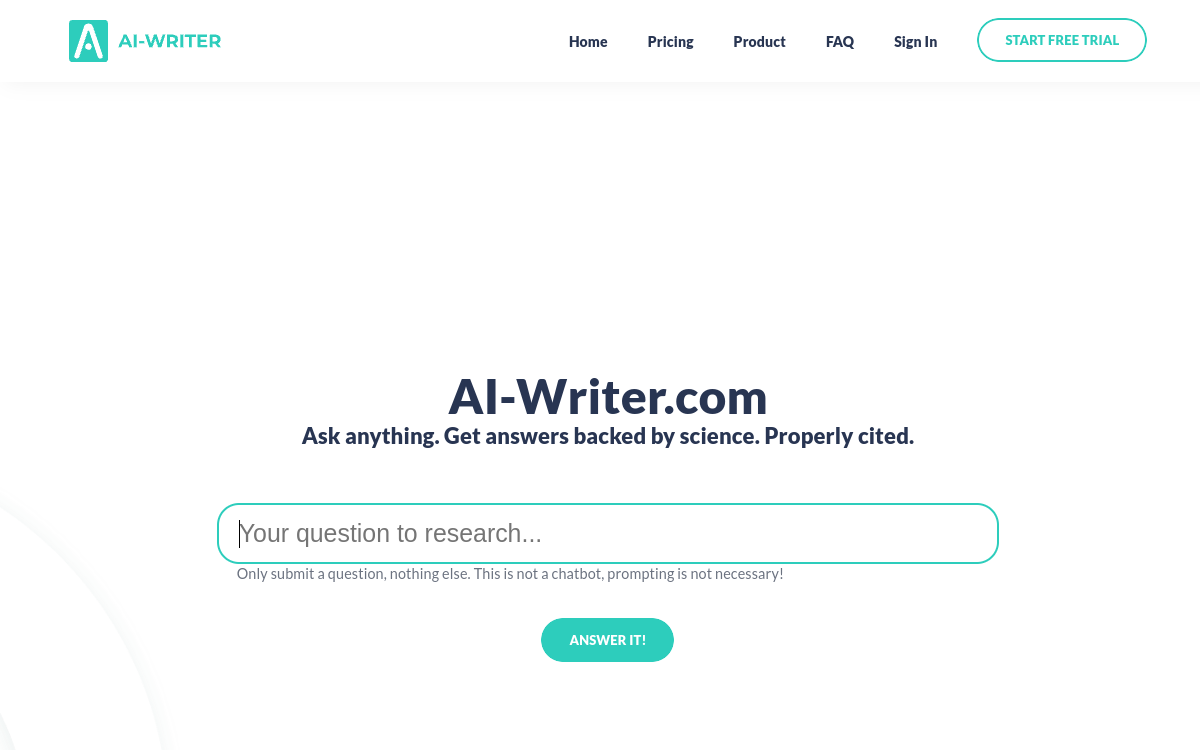
Writing an academic paper or literature review requires a standard that few AI-assisted writing tools truly meet: source reliability. AI-Writer addresses the problem from that precise angle. Rather than a free-text generator, it positions itself as a research assistant capable of answering questions by drawing on scientific literature, then citing each claim in a verifiable way. Its slogan sums up the intention: ask a question, get an answer backed by science, properly cited. In a context where mainstream chatbots are regularly caught out on accuracy, this promise meets a real need for students, PhD candidates and professionals who cannot afford phantom citations. This overview details what AI-Writer actually does, its named features, use cases, real pricing and limitations, so you can judge whether it suits your work.
What is AI-Writer?
The essentials
AI-Writer is an online academic research and writing assistant. It draws from a claimed corpus of over 100 million open-access, peer-reviewed scientific articles. From a question posed in natural language, it formulates a reasoned answer and links it to corresponding scientific works, indicating the exact passages used. The stated goal is factual accuracy superior to that of generic chatbots, thanks to this documentary foundation. The tool is aimed at students, PhD candidates, researchers, academic institutions and professionals who need traceable and defensible answers.
Key features
Several features structure the product. Topic Explorer identifies the key questions of a subject to ensure complete coverage before writing. The AI Research module answers each question by drawing on scientific literature. The Citations system traces claims back to the exact source paragraph, allowing fine-grained verification. Bibliography provides links and complete bibliographic information in APA, Chicago, Harvard, MLA and BibTeX formats. Finally, Review Paper generation assembles multiple research questions into a structured synthesis. On the usage side, input is via natural questions, without any particular prompt technique, and results are exported as downloadable HTML or via shareable links. This set covers the cycle from exploring a subject to producing a sourced document.
Use cases
Use cases revolve around academic work. A student can explore a thesis topic, gather key arguments and obtain an already-formatted bibliography. A PhD candidate saves time on literature review by directly querying the scientific corpus and retrieving exact citations. A researcher can generate a structured Review Paper draft to start a synthesis. Beyond the academic world, professionals who need to back their analyses with reliable sources, for example in regulated or technical sectors, find value in traceable answers. In all cases, the common thread remains producing factual and verifiable content rather than purely creative text.
Advantages
The main benefit is trust. By linking each answer to identifiable scientific articles and the precise paragraph used, AI-Writer reduces the risk of unsupported claims that hamper mainstream chatbots. Native support for five citation systems avoids tedious bibliographic formatting work. Topic Explorer helps ensure you don’t miss important angles, improving rigor. The 7-day free trial without a credit card lets you evaluate the tool without commitment. For an audience subject to strict citation requirements, this gain in reliability and formatting time represents real value.
Pricing
AI-Writer offers a free 7-day trial, with no credit card and no automatic renewal. Three paid plans follow. The Basic plan is $29/month, designed for students and limited to one user. The Standard plan, highlighted as the most popular, is $49/month and allows three users, targeting PhD candidates and researchers. The Power plan, at $375/month, targets intensive use with up to ten users. Discounted annual rates are offered. The exact number of questions per plan is not clearly displayed on the pricing page.
Conclusion
AI-Writer doesn’t try to be a universal content generator: it assumes a specialty, sourced academic research, and executes it seriously. Its foundation in millions of scientific articles, verifiable citations and bibliographic formats make it a solid ally for students and researchers. If your need is SEO or marketing, this isn’t the right tool. But for producing reliable and defensible work, the free trial deserves a look before judging.