


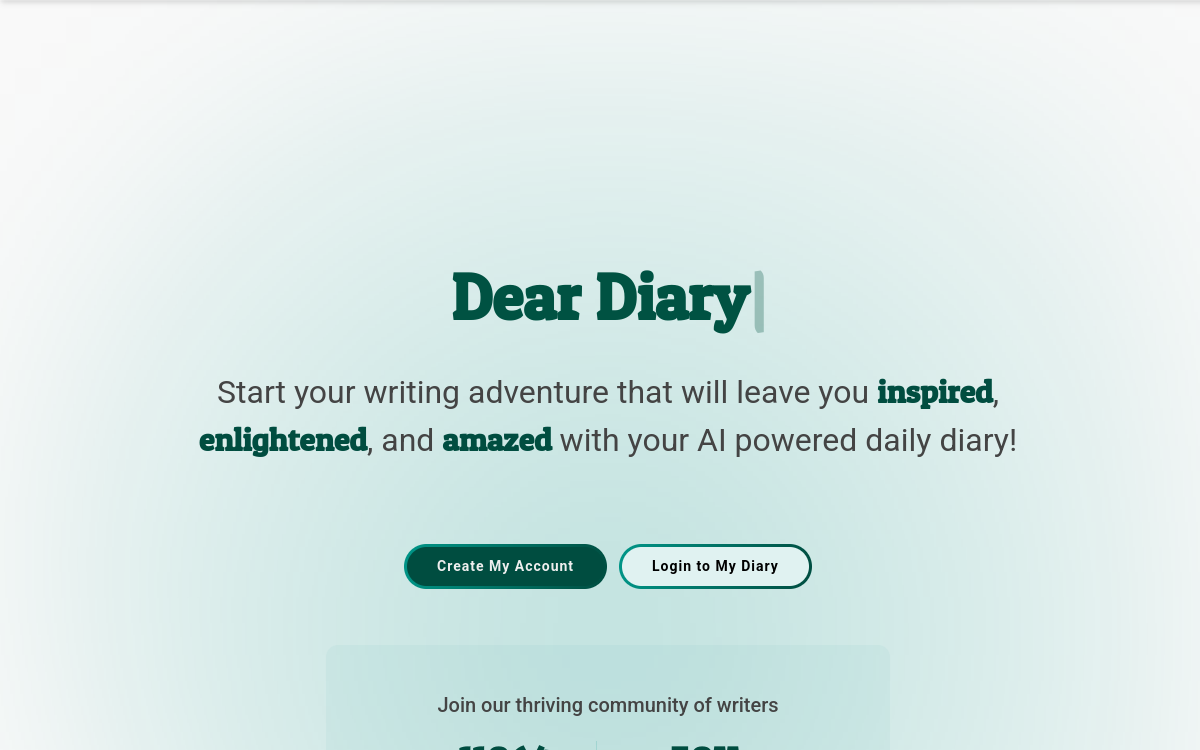
Keeping a journal is a habit recognized for its effect on introspection, emotional management and creativity. But the routine of daily writing remains demanding: finding the time, the angle, the words. AI Diary offers a new way to practice journaling by relying on AI to turn the act of writing into a dialogue. The user is no longer alone facing a blank page, but in conversation with a digital companion that remembers, prompts and analyzes. In this article, we look at what AI Diary is worth, its features, its use cases and its limits in 2026.
What is AI Diary?
The essentials
AI Diary is an online platform that combines a personal journal with a conversational assistant. The user writes or speaks, the AI replies, asks questions and keeps the memory of the exchanges. Entries are enriched by various features: mood analysis over time, summaries of past weeks, poems inspired by one’s entries, or statistics about one’s writing style. The tool is designed to become a reflection companion, not a substitute for a therapist. A limited free plan exists, and a subscription unlocks the full experience, in particular long-term memory.
Key features
The heart of AI Diary is the continuous conversation. The AI remembers the topics discussed over the days, and can connect today’s mood to an event noted the previous week. Mood analysis provides a chart of evolution over time, useful for spotting cycles. Smart summaries condense weeks or months, making it easier to step back. Poems generated from the entries offer a playful, creative dimension. Style analysis examines vocabulary richness, grammatical complexity and structure, and suggests ways to evolve one’s writing. Voice mode lets you narrate an entry and receive an audio reply, which humanizes the experience.
Use cases
The use cases are varied. A journaling enthusiast can use it as a self-observation notebook, where the AI helps structure their thoughts. A creative can use it as an idea trigger, drawing on the prompts and generated poems. Someone wishing to track their mood daily can rely on the analysis to spot trends. A coach can encourage their clients to use the tool between sessions to prepare their reflections. People in life transitions (moving, career change, parenthood) can find in it a discreet companion to get through those stages.
Advantages
AI Diary’s main contribution is turning journaling into a dialogue. This reduces blank-page syndrome and increases writing frequency. Long-term memory creates a continuity that classic paper journals do not easily allow. Mood and style analyses add a layer of structured introspection, which can feed a broader personal journey. Finally, voice mode makes the practice accessible in contexts where writing is not possible (while walking, while driving).
Pricing
AI Diary offers a free plan limited to 5 messages per day, with no memory beyond a single day and no access to advanced analyses. The paid subscription unlocks long-term memory, mood analysis, summaries, poems and writing-style analysis. The cost remains reasonable compared with the practical value for users who practice journaling seriously. Occasional discounts are regularly offered.
Conclusion
AI Diary reinvents an age-old practice thanks to AI. By turning the journal into a dialogue, the tool helps you write more regularly, understand yourself better and explore your thoughts. It is not a substitute for human support when needed, but it is an original and useful companion for anyone who wants to integrate introspection into their digital daily life.