


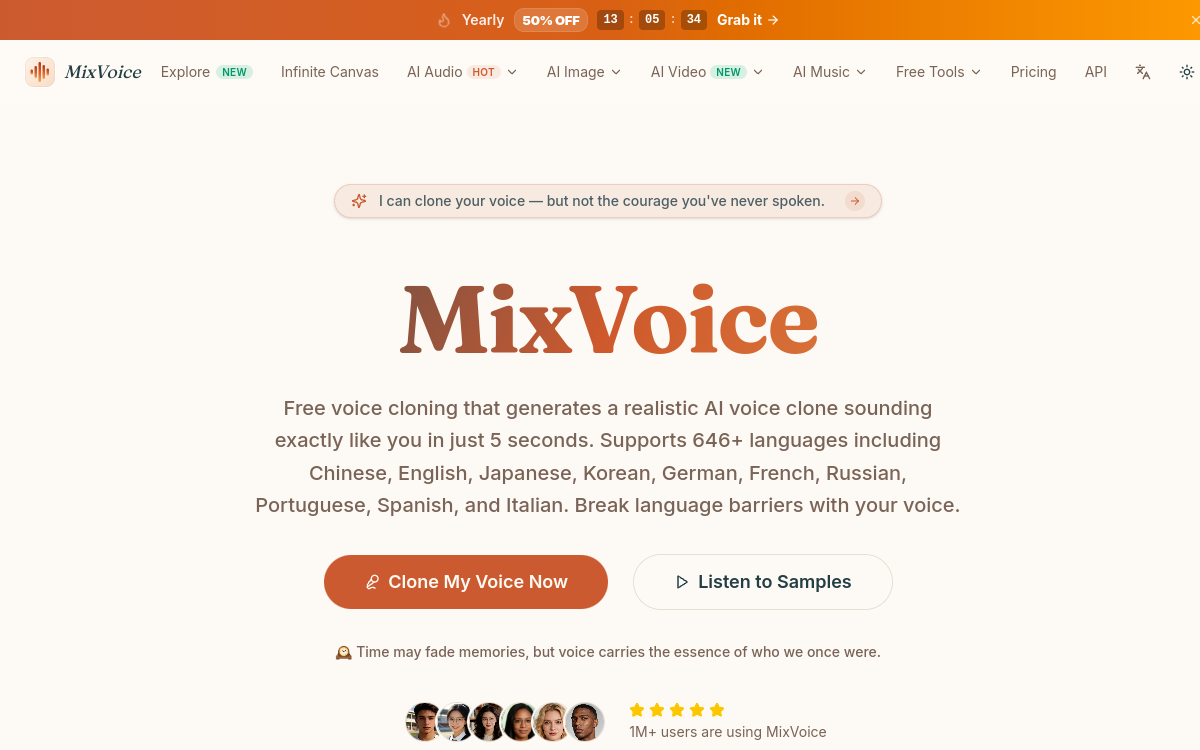
Artificial intelligence voice cloning has moved from the research lab to a mainstream tool in just a few years. AI Clone Voice Free embodies this democratization by offering an accessible solution directly online, with no registration required to get started. The promise is clear: from a short audio sample, users get a voice model capable of reading any text with a faithful tone and natural rendering. This approach opens up numerous opportunities for content creators, podcasters, trainers, and brands wishing to scale up the production of consistent voiceovers in multiple languages without systematically returning to the studio. The platform goes beyond simple cloning: it offers a complete ecosystem with TTS, AI Cover, AI Music, AI dubbing, noise reduction, and voice replacement. A free tier allows users to test these features, while an Unlimited plan targets the intensive needs of regular creators and small teams. This guide reviews the features, use cases, and business model of AI Clone Voice Free to help you assess its relevance.
What is AI Clone Voice Free?
The essentials
AI Clone Voice Free is a web platform for voice cloning and AI speech synthesis. The user provides a short audio sample, and the platform generates a voice model capable of reading any text with a similar timbre. In parallel, the tool offers a broader suite covering AI music creation, AI covers, automated dubbing, noise reduction, and voice replacement. The free tier allows testing without registration, making it an excellent entry point to evaluate quality before upgrading to a paid plan. The Unlimited plan targets intensive creators with up to 6 million characters per month. The tool is part of the broader trend of consumer AI platforms aiming to simplify once-technical tasks. This educational approach facilitates adoption by non-specialist profiles and accelerates daily onboarding. The interface, intentionally streamlined, focuses on the essentials to reduce the learning curve.
Key features
AI Clone Voice Free is organized around a voice cloning engine capable of generating a model from just a few seconds of audio. The text-to-speech (TTS) engine then reads the entered text with the cloned voice, respecting intonation and prosody. The platform offers a Voice Design feature to customize certain characteristics (timbre, register, expressiveness), useful for creating original voices without cloning a real person. The complementary suite includes AI Music for music creation, AI Cover to generate covers with a cloned voice, AI dubbing to translate and synchronize videos, noise reduction to clean raw audio, and voice replacement to modify the voice of an existing track. The lack of registration requirements at startup radically simplifies onboarding, contrasting with most competitors that require account creation before any testing. The interface is designed to be accessible to creators without an audio technical background. The platform also offers a history management system to find recent creations and re-export them if needed. A system of templates and presets accelerates setup for users who want a quick result without configuring every parameter. On the collaboration side, sharing links facilitates the review of deliverables by colleagues or clients before final validation.
Use cases
The use cases covered by AI Clone Voice Free are diverse. Podcasters find it a way to generate intros, outros, and ads read in their own voice, without having to re-record every time. YouTube creators can generate consistent voiceovers for short video series. Online trainers automate the production of audio modules in multiple languages from a reference voice. Brands produce on-hold messages and audio ads consistent with their vocal identity. Amateur dubbing studios experiment with original voices for indie projects. Developers integrate TTS into their applications with a distinctive brand voice. Educators build educational voice assistants for children. The free tier appeals to students, makers, and hobbyists who want to explore voice cloning without a budget. Creative agencies integrate the tool into their deliverables to accelerate exploration phases and present more options to their clients.
Advantages
The benefits of AI Clone Voice Free focus on three areas. The first is accessibility: no registration required to start, and a free tier to test risk-free. The second is versatility: the complete suite covers cloning, TTS, music, dubbing, and audio cleaning, avoiding the need to juggle multiple tools. The third is economy of scale: the Unlimited plan offers up to 6 million characters per month, which suits highly intensive creators with no marginal cost. For podcasters, YouTube creators, and online trainers, the time savings are considerable. For brands, vocal identity consistency reinforces memorability and professionalizes audio content published across different channels. For teams scaling up their production, the cumulative time savings quickly translate into hours saved each week on recurring tasks. This efficiency frees up budget and attention for higher value-added activities such as strategy or core creativity.
Pricing
AI Clone Voice Free offers several access levels. The free tier allows immediate testing of cloning and text-to-speech without registration, making it one of the most accessible entry points on the market. The Unlimited plan targets intensive creators with up to 6 million characters per month, unlimited voice cloning, and full access to AI Music, AI Cover, AI dubbing, noise reduction, and voice replacement. An intermediate plan with around 2 million characters is designed for regular but non-massive uses. Exact rates vary according to promotions and active plans. It is advisable to test the free tier extensively before choosing a paid plan to evaluate the quality on concrete cases representative of your activity.
Conclusion
AI Clone Voice Free stands out for its rare accessibility in the AI voice cloning space: start without registration, test for free, and then upgrade to the Unlimited plan when needs explode. The complete audio suite (TTS, AI Cover, AI Music, dubbing, noise reduction) makes it a versatile tool for creators, podcasters, brands, and trainers. As with any voice cloning tool, ethical use is central: cloning your own voice or that of consenting individuals, never impersonation. For the majority of voiceover, e-learning, and social content projects, the platform offers an excellent quality/accessibility ratio and deserves serious evaluation.