



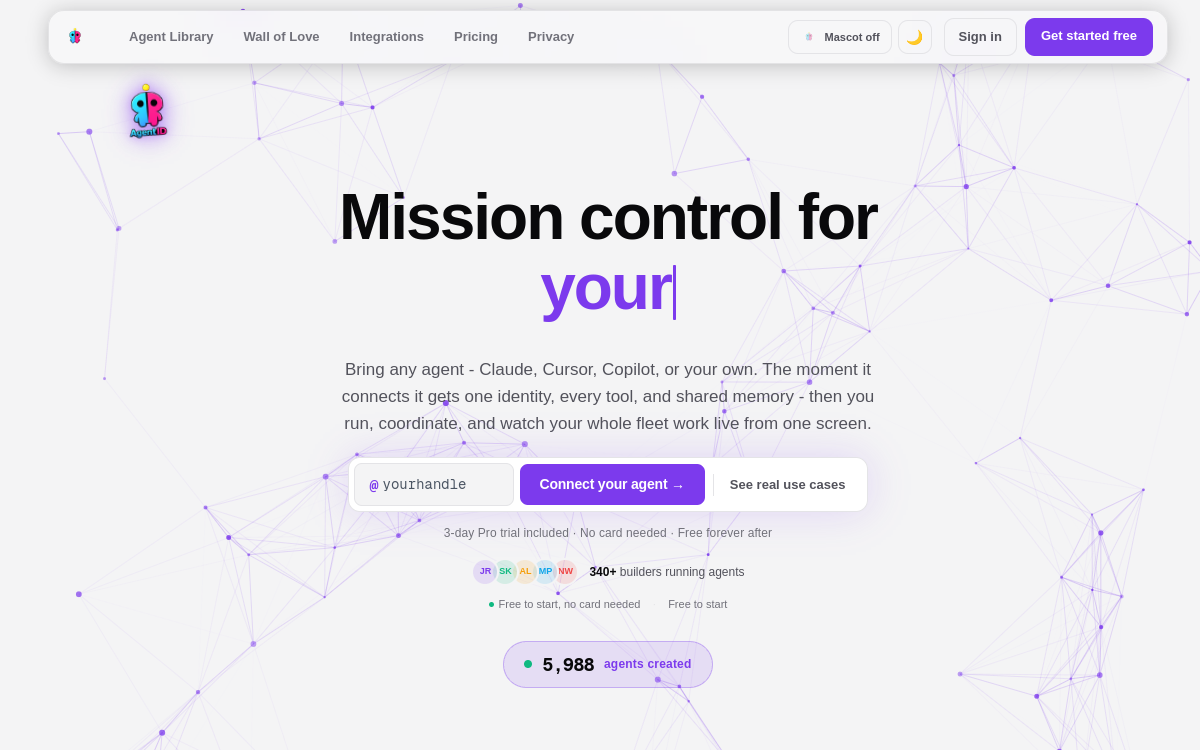
AI agents change the nature of digital tools: you no longer just launch functions, you delegate to entities able to reason, remember and act over time. This evolution raises a new question: how do you give them a clear identity, track their actions and orchestrate them together? AgentID tries to answer this question with a platform dedicated to creating and managing agents, with a visual canvas and a strong identity logic. The tool mainly addresses startups, agencies and freelancers who want to build products or services around AI agents. In this article, we look at what AgentID concretely brings, its features, its use cases and its limits.
What is AgentID?
The essentials
AgentID is an orchestration and identity platform for AI agents. Each agent is defined by a complete identity: voice, values, rules, tools, memories. The visual canvas lets you connect triggers (scheduled, manual or via webhook) to agents and tools, then to deliverables. Agents can call popular LLMs like Claude, Cursor or Codex, or connect to a custom model. Memory is tracked in detail, with a per-run history allowing you to trace every decision. The goal is to turn an ephemeral run into a true persistent digital actor.
Key features
AgentID offers a set of features designed for production. The visual canvas makes it easy to compose complex workflows in a few minutes, without having to write code. The identity system guarantees that each agent keeps its expected behavior, even when it calls several tools or models. Connecting custom APIs via HTTP in less than a minute removes integration friction. Triggering can be done by schedule, by webhook or manually, which covers most scenarios. Memory management is one of the strong points: every update is traced and can be inspected or rolled back, which brings real discipline to managing agents in production. On the ops side, the dashboard offers a real-time view of runs, called tools and modified memories, with collaborative work possible around each agent.
Use cases
AgentID addresses several use cases. A startup can build a product whose value rests on several complementary agents: a sales agent, a support agent, an analyst agent. An agency can offer its clients agent-based automations, with a solid management framework. A freelancer can industrialize their own processes by deploying agents for monitoring, prospecting or lead qualification. Internal teams at large companies can also explore this path for very targeted use cases, avoiding the pitfall of uncontrolled agents.
Advantages
AgentID’s main contribution lies in the combination of strong identity and visual orchestration. Where other platforms treat agents as disposable scripts, AgentID makes them persistent, measurable and improvable actors. The visual canvas democratizes the creation of complex workflows for non-developer profiles, without sacrificing rigor. Multi-LLM compatibility, including Claude, gives the freedom to choose the model best suited to each task, and fast HTTP integration opens access to any system.
Pricing
AgentID usually offers a freemium plan to get started, with reasonable limits on the number of runs and agents. The paid plans align on the volume of runs, the number of active agents and the need for collaborative or security features. The grid remains competitive against the cost of a development team dedicated to agent orchestration, making it a reasonable investment for organizations that take their AI strategy seriously.
Conclusion
AgentID is a particularly interesting platform at a time when AI agents are becoming central building blocks of digital products. Its identity logic, its visual canvas and its multi-LLM openness make it an excellent tool to structure an agent strategy. For players scaling up, it’s a credible partner to turn prototypes into truly operable services.