



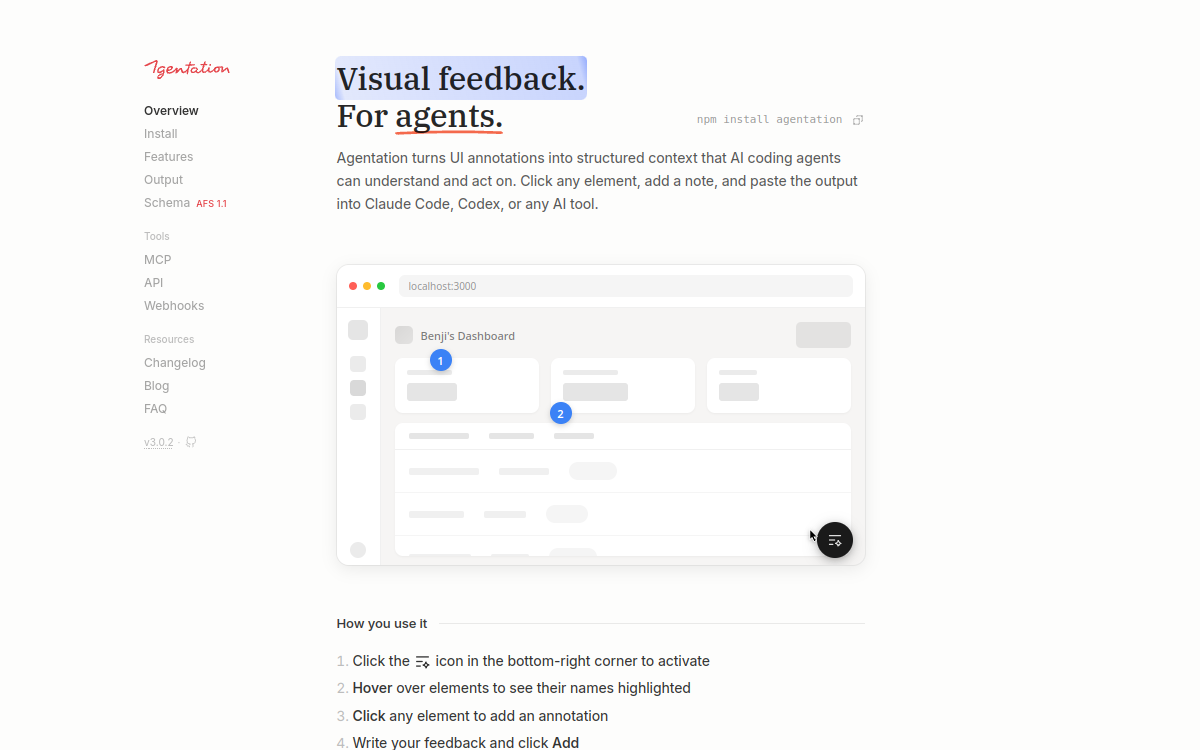
Generative AI entered a new phase in 2026: that of agents capable of acting, not just answering. Agentation fully fits this trend with an orchestration platform dedicated to business operations. Where other platforms focus on building individual agents or on generating text, Agentation positions itself at the orchestration layer: how to coordinate several agents to execute a complete process, relying on the tools the company already uses. This approach answers a clear need: leveraging AI without replacing the existing stack. For ops teams, it’s a pragmatic path that lets you gradually industrialize automation while keeping fine control over performance. The promise is strong: turning operational playbooks into measurable AI agents.
What is Agentation?
The essentials
Agentation is a SaaS platform that lets you design, deploy and supervise AI agents for business use cases. Each agent can be configured with a precise role, a knowledge base, business rules and a list of tools accessible via connectors. The platform also offers an orchestration engine that lets you chain several agents within a business workflow. Everything is driven through a centralized dashboard that measures performance and identifies possible improvements.
Key features
Agentation’s features are designed for ops teams. The agent builder lets you define their instructions, tone of voice, permissions and tool access. The orchestration engine links several agents within a single workflow, with routing, fallback and escalation rules. Native connectors cover CRMs, emails, knowledge bases and internal tools via API. The dashboard aggregates essential KPIs: volume of tasks handled, average time, success rate, user satisfaction. Detailed logs let you understand every decision and debug the agents. Finally, customization tools let you finely tune each agent’s behavior according to the company’s context.
Use cases
Agentation is used in varied contexts. A support team deploys an AI agent that answers simple requests and escalates complex cases to a human. A marketing team uses several agents to orchestrate the creation, validation and publication of content. A finance team uses it to automate invoice tracking and reminders. An HR team sets up an agent to qualify applications and prepare first interviews. Agencies create agents dedicated to their clients, allowing them to offer a high-value service without multiplying human resources.
Advantages
Agentation’s benefits are measured in freed-up time, improved service quality and process consistency. Ops teams gain productivity by entrusting repetitive tasks to agents. Process quality improves thanks to the systematic application of business rules. Indicators are clearer thanks to the centralized dashboard. For executives, it’s also a competitive-advantage lever: automating key processes without growing headcount and redeploying people to high-value tasks. Multi-agent orchestration finally makes it possible to structure ambitious workflows that simple chatbots could not handle.
Pricing
Agentation does not publish public pricing. The price depends on the number of agents deployed, the volume of tasks handled and the connectors activated. A demo and a scoping of the perimeter are offered on request. This model suits SMBs and mid-market companies that want to steer their AI budget according to actual usage and measured ROI.
Conclusion
Agentation embodies the new wave of AI agent orchestration platforms dedicated to business operations. For ops teams that want to industrialize their processes and fully leverage AI, it’s a platform worth studying seriously. The shift from a logic of isolated tools to an orchestration of agents is probably the major market evolution of 2026.