


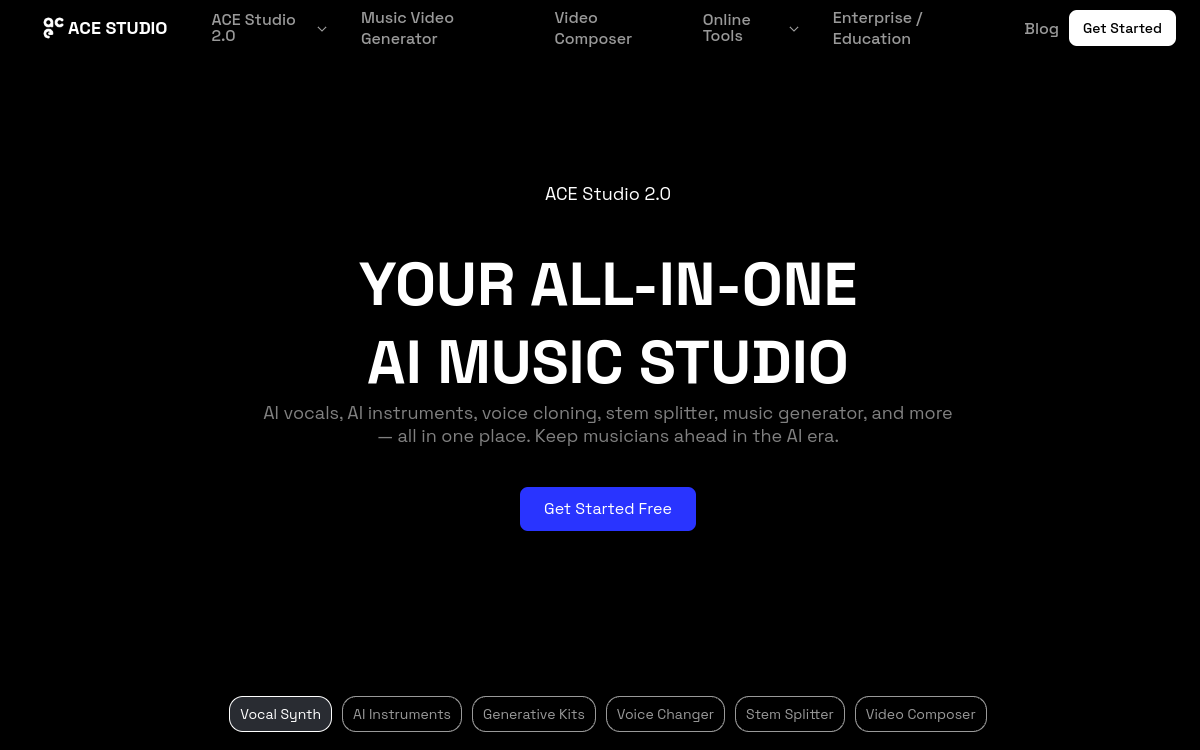
Artificial intelligence-assisted music production has undergone a spectacular evolution in recent years, deeply transforming the practices of producers, composers, and content creators. Among the most striking innovations is singing voice synthesis, which allows the generation of voices with expressiveness and quality close to those of human singers from simple MIDI files and written lyrics. ACE Studio, developed by the company Timedomain, stands out as one of the benchmarks in this demanding segment. The platform offers an impressive arsenal of over 140 AI voice models spread across eight languages, providing users with unprecedented tonal and stylistic diversity. Beyond simple vocal generation, ACE Studio offers granular control over expression parameters (breath, falsetto, tension, vibrato), allowing users to achieve a level of realism and emotion that rivals traditional studio recordings. The platform also integrates complementary features such as voice cloning, a stem separator, and AI instruments that generate complete musical accompaniments. Key targets: independent music producers, composers, YouTube and TikTok content creators, as well as small studios looking to reduce singing-related costs. This article will explore in depth the capabilities and challenges of ACE Studio.
What is ACE Studio?
The essentials
ACE Studio is an AI-powered singing voice synthesis platform, designed and developed by the Chinese company Timedomain, which specializes in innovative audio technologies. The platform transforms MIDI files accompanied by lyrics into studio-quality singing vocal performances, leveraging deep learning models trained on vast corpora of professional singing. Unlike classic text-to-speech generators that simply pronounce text, ACE Studio must manage melody, rhythm, intonation, and musical expression, which represents a considerable technical challenge. The library includes over 140 distinct AI voice models, each with its own timbre, range, and style, spread across eight major languages including English, Chinese, Japanese, Spanish, French, and German. The platform also offers complementary features that make it a true production studio: voice cloning, voice changing, a stem separator to isolate tracks from existing recordings, AI instruments that generate accompaniments, and generative kits for complete music creation. The generated voices are royalty-free for commercial use.
Key features
ACE Studio stands out for the richness and depth of its functional arsenal, which goes far beyond simple vocal generation. The flagship feature is, of course, singing voice synthesis from MIDI and lyrics, with over 140 voice models available. Each model offers its own unique timbre, range, and style, allowing users to choose the most suitable voice for each musical project. The distribution across eight major languages offers a rare international coverage in this segment. Granular control is one of the major highlights: users can finely adjust the breathing between phrases, the intensity of the falsetto on high notes, vocal tension to add character, and vibrato to add expression. These parameters are essential for producing convincing and emotionally engaging vocal performances, moving past the mechanical nature typical of early generations of voice synthesis. The voice cloning feature allows the creation of a custom vocal model from recordings of a real voice, opening up creative possibilities but also raising ethical questions that the platform manages with strict terms of use. Voice changing transforms an existing vocal performance using another model, allowing for quick creative trials. The stem separator isolates different tracks (vocals, drums, bass, other instruments) from an existing recording, facilitating remixing and reuse. AI instruments generate musical accompaniments from simple descriptions or chords, completing the production ecosystem. Generative kits offer pre-established combinations to get started quickly.
Use cases
ACE Studio’s use cases extend to many profiles of audio and music creators. Independent music producers are a natural target, especially those working on tight budgets who cannot always hire professional singers. ACE Studio allows them to quickly prototype tracks with quality voices, test different vocal styles on the same track, or even finalize complete productions. Composers use the platform to bring their demos to life: before investing in an expensive studio recording, they can present a convincing sung version of their composition to clients or collaborators. YouTube and TikTok content creators exploit royalty-free voices to produce jingles, intros, and original songs without licensing constraints. Independent video game studios can generate theme songs for their games, in multiple languages if necessary for localizations. Music teachers use ACE Studio to demonstrate different vocal styles to their students or to produce educational materials. Advertising agencies access an extensive vocal catalog for their commercials, without having to pay for studio sessions for each linguistic variation. Karaoke and cover enthusiasts can create custom versions of their favorite songs by changing the voice. Researchers in cognitive science or linguistics leverage the models for controlled experiments on vocal and musical perception.
Advantages
ACE Studio brings a series of significant benefits to its target users. The first benefit is economic: replacing a professional singer with a quality AI voice drastically reduces music production costs, which is particularly valuable for independent producers and creators. This democratization opens up access to studio-quality vocal productions at budgets that were previously out of reach. The time savings are considerable: generating a vocal performance takes a few minutes instead of several hours of recording and mixing. Creative iterations become fast: testing different vocal styles, different keys, or different arrangements no longer requires scheduling new studio sessions. 24/7 availability eliminates the scheduling constraints often associated with human singers. The granular control offered over vocal expression makes it possible to achieve a level of artistic quality that rivals traditional recordings, provided one masters the parameters. The diversity of over 140 models prevents creative fatigue and allows the exploration of various vocal styles without having to recruit new singers. Multilingual coverage facilitates international productions and localizations, which are particularly valuable for globally distributed content. The royalty-free status of the generated voices eliminates legal complications related to vocal licensing, a critical point for commercialized content. The stem separator and AI instruments transform ACE Studio into a true, complete studio, reducing reliance on other tools.
Pricing
ACE Studio’s pricing structure offers several options tailored to different user profiles and levels of commitment. The budget entry option is a plan at around 19 dollars per year giving access to a single voice model, ideal for users with a limited specific need and a tight budget. The main annual subscription is set around 149 dollars per year, or approximately 12.42 dollars per month in monthly equivalent, giving full access to all features and the extensive voice library. This option represents the best value for money for regular users. The monthly subscription without an annual commitment is between 16 and 22 dollars per month depending on current promotions, more expensive per month but more flexible for one-off projects. A 14-day free trial is offered on some plans, allowing users to test the platform concretely before committing. This pricing diversity covers all user profiles, from occasional creators to intensive producers. Professional users also benefit from custom quote options for high-volume usage or specific integrations.
Conclusion
ACE Studio stands out as a serious and mature benchmark in the booming market of AI-powered singing voice synthesis. Its combination of over 140 voice models, granular control over expression, complementary features like the stem separator and AI instruments, and its royalty-free commercial status make it a complete solution for music producers, composers, and content creators. The steep learning curve and the need to master MIDI are the main limitations, but they correspond to the requirements of a professional tool. For serious players in AI-assisted music production, ACE Studio fully deserves a thorough evaluation.