



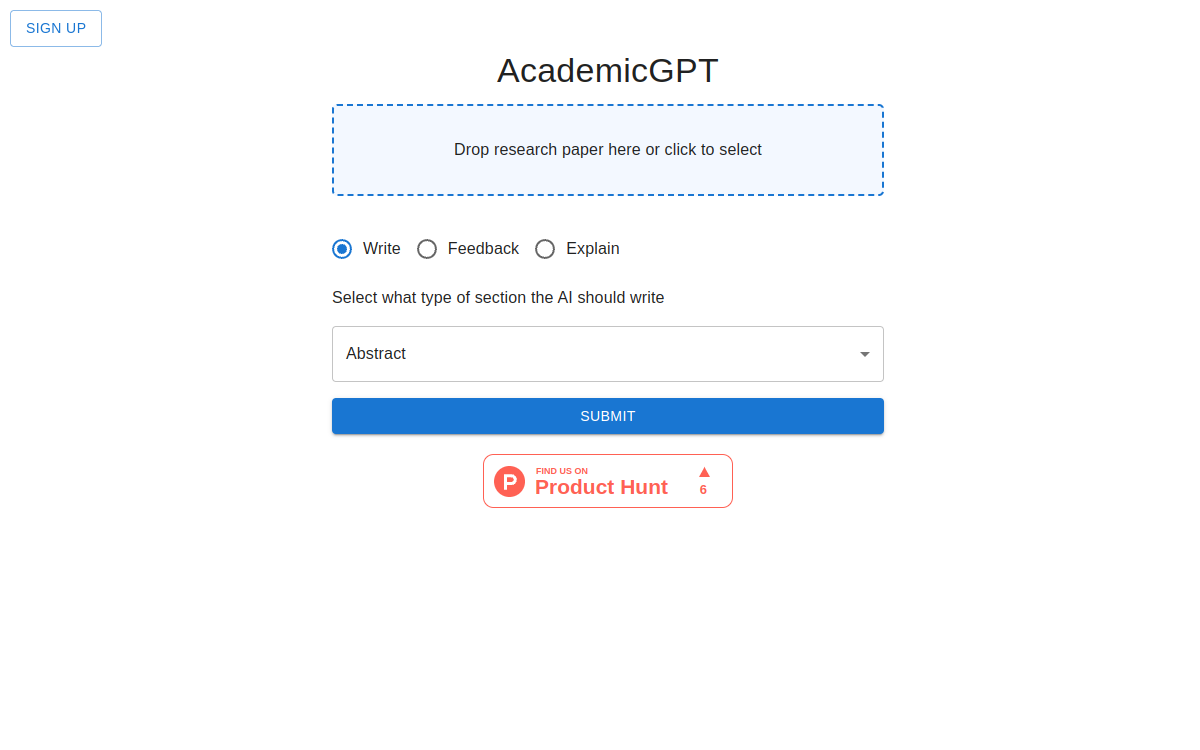
Writing a scientific article takes time: structuring a clear abstract, articulating methods and results, discussing limitations and, above all, supporting each claim with solid references. AcademicGPT positions itself as an artificial intelligence assistant designed for this precise work. The tool is aimed at students, teachers and researchers who want to accelerate the production of their manuscripts without starting from a blank page. The principle is simple: you upload your working document via drag-and-drop, the AI analyzes its context, and then it proposes to write or refine the different sections of the article. In addition, there is help in searching for citations in recognized scientific databases. In a landscape where generalist assistants like ChatGPT can do a bit of everything, AcademicGPT bets on specialization around the research writing cycle. This page details what the tool actually does, its use cases, its strengths and limitations, as well as what we know about its pricing model, to help you judge whether it has a place in your academic workflow.
What is AcademicGPT?
The essentials
AcademicGPT is an online application for academic writing assistance powered by AI. Concretely, it accompanies the user throughout the creation of a research article: writing and improving the standard sections of a paper, searching for bibliographic references and paraphrasing passages. The tool understands the context of the uploaded document to propose content adapted to the subject being addressed. It targets a clear academic audience: students preparing a thesis, doctoral candidates, researchers and teachers. It is accessible from a web browser and via a mobile application, which allows you to work on a manuscript both at the office and on the go. AcademicGPT is therefore not a generalist text editor but a research-oriented copilot, whose value lies in its knowledge of the format and expectations of scientific writing.
Key features
AcademicGPT’s central feature is help with writing the sections of an article: abstract, introduction, methods, results, discussion and conclusion. The user uploads their document, and the AI generates or refines coherent and structured content for each of these parts. The second pillar is citation management: the tool searches for relevant references in scholarly sources such as PubMed and arXiv, to support arguments with existing work. Then comes paraphrasing: you can ask to rewrite a passage to improve its clarity, coherence and reduce repetition. The interface is based on a drag-and-drop system that simplifies file uploads, accompanied by clear instructions. Finally, the tool claims multiplatform access via web browser and mobile application. These functions cover the recurring needs of a scientific author: producing a structured first draft, sourcing the bibliography and polishing the style before submission to a journal.
Use cases
AcademicGPT finds its usefulness at several stages of a research project. A student starting a thesis can use it to get a starting structure and a first draft of each section, which overcomes blank page syndrome. A doctoral candidate in the writing phase can accelerate citation research by querying databases like PubMed or arXiv, then integrate the found references. An experienced researcher can use it as a paraphrasing tool to clarify a discussion or condense an overly long abstract. Teachers can use it to prepare materials or academic writings. In all cases, the tool acts as an accelerator: it takes on the tedious work of formatting and sourcing to let the author focus on substance, analysis and interpretation of results.
Advantages
The main benefit of AcademicGPT is time savings on time-consuming but essential tasks: structuring an article, formulating each section and finding relevant references. By bringing together writing, citation and paraphrasing in a single interface, the tool reduces back-and-forth between a word processor, a bibliographic search engine and a reference manager. Its academic specialization is an asset: it knows the expected format of a research paper, which avoids having to re-explain the context with each query as with a generalist assistant. Web and mobile access adds flexibility, allowing you to work on a manuscript at any time. For an author under time pressure, this package represents concrete support as long as you keep a critical eye on the content produced.
Pricing
AcademicGPT’s official website does not clearly detail its pricing structure, which warrants caution. According to several directories and third-party reviews, trial usage is generally available for free, while full access to the platform requires a monthly subscription. The amounts reported by these sources are around $10 to $20 per month, but these figures vary from one directory to another and are not confirmed by a publicly viewable official pricing page. Before any commitment, it is therefore recommended to directly verify the pricing terms, the scope of the free trial and any usage limits on the publisher’s site, as this information may change.
Conclusion
AcademicGPT is a targeted assistant for those who write scientific articles. Its strength lies in its specialization: writing the sections of a paper, finding citations in PubMed or arXiv and paraphrasing passages, all from the web or mobile. It’s an interesting copilot for saving time on structuring and sourcing, provided you carefully review the outputs and verify the accuracy of references. Pricing transparency and public documentation remain its weak points. For an academic author in a hurry but rigorous, it deserves a try, keeping in mind that it assists research work without ever replacing it.