


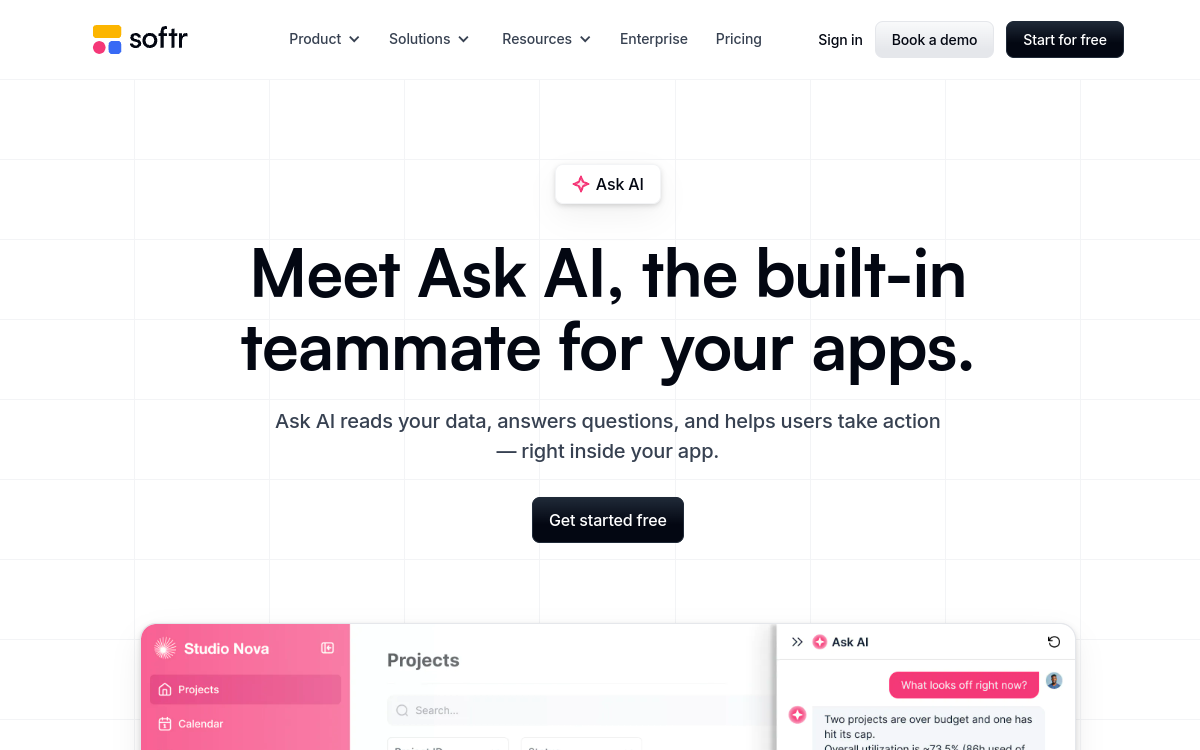
Softr has established itself as one of the leaders in no-code for transforming an Airtable or Google Sheets database into a professional web application. With the arrival of conversational AI, the next logical step was to offer end users the ability to chat with their data. Softr Ask AI meets exactly this need: adding a chatbot capable of querying an application’s data in real time, without coding. This extension transforms client portals, internal tools, and dashboards into modern conversational interfaces. For no-code builders, ops teams, and agencies, it is a natural upgrade that multiplies the value of already deployed apps, opening up new possibilities for use and daily engagement of business users.
What is Softr Ask AI?
The essentials
Softr Ask AI is a conversational assistant feature integrated into the Softr no-code platform. It allows you to add a chatbot to any Softr application in a single click. The assistant reads live data from dynamic blocks (lists, tables, profiles) and answers user questions in natural language. Ask AI respects already configured visibility and permission rules, which guarantees the security of sensitive data. No API key is required; activation is done directly from the Softr editor. AI credits are included in existing Softr plans, with different quotas depending on the tier. Ask AI targets no-code builders and business users who want to enrich their applications without requiring additional development.
Key features
Softr Ask AI brings a coherent set of features. Activation is done in one click from the Softr editor, without technical configuration. The assistant reads live data from the application’s dynamic blocks, ensuring answers are always up to date. Compliance with Softr permissions ensures that each user only sees the data they are authorized to access. Integration within the app avoids any need for external tools or iframes. AI credits are pooled at the Softr plan level, simplifying budget management. GDPR and HIPAA compliance allows Ask AI to be used in sensitive contexts. The feature fits into the existing Softr workflow, reducing the learning curve for builders already familiar with the general platform.
Use cases
Softr Ask AI serves several concrete use cases. No-code builders use it to add an analytics chatbot to a client portal, capable of answering questions about orders or invoices. Ops teams integrate it into their internal tools to allow teams to ask questions about business data without going through filters. Agencies leverage it to deliver value-added, enriched apps to clients. SMEs build conversational internal tools for their sales or support teams. Member portal creators use it to facilitate access to information in communities. Associations use it for their volunteer and donor portals, simplifying information search through intuitive natural questions quickly on a daily basis.
Advantages
The main benefit of Softr Ask AI is its ease of adoption. With a single click, a no-code app gets a chatbot capable of querying live data. Compliance with permissions guarantees security without additional configuration. Integration into the Softr business model avoids external subscriptions and billing surprises. GDPR and HIPAA compliance opens up use cases in regulated sectors. For builders, it is a strong argument to differentiate their deliverables. For end users, it is a significant productivity gain: asking a question in natural language is much faster than using complex filters. It is a democratization of conversational data that meets a strong expectation of modern business users accustomed to consumer AI assistants.
Pricing
Softr Ask AI is included in all Softr plans, including the free plan, with monthly AI credits varying by tier. The Free plan includes limited credits and basic features. The Basic plan, around 59 dollars per month, unlocks more credits and a custom domain. The Professional plan, around 167 dollars per month, offers more credits and advanced blocks. The Business plan, around 269 dollars per month billed annually, offers maximum credits and premium features. This integrated structure avoids the multiplication of subscriptions and gives builders clear budget visibility. For high-traffic apps, it is recommended to estimate projected consumption before any wide deployment to the portal’s end business users.
Conclusion
Softr Ask AI perfectly illustrates how AI can enrich no-code without complicating it. Its native integration into the Softr platform, its respect for permissions, and its shared business model make it a valuable extension for builders. Its presence starting from the free plan democratizes its use and accelerates adoption. The main limitations relate to limited monthly credits and dependence on the Softr ecosystem. For no-code builders, ops teams, and agencies already using Softr, Ask AI is a feature to activate immediately to enrich portals and internal tools with a modern conversational dimension accessible to all, quickly improving the experience of business users in their daily interactions with their professional data.