


Customer experience has become a fierce competitive battleground, where every second counts and the slightest friction is paid for in churn rate. To respond to this pressure, many organizations are turning to conversational artificial intelligence. Angel CX positions itself in this niche with a clear promise: to deploy an omni-channel platform capable of absorbing the mass of repetitive requests while preserving human quality on sensitive topics. The tool is not just a simple chatbot; it combines voice, chat, and call center around a unified orchestration. This approach particularly appeals to key accounts that must reconcile productivity, regulatory compliance, and personalization of the customer relationship, without dismissing the expertise of their existing teams.
What is Angel CX?
The essentials
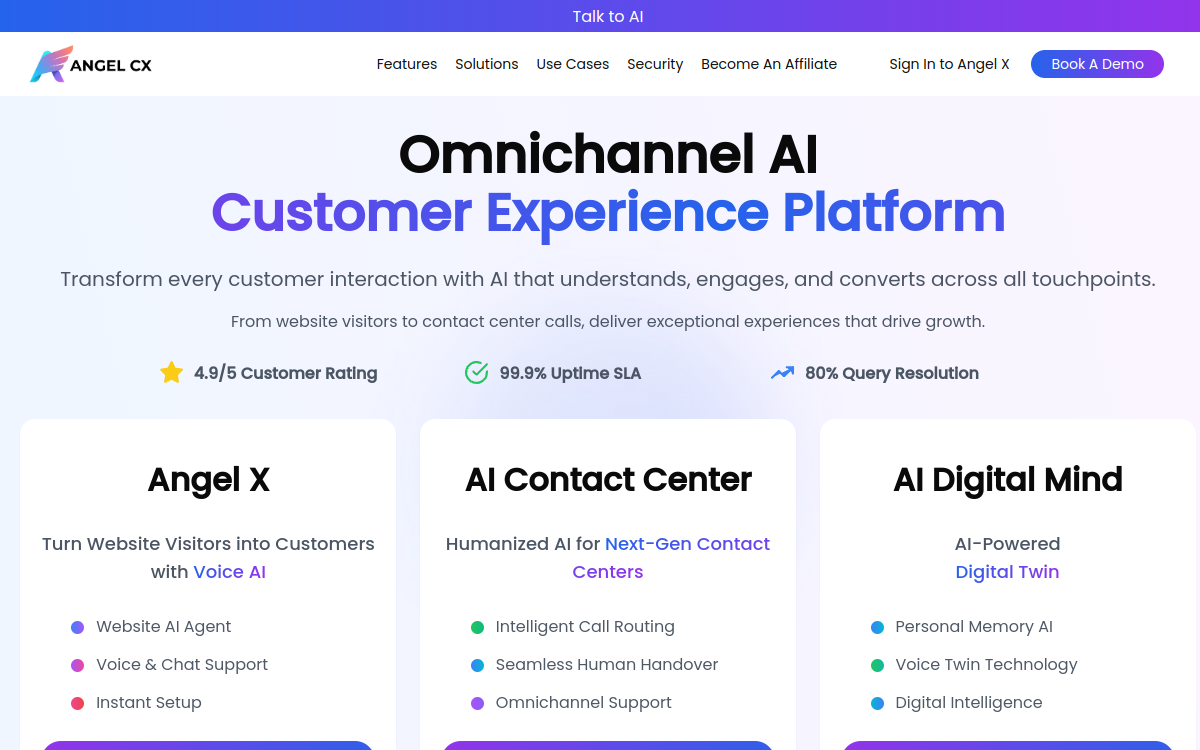
Angel CX is a conversational agent platform designed for companies wishing to modernize their customer experience. It is built around three building blocks: Angel X for voice and web chat, Angel Tel for the AI call center, and AI Digital Mind, a layer of personal memory and vocal avatar. The publisher claims over twenty-five years of CX experience and showcases around a hundred clients in some fifty countries. Angel CX particularly targets regulated and demanding sectors such as banking, insurance, healthcare, e-commerce, and telecoms. The platform integrates with existing CRM, helpdesk, and telephony tools to orchestrate a unified customer journey across all available touchpoints.
Key features
Angel CX combines several key features to automate a large portion of customer interactions. The Angel X agent responds instantly on websites via text or voice, drawing on the company’s knowledge base. Angel Tel handles incoming calls, manages intelligent routing, and resolves simple requests from end to end. AI Digital Mind adds a dimension of personalization thanks to the memory of previous exchanges and vocal avatars capable of reproducing a specific tone or accent. The platform also offers analytics tools to track satisfaction, measure first-contact resolution, and identify high-impact topics. Finally, the handover to human advisors is designed to be seamless, with a full context transfer in real time.
Use cases
The use cases of Angel CX cover a wide range of business scenarios. In e-commerce, the Angel X agent answers questions about orders, manages returns, and offers personalized recommendations, which reduces cart abandonment. In banking, it handles KYC eligibility, credit request qualification, or questions about current fees, twenty-four hours a day. Healthcare operators use it for appointment scheduling, post-consultation follow-up, and reminder management. In telecoms, it manages billing, first-level technical diagnostics, and commercial requests. Finally, some public administrations are experimenting with it as a single point of contact to guide users to the right services, speaking the language and tone expected by each target audience.
Advantages
The main benefit of Angel CX is absorbing a massive volume of interactions without degrading the experience. AI agents process simple requests in seconds, freeing up human advisors for complex or high-value cases. This approach improves customer satisfaction, reduces cost per contact, and stabilizes seasonal activity peaks. GDPR, SOC 2, and ISO 27001 compliance reassures legal and security departments, an essential condition in banking or healthcare. Centralizing channels in a single platform avoids silos between customer service, marketing, and sales. Finally, integrated analytics gives CX teams a continuous view of performance and friction points, fueling a more disciplined and faster continuous improvement loop.
Pricing
Angel CX operates on an enterprise model with custom pricing. Prices depend on the volume of interactions, channels covered, required integrations, and the level of support desired. There is no self-service offer, but the publisher offers demonstrations and pilot phases before any commitment. Contracts generally include support for journey design, prompt writing, CRM integration, and continuous performance optimization. This project logic is consistent with the enterprise target but requires a significant budget and a real strategic commitment to customer service transformation. Costs should be weighed against the expected return on investment in productivity.
Conclusion
Angel CX presents itself as a mature platform for large organizations wanting to transform their customer experience with AI. Its omni-channel coverage, regulatory compliance, and industry expertise make it a credible player against CX giants. The business model requires real involvement from business departments and a substantial budget, but the benefits can be very significant on satisfaction and cost indicators. For an ambitious customer relationship modernization project, Angel CX deserves a place on the shortlist of solutions to evaluate, provided the topic is approached with a clear roadmap.