


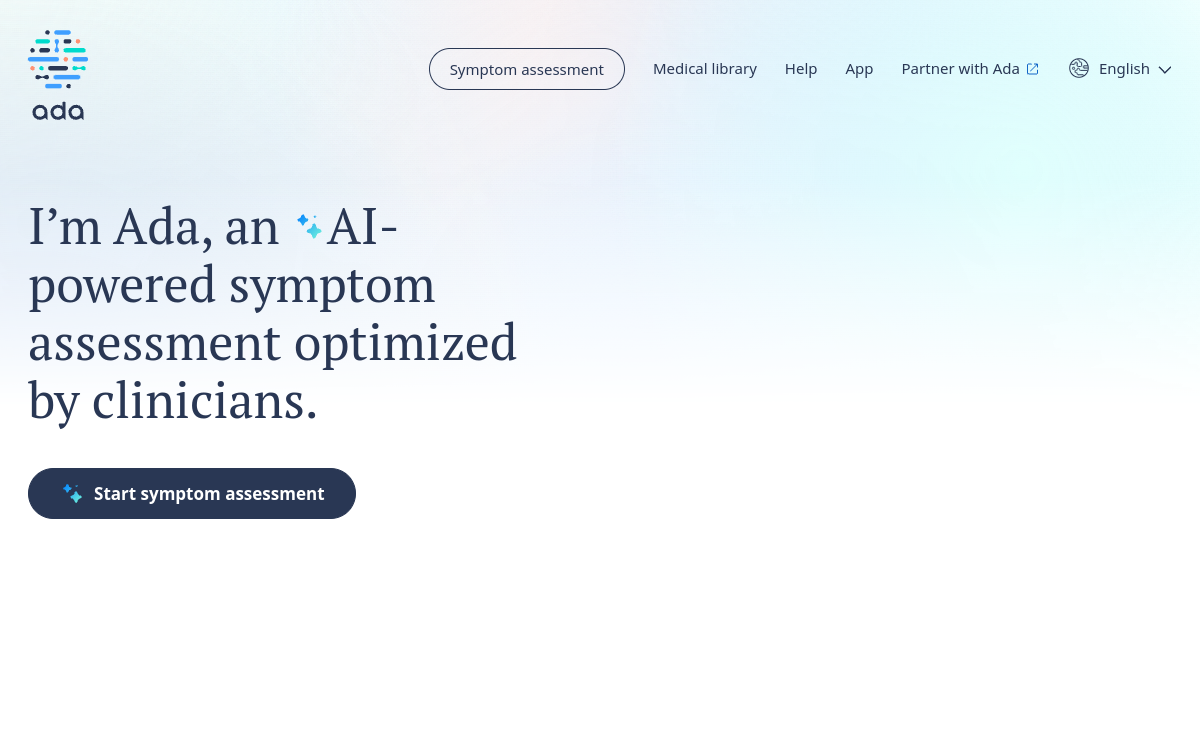
Ada Health is a mobile symptom assessment app that combines artificial intelligence and medical expertise. Launched in Europe and used by millions of people worldwide, it offers a simple journey: describe what you are feeling, answer targeted questions, and get a list of possible causes, accompanied by a clear recommendation on the next steps. Designed as a reliable gateway to the healthcare system, Ada Health is aimed at individuals, families, travelers, and healthcare companies looking to better guide their patients. Its key asset: a medical reasoning engine designed and maintained by doctors, capable of analyzing hundreds of symptoms and cross-referencing them with a broad catalog of pathologies. In a world where access to care can be slow or complex, the app offers an instant, free, and confidential first opinion. This guide details how Ada Health works, its use cases, its benefits, its business model, and its value compared to other health assistants on the market.
What is Ada Health?
The essentials
Ada Health is a digital health app published by the German company Ada Health GmbH, founded by doctors and scientists. Its technological core is based on a medical artificial intelligence specialized in symptom assessment, powered by a clinically validated knowledge base. In practice, the user interacts with the app via a guided chat interface. Ada Health asks questions about symptoms, medical history, age, and sex, and then generates a personalized report. This summary includes hypotheses ordered by probability, advice on the urgency of the situation, and the most appropriate care recommendation, ranging from simple rest to an immediate medical consultation. The Berlin-based company collaborates with universities, hospitals, and scientific publishers to maintain a high level of clinical quality. The app is free for individuals, works offline for many steps, and offers a personal account to keep track of assessment history. Alongside this consumer product, Ada Health develops dedicated solutions for insurers, hospitals, and healthcare systems, which can be integrated via API or embedded into an existing patient experience.
Key features
Ada Health provides several complementary features. The symptom assessment engine is the central element: it alternates between open-ended and multiple-choice questions to precisely understand the situation, then produces a detailed report. The app also offers tracking of past assessments, allowing users to compare the progression of a symptom over time. An educational library helps users understand common conditions, their causes, and their treatments. The interface is translated into several languages, including French, English, German, Spanish, Portuguese, and Swahili, making it a relevant tool in many countries. On the enterprise side, Ada Health offers solutions that can be integrated into insurance services, hospitals, and employer programs: automated triage, personalized patient journeys, healthcare system navigation, API integration, and usage dashboards. Everything is designed to respect data privacy: the publisher applies strict standards compatible with the GDPR and regularly publishes clinical studies on its AI’s performance. The platform is continuously updated by a committee of medical experts who review content and validate new models. Finally, Ada Health offers features designed for travelers and expats, such as the ability to conduct an assessment in a language different from that of their country of residence. For healthcare professionals who request it, integrations are possible with electronic health records, intake chatbots, and teleconsultation platforms. This versatility makes it one of the few consumer digital health products that can also support institutional strategies.
Use cases
The use cases for Ada Health are numerous. In daily life, individuals can use it to understand a sudden pain, a persistent fever, or unusual symptoms before deciding whether to consult a doctor. Parents appreciate the app for quickly assessing a child’s condition and knowing if a doctor’s visit is necessary. Travelers use it abroad when access to a healthcare professional is complicated, in order to get a reliable first opinion in their own language. On the corporate side, health insurers integrate Ada Health into their services to guide their policyholders to the right care pathway. Hospitals and clinics use its solutions to pre-triage requests and reduce pressure on emergency rooms. Employer health programs rely on the tool to offer a modern wellness service to their employees. Finally, NGOs and public health systems in regions with low medical density leverage the technology to expand access to initial health advice.
Advantages
The primary advantage of Ada Health is its medical quality: its AI is co-developed with doctors, continuously supervised, and scientifically evaluated. It is one of the few consumer tools to publish clinical studies on its accuracy. Secondly, the user experience is particularly well-crafted: a clear interface, a reassuring tone, and accessible language. The assessment process takes an average of a few minutes, making it a quick and useful tool in moments of doubt. Thirdly, the app is free for the general public, democratizing access to initial health advice. Finally, Ada Health respects privacy: data is secured, and the publisher commits to not selling personal information to third parties. For organizations, the API and enterprise solutions bring measurable operational gains: better guidance, reduction of unnecessary consultations, and increased patient satisfaction. Added to this is the multilingual dimension, which is particularly valuable in regions where accessing a healthcare provider who speaks the local language remains a daily challenge.
Pricing
Ada Health’s business model relies on a clear distinction between the general public and enterprises. For individuals, the app is completely free on the App Store and Google Play, with no subscription or mandatory in-app purchases. All symptom assessments and personal tracking remain accessible at no cost. For healthcare industry players, customized partnerships are offered: API integration, personalized patient journeys, usage dashboards, multilingual options, and clinical support. Pricing is available upon request, depending on user volume, activated features, and the level of integration. Interested organizations can contact the sales team via the official website to obtain a demo and a quote tailored to their project.
Conclusion
Ada Health is an excellent example of AI applied to healthcare with seriousness. For the general public, it is a free, reassuring, and educational app that helps users better understand their symptoms and decide on the next steps. For healthcare players, it is a robust platform to improve triage, guidance, and the patient experience. It does not replace a doctor or an emergency service, but serves as a useful companion in between. A reference to know when interested in the digital transformation of healthcare. Its clinical rigor and accessible interface make it a highly recommendable gateway, to be used intelligently alongside traditional care.