



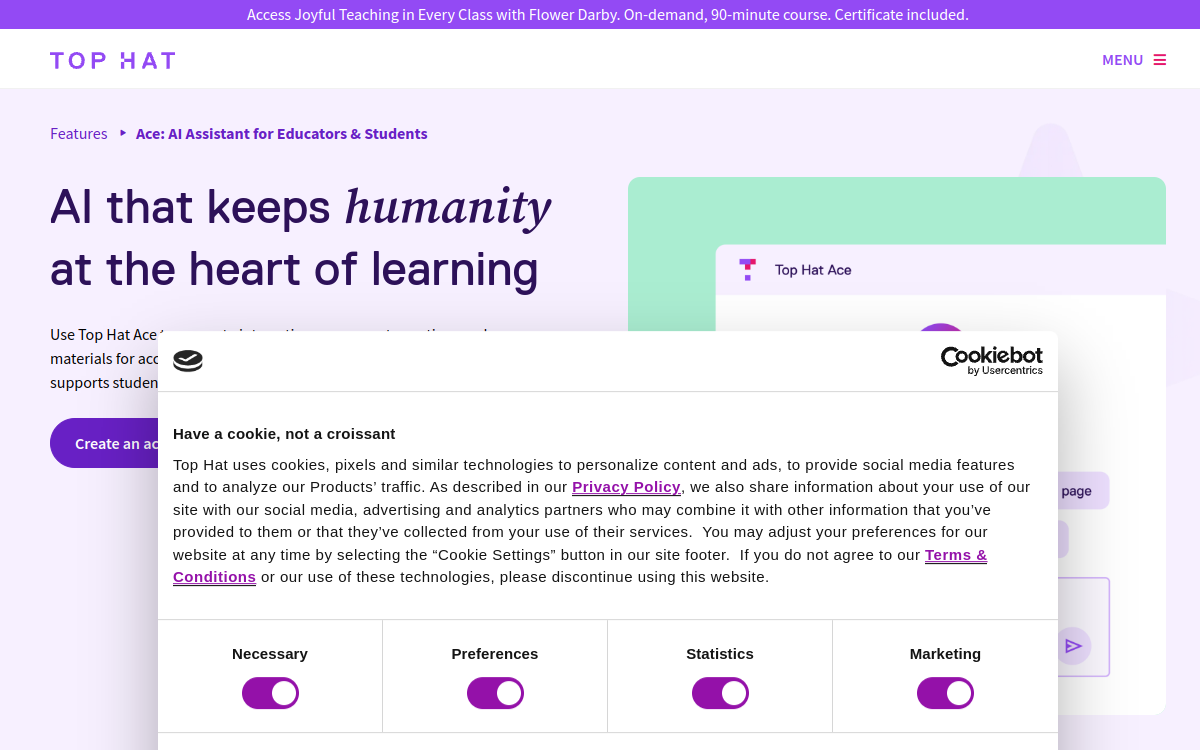
Higher education is undergoing a period of profound transformation, accelerated by the arrival of generative artificial intelligence tools in pedagogical practices. While ChatGPT and its equivalents initially raised concerns among educators, who feared cheating and the devaluation of assessments, a new generation of tools is emerging with a radically different approach: integrating AI to serve pedagogy rather than merely enduring it. Top Hat Ace is part of this movement, offering an AI teaching assistant specifically designed for universities and colleges, natively integrated into the Top Hat platform widely adopted in North America. Powered by GPT-4, the tool does not just answer questions: it generates assessments from course materials, transforms static PDFs into accessible interactive experiences, and provides students with a conversational tutor grounded in the content actually taught. This contextual approach avoids the pitfalls of generalist chatbots that can provide answers contradictory to the syllabus. In this article, we will explore in detail the capabilities of Top Hat Ace, its use cases in a university context, its benefits, and its business model.
What is Top Hat Ace?
The essentials
Top Hat Ace is an artificial intelligence-powered teaching assistant, developed and natively integrated into the Top Hat teaching platform, a solution already adopted by many universities and colleges, primarily in North America. Powered by GPT-4, OpenAI’s flagship language model, Top Hat Ace distinguishes itself from generic AI assistants by its strict grounding in the pedagogical content of the courses using the platform. This specificity ensures that the answers provided to students remain consistent with the taught curriculum, avoiding the contradictions or approximations that non-contextualized chatbots can generate. The tool offers three main functional areas: the automatic generation of assessment questions from course materials (slides, PDFs), the transformation of static documents into interactive pages compliant with WCAG 2.1 AA accessibility standards, and a conversational chatbot for students to answer their questions about course content. Compliant with the US FERPA regulations on academic data protection, Top Hat Ace fits into a legal framework tailored to the requirements of American academic institutions.
Key features
Top Hat Ace offers a coherent set of features designed to meet the specific needs of higher education. The automatic generation of assessment questions is one of the flagship features: from PowerPoint slides or course PDFs, the AI creates multiple-choice questions, open-ended questions, or practical exercises that can be directly integrated into formative or summative assessments. This automation represents a considerable time-saver for educators, who can thus focus on overall instructional design rather than the tedious writing of questions. The conversion of PDFs into interactive pages is the second major feature: static documents are transformed into enriched experiences compliant with WCAG 2.1 AA accessibility standards, ensuring that students with disabilities can fully access the content. The student chatbot represents the third functional pillar: grounded in the specific content of each course, it answers student questions using only the pedagogical sources validated by the instructor, thus avoiding the pitfalls of generalist chatbots. Personalized practice quizzes adapt to each student’s level and difficulties, with instant feedback that promotes active learning. The examples used in explanations are personalized based on the student’s interests and academic path, reinforcing engagement and relevance. Finally, post-class reports provide educators with detailed analyses of student participation, engagement, and the difficulties they encounter.
Use cases
The use cases of Top Hat Ace revolve around the main functions of higher education. For university professors, the tool automates the creation of assessments from their existing materials, drastically reducing the time spent writing questions. Science educators can generate practical exercises tailored to each chapter, while humanities educators leverage the AI’s ability to formulate nuanced open-ended questions. Converting PDFs into accessible interactive pages is particularly valuable for courses that rely heavily on documentation, such as law or history, where textual materials are abundant. Students use the chatbot grounded in course content as a tutor available 24/7, capable of answering their questions about the syllabus without the risk of misinformation. Personalized practice quizzes become an exam preparation tool, especially useful for identifying areas of weakness before summative assessments. Instructional designers exploit post-class reports to analyze the effectiveness of materials and identify concepts that cause difficulty, fueling a cycle of continuous improvement. Academic institutions modernize their educational offerings by providing these tools to their faculty, boosting their appeal to students. Accessibility services benefit particularly from the automatic conversion of documents into WCAG 2.1 AA pages, reducing the manual workload of making content accessible.
Advantages
Top Hat Ace brings a series of benefits aligned with the current challenges of higher education. For educators, time savings represent the most immediate benefit: the automatic generation of questions and the conversion of PDFs free up hours that can be reinvested in individualized student support or overall instructional design. The quality of assessments also improves, with a variety of generated question formats enriching assessment practices. For students, access to an AI tutor available 24/7, grounded in their course content, democratizes pedagogical help that was previously reserved for those who could afford a private tutor. Personalized quizzes with instant feedback promote active learning tailored to each individual’s pace. The guaranteed WCAG 2.1 AA accessibility on converted content meets growing legal obligations regarding inclusion and concretely improves the experience of students with disabilities. For institutions, native integration within Top Hat avoids the proliferation of tools and contracts, simplifying administrative management. FERPA compliance reassures legal departments regarding the protection of student data. Analytical reports enable data-driven pedagogical management, feeding into quality assurance processes. Finally, free inclusion in the Top Hat subscription avoids additional costs for institutions that are already clients of the platform.
Pricing
The business model of Top Hat Ace fits within the broader framework of the Top Hat platform. The AI assistant is included at no additional cost in the existing Top Hat subscription, making it a significant value-add for institutions and educators who are already users. The Top Hat platform is free for educators, who can adopt it without financial commitment. The business model relies on student licenses, billed at approximately 28 dollars per semester per student. This structure is common in the North American educational tools sector, where the cost is traditionally borne by students or integrated into tuition fees. For institutions wishing to cover this cost, institutional agreements are available upon custom quote. The lack of additional cost for Ace reinforces the attractiveness of the Top Hat offering compared to competitors who charge extra for their AI modules. Educators can thus test all features for free before asking their students to purchase the license.
Conclusion
Top Hat Ace embodies a mature vision of pedagogical AI applied to higher education. Its grounding in the content actually taught, its FERPA compliance, its attention to WCAG 2.1 AA accessibility, and its free inclusion in Top Hat make strong arguments for English-speaking academic institutions. The limitations remain essentially linguistic and sector-specific: the tool is only suitable for English-speaking universities and is not adapted for K-12 education. For higher education professors, students, and institutions operating in this ecosystem, Top Hat Ace represents a relevant pedagogical investment.