


Publishing in English remains a must for the majority of researchers and postgraduate students, regardless of their native language. However, academic writing follows very specific codes, where lexical nuance, syntactic rigor, and neutral tone carry as much weight as the scientific content. This is precisely the need met by Writefull Academizer, a free AI tool dedicated to transforming informal text into formal academic prose. Far from trying to replace the author, it aims to assist them in bringing their writing up to standard, while scrupulously preserving the original meaning. This article details its positioning, key features, typical use cases, and limitations, to help French-speaking researchers determine if Academizer can be a useful addition to their daily routine and scientific editorial pipeline for future international publications.
What is Writefull Academizer?
The essentials
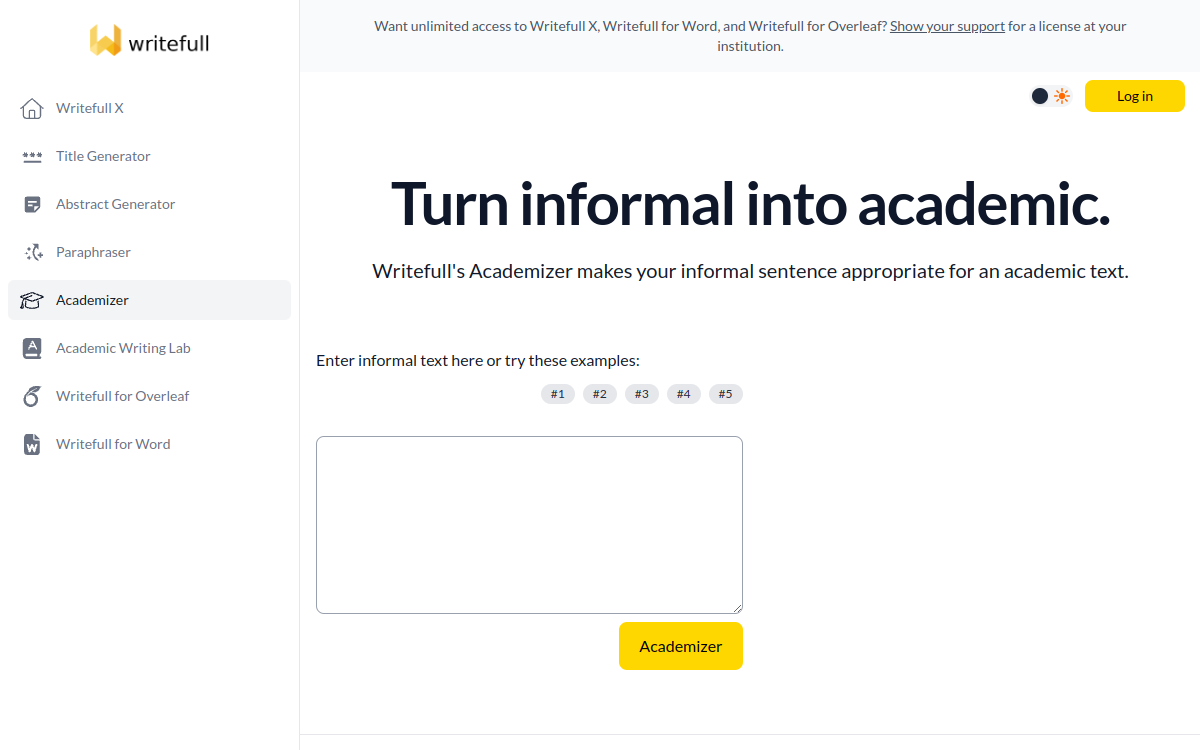
Writefull Academizer is a free web tool developed by Writefull, a British publisher known for its language proofreading solutions designed for researchers and scientific authors. Its mission is targeted: to transform informal text into formal academic prose without altering the meaning. The user pastes their text into the interface, launches the rewriting, and obtains a restructured, more neutral, and more precise version. The tool relies on language models trained specifically on scientific literature corpora, under the guidance of linguists specializing in natural language processing. This approach distinguishes it from generalist paraphrasing tools, which are not calibrated for the very specific stylistic constraints of academia. Academizer is part of a broader suite that includes language checking, paraphrasing, and an abstract generator useful for scientists.
Key features
Academizer is built around a few key functions. Sentence-by-sentence rewriting is the core of the tool: each statement is reformulated to adopt an academic register, favoring more precise structures, more neutral verbs, and vocabulary in line with the practices of scientific journals. Restructuring suggestions are provided when a sentence is deemed too long or ambiguous, which improves overall readability without altering the meaning. Within the Writefull suite, users will find other complementary building blocks: a language check module for errors and phrasing, a paraphrasing tool to reformulate specific passages, a title and abstract generator useful for the submission stage, as well as a GPT-generated text detector, which can serve both authors and reviewers. Regarding confidentiality, Writefull specifies that texts submitted to Academizer are not stored on its servers, providing an important guarantee in a field where manuscripts remain confidential until publication. Access is directly from the web, without installation, and usage remains governed by a fair use policy, designed to preserve service quality while preventing large-scale automated abuse by bots or scripts.
Use cases
The use cases for Academizer follow the timeline of academic life. A PhD student preparing an article for an international journal can use it to adjust the style of sections already drafted in the first instance. A master’s student can polish their thesis before final submission, ensuring that the vocabulary remains in line with academic expectations. A non-native English-speaking researcher, scientifically confident but less sure of their written English, can use it to reduce the need for costly external human proofreading. Authors preparing a book chapter, a research report, or a response to reviewers will find Academizer to be an effective complement to a human proofreader. Beyond these profiles, some teacher-researchers see it as an educational tool to show their students the difference between common phrasing and precise, nuanced academic phrasing at several key points.
Advantages
The first benefit of Academizer is obvious: it provides high-level stylistic expertise for free, which is traditionally reserved for experienced academic proofreaders. The second benefit is qualitative: the promise not to alter the meaning is essential in a context where scientific nuances are crucial. The third benefit relates to confidentiality: not storing submitted texts meets the ethical requirements of researchers regarding unpublished data and results. Integration into a wider suite allows for a natural sequence of complementary steps such as checking, paraphrasing, or abstract generation. Finally, the fact that the tool is designed by NLP linguists, rather than a purely marketing team, is reflected in the quality and consistency of the suggestions offered throughout the sentences reworked within long-term scientific manuscripts.
Pricing
Writefull Academizer is completely free, with no hidden subscriptions or paywalls for the main features. However, it remains governed by a fair use policy designed to prevent abusive use. Concretely, this means it is designed for individual research or academic writing use, rather than industrial volumes. For users wishing to benefit from the entire Writefull ecosystem (advanced language checking modules, integrations into Word or Overleaf via the paid suite), paid offers exist on the Writefull side, with pricing tailored for academic institutions. Academizer itself remains free and accessible from the browser, making it an ideal entry point to discover the publisher’s linguistic approach before any larger investment in a subscription.
Conclusion
Writefull Academizer is a valuable free tool for researchers and students who need to write in academic English without having a human proofreader at hand. Its specialization, the linguistic quality of its suggestions, and its confidential framework make it a useful companion for writing theses, articles, and dissertations. Its limitations in customization and its English interface are largely offset by the value provided, provided that users respect its non-commercial spirit and the fair use framework defined by the publisher.