


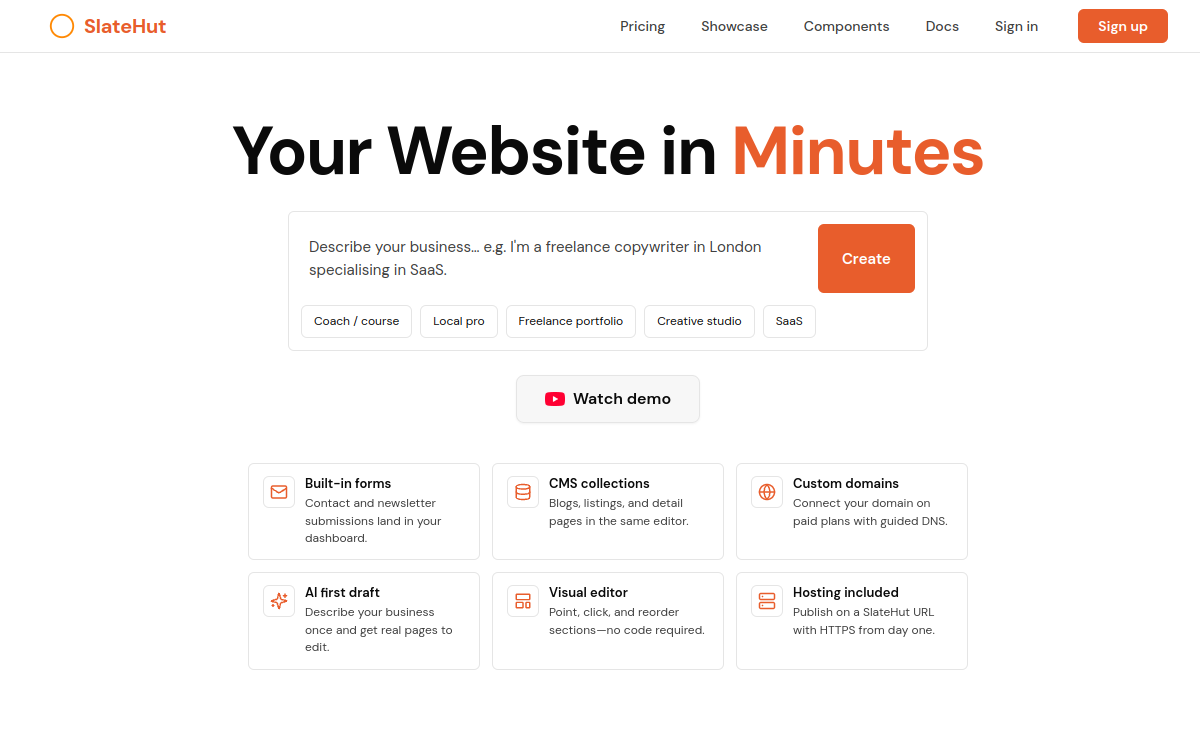
Website creation has long been a friction point for solopreneurs, freelancers, and small businesses. Between classic CMS platforms that require hours of configuration and no-code builders that can quickly reach their limits, finding a tool capable of producing a professional multi-page site in minutes remains a challenge. SlateHut is part of a new wave of AI builders aiming to transform this equation. From a simple natural language prompt, the platform generates a complete site with a hero section, pricing sections, contact forms, a blog, and much more. This article reviews the features, use cases, and limitations of SlateHut to help you determine if the platform meets your needs.
What is SlateHut?
The essentials
SlateHut is an AI-powered website builder. The service generates complete multi-page sites from a prompt in English describing the user’s business, tone, and needs. The platform offers a library of over 34 ready-to-use blocks including hero, pricing sections, contact forms, testimonials, and many others. SlateHut also integrates a CMS to manage blogs, case studies, and listings, contact forms connected to a dashboard, and support for custom domains. A notable feature is the native support for the Model Context Protocol, which allows other compatible AI tools to interact with SlateHut in a structured way.
Key features
SlateHut offers a set of advanced features for an AI builder. Multi-page generation from a prompt is the product’s signature: from a simple description, the platform produces a complete site with a hero section, products or services page, about page, contact page, and even a blog section. The block library covers over 34 templates spanning most use cases: pricing tables, testimonials sections, FAQ, team, legal notices, and more. The integrated CMS allows creating and managing content collections, which is useful for blogs, case studies, and product or service listings. Contact forms are managed natively with a dashboard that centralizes submissions. SlateHut also offers a REST API v1 covering generation, pages, sections, structured content, media, domains, and form data. MCP support opens the way for integrations with other compatible AI tools, which can reduce manual work when creating or updating sites. Finally, Launch+ plans unlock custom domains and higher credit limits.
Use cases
SlateHut adapts to several contexts. A freelancer can use the platform to quickly deliver sites to clients without getting locked into a heavy stack. An agency can scale its website production by reusing the platform for multiple projects. A solopreneur can validate a business idea by launching a complete site in less than an hour. A consultant can use SlateHut to build their online presence without technical dependency. A no-code builder can integrate the platform into a wider workflow thanks to the REST API and MCP. A startup can quickly prototype a product landing page before a launch.
Advantages
Adopting SlateHut brings several key benefits. The first is time savings: producing a complete multi-page site in minutes is a game-changer for freelancers and solopreneurs. The second benefit is the flexibility offered by the API and MCP, which turns SlateHut into a building block of a larger workflow. The third advantage is the accessibility of the free plan, which allows testing the platform without a credit card or commitment. Finally, the editorial quality of the generated sites reduces post-generation polishing work.
Pricing
SlateHut offers a free plan including one site on slatehut.com, $0.25 of AI credits per month, and 10 form submissions per month. Paid plans start around $15/month and unlock custom domains, more AI credits, more form submissions, and full API access. This pricing logic encourages progressive adoption, from free exploration to Agency plans that meet intensive production needs.
Conclusion
SlateHut is an option to watch for anyone wanting to quickly produce professional multi-page sites. Its combination of prompt-based generation, integrated CMS, REST API, and MCP support makes it one of the most complete AI builders currently available. For freelancers, agencies, and solopreneurs, the platform is well worth testing to gain agility in website delivery.