



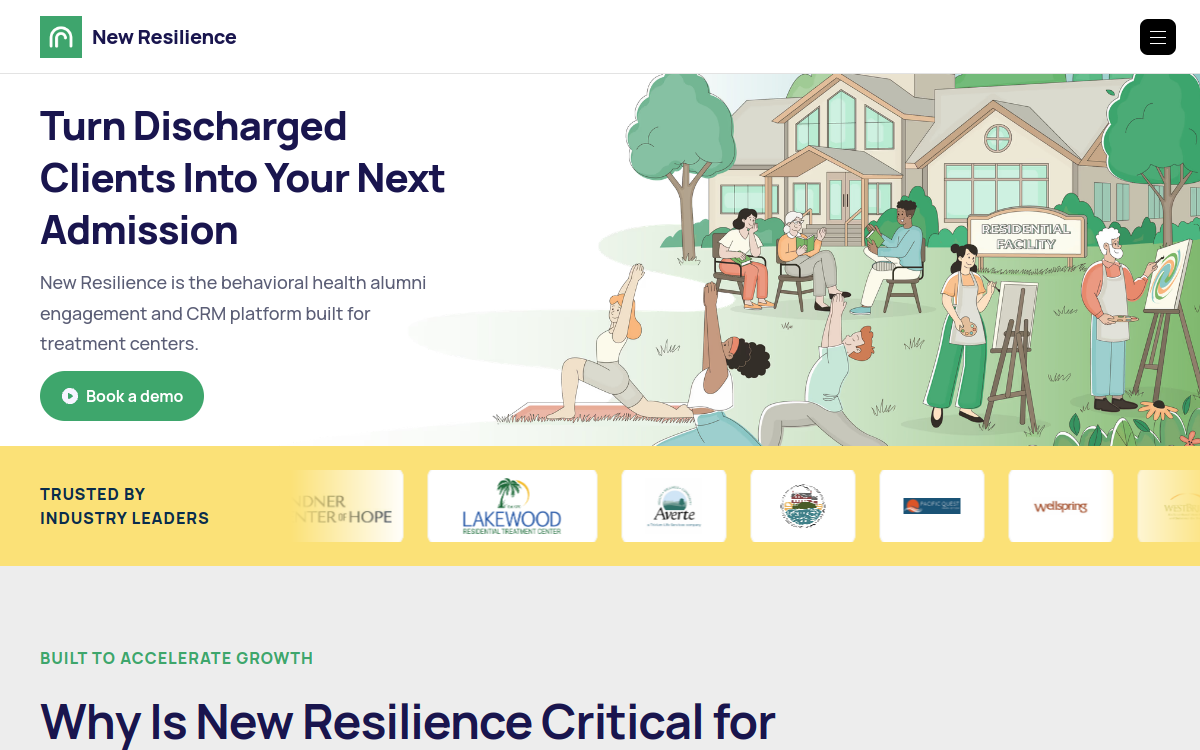
In the behavioral health sector, losing contact with a patient after discharge often means losing an opportunity for follow-up, or even readmission when it is most needed. New Resilience tackles this exact problem by offering a CRM designed for addiction, mental health, and eating disorder treatment centers. The stated promise is direct: convert discharged clients into future admissions through structured engagement that complies with the sector’s regulatory requirements. While many facilities still juggle spreadsheets, faxes, and disconnected marketing tools, the platform centralizes admissions, marketing, and alumni tracking in a single secure environment. The goal is not just to manage a contact database, but to keep a living connection with former patients while respecting the HIPAA, JCAHO, and CARF constraints that govern these facilities. For an admissions or marketing manager in a small to medium-sized clinic, it is a response to a very concrete need: to stop letting leads slip away due to a lack of follow-up.
What is New Resilience?
The essentials
New Resilience is a verticalized CRM platform for behavioral health providers: detox centers, residential programs, PHP, IOP, and outpatient services. Unlike a general-purpose CRM, it was designed around the workflows specific to this sector: admissions management, marketing tracking, inter-facility referral networks, and former patient (alumni) engagement. The platform is advertised as HIPAA-compliant and offers reporting tailored to JCAHO and CARF accreditations. It is organized around several building blocks: an admissions and marketing CRM, an Alumni Management module, a community for connecting centers, and options like benefits verification. The entire suite targets small and medium-sized organizations looking to professionalize their follow-up without deploying a heavy technical stack.
Key features
The core of the tool is a CRM covering admissions and marketing, with ready-to-use reporting and an integrated referral network. Starting with the Standard plan, the platform adds integrations with EHR systems, call tracking, Gmail and Outlook email synchronization, as well as a client portal that replaces faxing medical records. Email campaigns and smart automated follow-ups are also part of this tier. The Professional plan introduces AI-assisted medical record evaluation and customizable reporting dashboards. The Alumni Management module, offered as an add-on, is the one that leverages artificial intelligence the most: it sends automated, personalized text messages to discharged clients, monitors risk, relapse, and readmission signals in real time, and integrates sentiment analysis, drip campaigns, Google review requests, and re-engagement tools. iPhone and Android apps complete the setup for mobile teams, and each plan includes a set number of custom workflows, from 1 to 10 depending on the tier.
Use cases
A residential center can use New Resilience to centralize its admission requests, track the origin of each lead, and avoid losses associated with manual follow-up. A marketing team can use it to measure the correlation between their actions and referral growth, thanks to better data observability. The Alumni module is particularly useful for outpatient and IOP programs that want to maintain a connection after discharge: the AI identifies former patients whose interactions indicate a risk of relapse and triggers personalized follow-ups. Multi-site facilities leverage the community to exchange referrals and coordinate care. Finally, the benefits verification feature, billed per request, helps admissions teams quickly validate the eligibility and coverage of prospective patients prior to admission.
Advantages
The main benefit is the reduction of lost opportunities: by staying in touch with alumni and detecting relapse signals early, a center can turn discharges into new admissions instead of letting these opportunities vanish. Native HIPAA compliance and JCAHO/CARF reporting reduce the administrative burden associated with accreditations, which is often time-consuming in this sector. Centralizing admissions, marketing, and alumni tracking avoids dispersion across disconnected tools and improves visibility into commercial performance. Mobile apps allow teams to capture a lead or file wherever they are, limiting oversights. Finally, the rapid deployment, announced in a few weeks, and customizable workflows make it possible to adapt the platform to existing processes without a lengthy overhaul.
Pricing
New Resilience offers three monthly plans. The Basic plan at $200/month includes the CRM, reporting, mobile apps, access to the referral network, one custom workflow, and three seats. The Standard plan at $650/month adds EHR integrations and call tracking, Gmail/Outlook sync, the client portal, email campaigns, automated follow-ups, three workflows, and unlimited users. The Professional plan, recommended at $1,100/month, adds AI medical record evaluation, customizable reporting dashboards, ten workflows, and 24/7 white-glove support. The Alumni Management module is billed on a custom quote basis, and benefits verification costs $1 per request. Free demos are available by appointment.
Conclusion
New Resilience is not a CRM for everyone, and that is precisely its strength. By focusing on behavioral health centers, it addresses needs that general-purpose tools ignore: HIPAA compliance, accreditation reporting, and AI-driven alumni engagement. For a small or medium-sized US facility looking to stop losing leads and convert former patients back into admissions, the platform is a credible and well-targeted option. Outside of this vertical, however, it has little reason to exist. The best way to evaluate it remains the free demo offered by the publisher.