



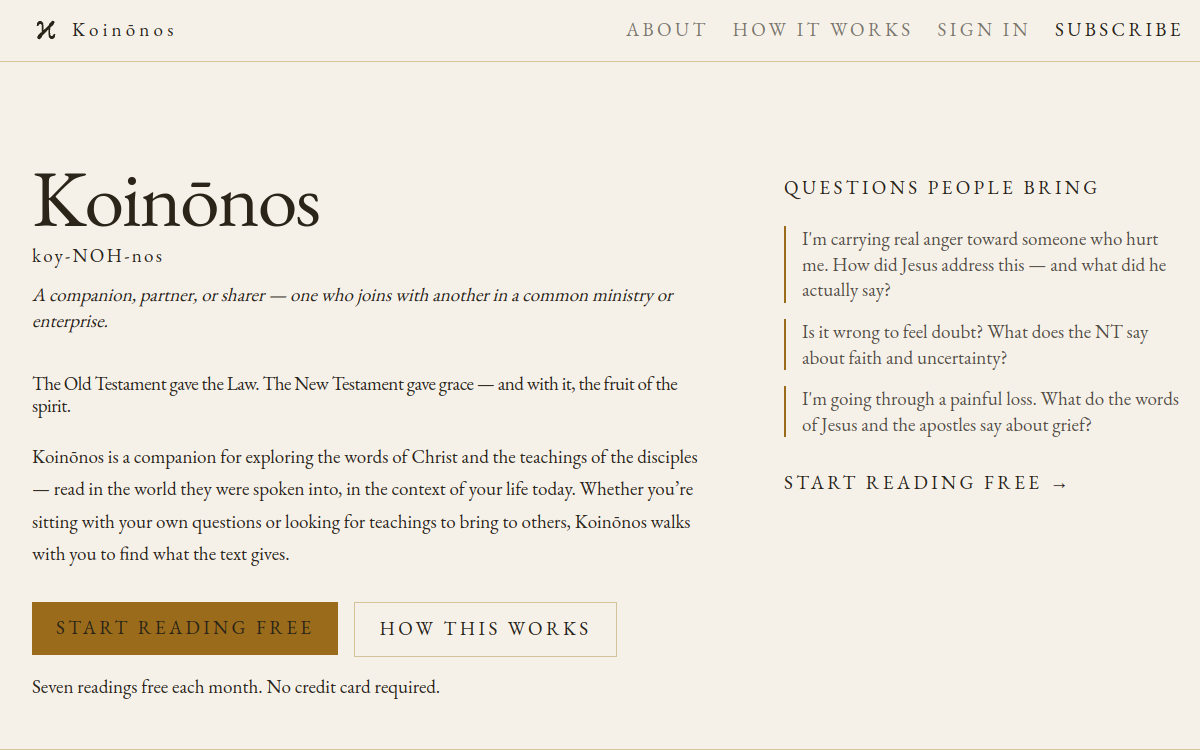
Reading the New Testament often presents a difficulty: a text written in Greek two thousand years ago, in a long-gone Mediterranean culture, reaches us through modern translations that sometimes freeze the meaning. Koinōnos offers a different approach. This tool helps explore the teachings of the New Testament by placing them back into the world where they were spoken, while connecting them to the concrete questions of today’s life. Rather than providing a ready-made answer, it starts from a personal question to find the relevant passages, offer translations from the original Greek, and restore the historical and cultural context of the first century. The positioning is explicit: Koinōnos is not an advice application, but a tool for discovery and exploration. It holds the lamp without telling you what to conclude. This page details what it does, how it works, who it is for, and what can be expected from it, based on the information published by the publisher. The goal is to give you a clear vision before trying the seven free readings offered each month.
What is Koinōnos?
The essentials
Koinōnos is a New Testament study companion. Its name comes from a Greek word evoking fellowship and sharing. Concretely, the user asks a question, for example about anger, doubt, grief, social inclusion, or conflict resolution in Paul’s letters. The tool then identifies the relevant teachings, brings up the Greek words when the meaning relies on a specific term, and places everything back into the original cultural and historical framework. It offers fresh translations from the Greek rather than using established versions like the KJV or NIV. The guiding principle is neutrality: Koinōnos does not take sides, does not moralize, and does not offer any prescribed conclusion. It defines itself as a tool for discovery, not a dispenser of opinions.
Key features
Several features structure the experience. First, question-based search: instead of navigating through chapters, the user formulates a query in natural language and the tool finds the relevant passages. Second, fresh translations from the original Greek, which avoid dependence on a single version and allow comparing multiple renderings of the same passage. Greek vocabulary analysis is a third pillar: when the meaning of a verse depends on a specific word, the tool highlights this term and its semantic field. Next comes the restoration of the first-century historical and cultural context, which sheds light on sentences whose scope might escape a modern reader. Finally, the posture of neutrality is itself an assumed characteristic: readings are presented as unbiased and independent of traditions, with no imposed conclusion. The whole forms a coherent system, oriented towards understanding the text in its world rather than towards a normative application. The tool exemplifies cases such as the interpretation of a phrase like ‘the truth will set you free’, illustrating this link between question, passage, Greek word, and context.
Use cases
The use cases cover several profiles. A person on a personal spiritual journey can ask the tool about an emotion or a situation, such as grief or a relationship conflict, and discover how the New Testament texts address it in their original setting. A reader curious about philology can explore the meaning of a verse by relying on the underlying Greek word and comparing translations. Someone preparing a lesson, a Bible study, or a group discussion can use it to gather relevant passages and their context before presenting a topic to others. Finally, anyone intrigued by a famous phrase in the text can search for its real meaning rather than its common reading. In all cases, the tool remains a starting point for exploration, never a verdict.
Advantages
The main benefit is direct access to a contextualized reading without prior expertise in ancient Greek or first-century history. Where such a study would usually require several books and lexicons, Koinōnos centralises translation, vocabulary, and context around a concrete question. The claimed neutrality offers another advantage: the user retains their freedom of interpretation, which is equally suited to different sensitivities and an honest teaching approach. The question-and-answer format makes exploration intuitive and fast, avoiding chapter-by-chapter navigation. Finally, the offer of seven free readings each month, with no credit card required, allows evaluating the tool’s utility before any financial commitment. For anyone wanting to understand a passage in depth, the gain in time and clarity is tangible.
Pricing
The business model is based on a free tier and a subscription. The free version gives access to seven readings per month, with no credit card required, which is enough to test the tool and judge its relevance. Beyond this quota, a subscription plan is offered for more intensive use. To date, the publisher’s website does not disclose the amount or currency of this subscription, nor the precise details of what it includes compared to the free tier. It is therefore advisable to start with the free readings, then consult the tool directly when subscribing to find out the current pricing conditions.
Conclusion
Koinōnos meets a specific and well-identified need: to understand the teachings of the New Testament in the language and world where they were formulated, without an imposed interpretation. Its combination of translations from the Greek, vocabulary analysis, and historical context makes it a useful study companion, both for personal research and for lesson preparation. The monthly free offer allows trying it risk-free. It remains to clarify the subscription price before regular use. For anyone looking to read the text more closely rather than receive instructions, the tool is worth a try.