


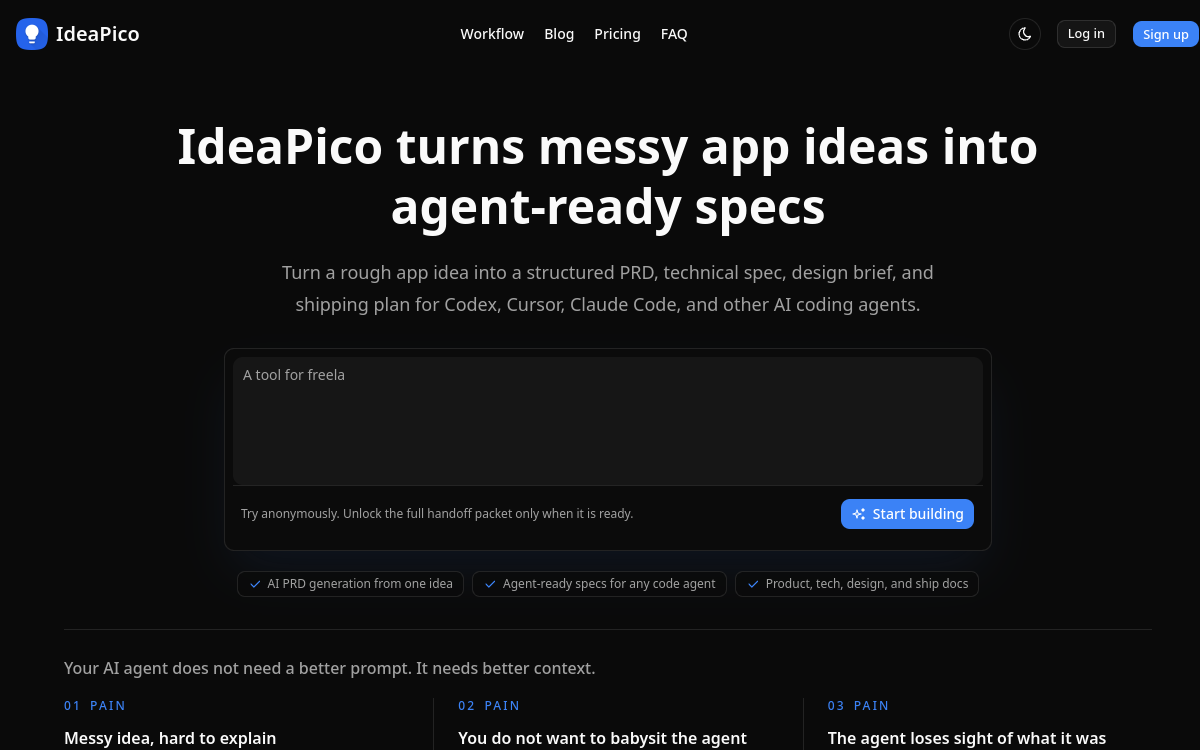
AI-assisted development has changed the way we build applications: agents like Claude Code, Cursor, or Codex can now generate a large part of the code from instructions. But these agents remain dependent on the quality of the context they are provided. A poorly defined idea, vague technical decisions, or an incomplete product scope lead to back-and-forth, code rewrites, and sessions interrupted halfway through. This is precisely the problem IdeaPico aims to solve. Instead of producing code, the tool focuses on the step that precedes it: transforming a still-rough application idea into a structured specification package that can be used directly by a code agent. Through an adaptive Q&A interview, IdeaPico helps the creator clarify their choices, then assembles a set of documents ready to serve as a working foundation. This article details what IdeaPico actually does, how it works, who it is for, its concrete advantages, and its pricing model, to help you judge if it has a place in your workflow.
What is IdeaPico?
The essentials
IdeaPico is an online tool that converts an application idea, even a partial one, into a complete specification document intended for AI code agents. Its operation is based on an adaptive interview: the tool asks targeted questions to understand the project, then generates four distinct documents. The first describes the product (scope, user journeys, edge cases, acceptance criteria). The second covers the technical aspects (architecture, data models, APIs, build plan). The third focuses on design (design system, screen rules, components). The fourth concerns production deployment (configuration, verification, release checklist). The central idea is to provide code agents with a complete build context, rather than instructions improvised on the fly.
Key features
The flagship feature of IdeaPico is the generation of four separate Markdown documents: product.md, tech.md, design.md, and ship.md. Each covers a dimension of the project, allowing for a clear isolation of product, technical, design, and deployment decisions. Upfront, the adaptive Q&A interview guides the user to make important decisions before development, rather than discovering them along the way. Once the documents are ready, IdeaPico offers a one-click handoff: a copy instruction allows the context to be transferred directly to the chosen code agent. The tool displays explicit compatibility with a wide range of agents: Codex, Claude Code, Cursor, Bolt.new, Windsurf, v0.dev, and GitHub Copilot. An auto-fetch capability is also mentioned, allowing agents to retrieve documents directly from repositories. The overall goal is to reduce build interruptions and rework caused by incomplete decisions. The result is a package of four documents obtained in just a few minutes, starting from an initially poorly formed idea.
Use cases
IdeaPico is primarily aimed at people who want to build an application with the help of code agents but do not necessarily master the art of prompt engineering. A typical use case is creating a first application: the user describes their idea, answers the questions, and gets a structured brief they wouldn’t have known how to write on their own. Another use case is preparing the context before a coding session: instead of starting a session with vague instructions, the agent is supplied with clear documents from the start. IdeaPico also helps reduce rework by locking in scope, architecture, and design decisions before any code is written. Founders, product managers, designers, and indie builders find it a quick way to scope a project and avoid blank-page syndrome when facing a code agent.
Advantages
The main benefit of IdeaPico is the gain in clarity before coding. By forcing key decisions through the interview, the tool limits ambiguities that generate errors and downstream rework. The separation into four documents makes it easy to read, modify, and share among different project stakeholders. Compatibility with numerous code agents prevents being locked into a single ecosystem: the same spec package can feed Claude Code, Cursor, or Bolt.new depending on preferences. The one-click handoff reduces friction between the scoping phase and the development phase. Finally, the pay-per-use model, with no subscription, is well-suited for one-off projects: you pay for what you actually use, with no recurring commitment.
Pricing
IdeaPico operates without a subscription, on a pay-per-project model. A single project costs $49. The pack of three projects is billed at $129, or about $43 per project, and the pack of ten projects is $399, or $39.90 per project. Logged-in users benefit from a free trial credit to test the tool, valid for thirty days according to the displayed information, while purchased credits have a longer validity. This model is suitable for creators who launch projects occasionally rather than teams producing continuously. For very frequent iterations, the cumulative cost per project should be anticipated.
Conclusion
IdeaPico occupies a useful niche in the AI-assisted development workflow: it does not code, but it prepares the ground so that code agents can work with a solid context. Its generation of four structured documents, its adaptive interview, and its compatibility with major agents make it a coherent complement for founders, product managers, and indie builders. The pay-per-project model, with no subscription, remains reasonable for occasional launches, provided you anticipate the cost in case of repeated iterations. If you are starting a project and looking to clarify your brief before launching an agent, IdeaPico is worth a try thanks to its free credit.