



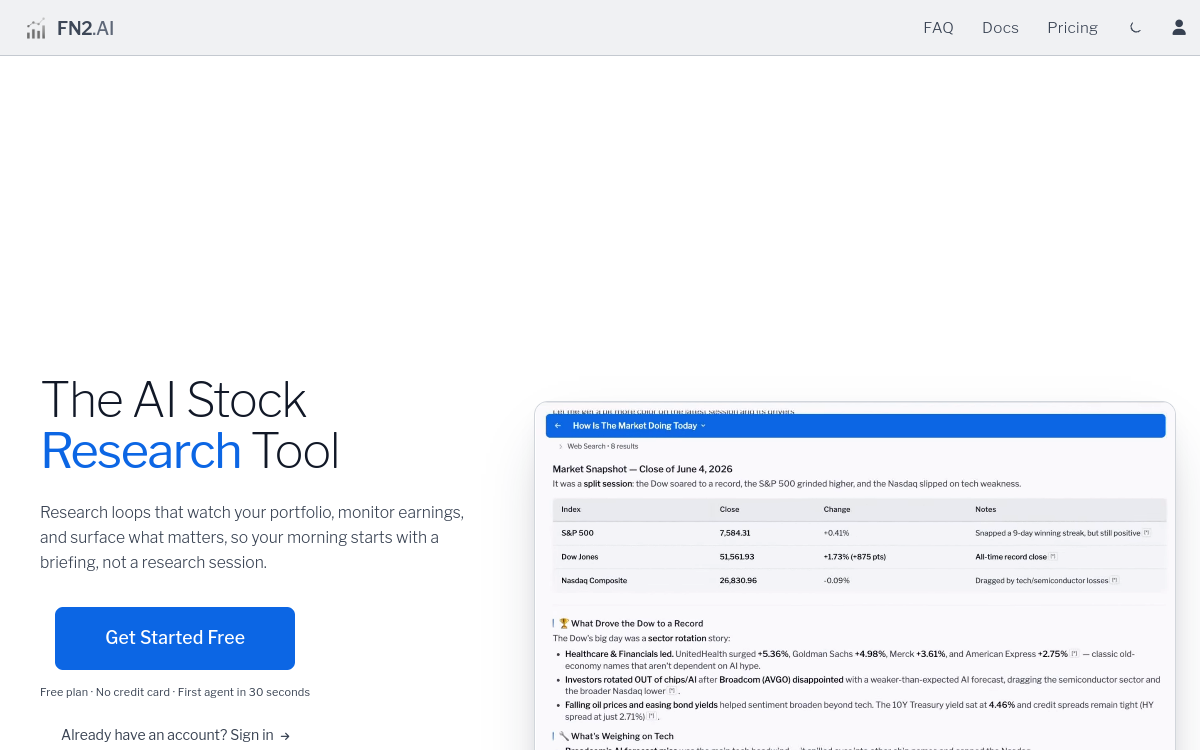
Tracking an investment portfolio requires digesting a continuous stream of information: quarterly earnings, macroeconomic announcements, sector movements, conference call transcripts. For an individual as well as a manager, time quickly runs short. FN2 proposes to delegate this monitoring to autonomous research agents, who monitor the markets and bring up the essentials in the form of ready-to-read summaries. Its promise, summarized by the phrase ‘answers, not homework’, well reflects its ambition: to spare the tedious work of collection and analysis to deliver only useful conclusions. This article examines what these agents actually do, what data they rely on, who the tool is for, and how much it costs, without losing sight of its limitations.
What is FN2?
The essentials
FN2 is a platform of artificial intelligence-based research agents dedicated to financial tracking. Its positioning consists of automating the research workflows that investors usually perform by hand. Rather than a simple chatbot, FN2 offers specialized agents, each responsible for a specific mission and capable of working in the background. The platform is aimed at individual investors and portfolio managers who want briefings and analyses without spending hours on them. An essential point distinguishes the tool: it relies on public and verifiable data, and explicitly points out that it does not provide financial advice. FN2 therefore presents itself as a research assistant, whose value lies in the speed and structuring of information, and not in a buy or sell recommendation.
Key features
FN2 is organized around a series of agents with defined roles. The morning briefing produces an analysis before the markets open in about ten seconds. The earnings monitor evaluates company publications, with a beat/miss scoring and executive quotes, to quickly grasp the tone of a quarter. The thesis tracker periodically verifies the validity of an investment thesis. Macro monitoring tracks rates and the yield curve, while the sector scanner ranks sectors according to their fundamentals. Added to this is the ability to create a custom agent, configured according to the user’s own needs. The data used comes from recognized public sources: Polygon.io for market data, SEC EDGAR for regulatory filings, the FRED database for economics, as well as millions of earnings transcript segments. This combination of fast agents and verifiable sources makes it possible to transform a mass of raw data into readable summaries, delivered in seconds rather than after a long manual search.
Use cases
The use cases of FN2 follow an investor’s daily routine. Before the opening bell, an individual consults their morning briefing to know what might affect their positions. During earnings season, they rely on the dedicated monitor to quickly understand if a company beat or missed expectations. A manager uses the thesis tracker to verify that their hypotheses still hold, or macro monitoring to anticipate the effect of a rate decision. A market-curious profile explores the sector scanner to identify the best-positioned sectors. Finally, a user with specific needs creates their own agent to automate custom monitoring. In all cases, the tool serves to save time on collection and formatting, leaving the final decision to the human.
Advantages
The primary benefit of FN2 is the time saved: delegating monitoring to agents avoids hours of reading and cross-referencing. The second is structuring: the delivered summaries are directly actionable, whereas raw data requires analysis effort. Anchoring on verifiable public sources, such as SEC EDGAR or FRED, strengthens confidence in the results. The ability to create custom agents adapts the tool to various strategies. Finally, the free plan allows testing the approach risk-free. These assets make FN2 a useful research assistant for anyone wanting to actively follow the markets without drowning in information, while keeping in mind that the tool informs but does not advise.
Pricing
FN2 offers several tiers in dollars. The free plan offers about 200 chats per month and one daily background agent, with no credit card required, allowing you to test the tool. The Pro plan, at $29 per month, increases the volume to about 4,000 monthly chats, adds hourly and daily agents, advanced charts, exports, and priority research capacity. The Max plan, at $89 per month, offers about 20,000 chats, expanded access to agents, the highest individual capacity, and priority support. This progression by query volume and agent capabilities allows aligning the expense with the desired intensity of monitoring, from occasional tracking to in-depth daily surveillance.
Conclusion
FN2 illustrates the value of autonomous agents applied to financial research: automating monitoring, structuring information, and delivering rapid summaries from verifiable public sources. For an individual investor or a manager, it is an effective way to save time on collection and analysis. Its limitations must be kept in mind: lack of financial advice, coverage focused on US markets, quotas per plan, and the need to cross-reference summaries. Used as a research copilot rather than an oracle, FN2 finds its full relevance.