



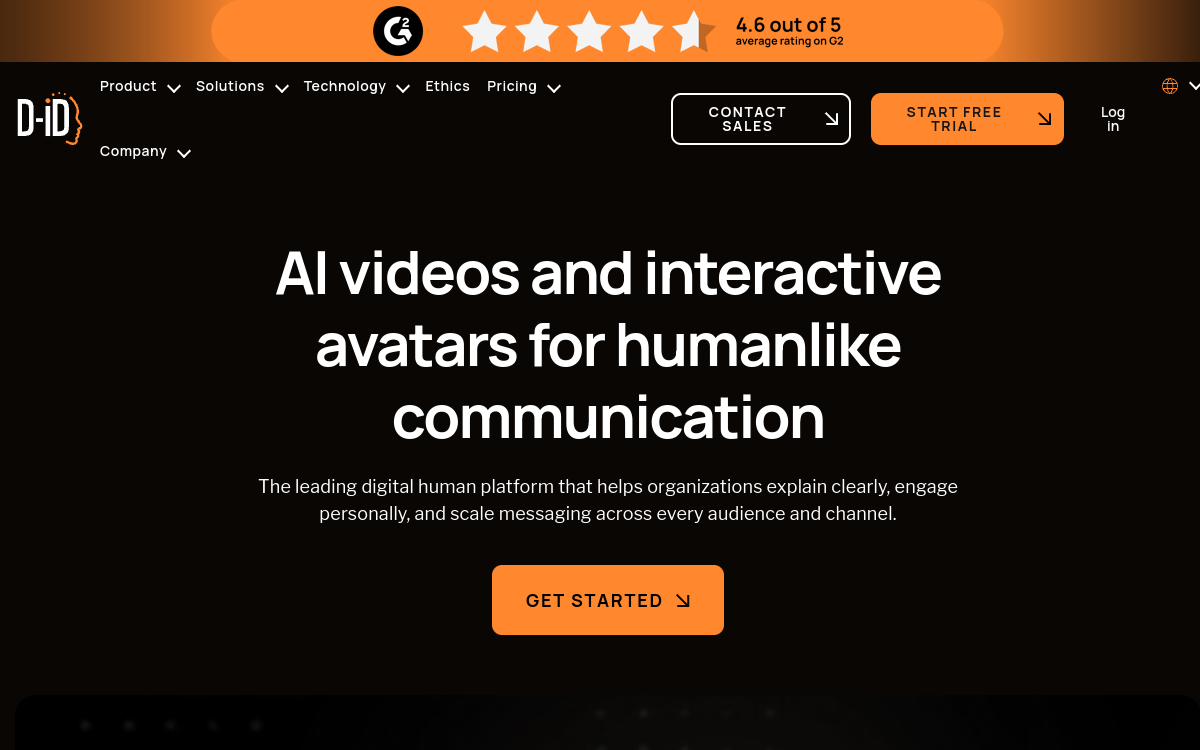
Creating a video where a character speaks to camera once required filming, an actor, and an editing studio. D-ID radically changes this equation by generating speaking video avatars from a simple photo and text script. Presented as the leading digital human platform, the solution helps organizations explain clearly, engage personally, and deliver their messages across all channels. Concretely, you provide a face image and the text to be spoken; D-ID then animates the face, adds synthetic voice, and synchronizes the lips to produce smooth video. Beyond this self-service studio, the company offers real-time conversational avatars, an API for developers, and video translation features. This article details what D-ID really is, its named features, concrete use cases, advantages, observed pricing, and our conclusion, to help you judge whether the tool meets your video production and digital avatar needs.
What is D-ID?
The essentials
D-ID is a digital human platform built on a flagship product, Creative Reality Studio. This studio transforms a photo and script into a speaking avatar video, with synthetic voice and lip synchronization. The ecosystem also includes Visual AI Agents, conversational avatars capable of real-time dialogue, as well as an API for developers wanting to integrate these capabilities into their own applications. Added to this are features like Video Translate for multilingual support and video campaign modules oriented toward marketing. The platform accepts JPEG, JPG, and PNG images, supports 120+ languages, and exports videos in MP4 format. It is used by major brands like Microsoft, Coca-Cola, and Warner Bros.
Key features
The core of D-ID is video avatar generation: from a face photo and text, the tool produces a character that speaks with realistic lip synchronization. The voice can be generated via speech synthesis or cloning, and the platform covers 120+ languages, making it easy to localize the same content for different markets. Visual AI Agents add a conversational dimension: avatars respond in real-time, useful for customer support or interactive experiences. The Video Translate feature allows you to adapt existing videos into other languages. On the input side, D-ID accepts JPEG, JPG, and PNG files up to 10 MB, and can even generate portraits from text using technology similar to Stable Diffusion. Output is in MP4 format, up to 1280×1280 pixels (1080p on Premium plans), for a maximum duration of 5 minutes. Finally, the developer API and integrations with PowerPoint, Canva, and Google Slides allow you to insert avatar creation directly into existing workflows without changing tools.
Use cases
D-ID use cases span multiple industries. In marketing, teams produce personalized videos at scale, for example messages tailored to each audience segment. In sales, avatars serve to create product demos and animated presentations. Training and L&D departments generate video lessons and AI tutors capable of delivering educational content in multiple languages. On the customer experience side, Visual AI Agents power support videos and continuously available agents. Content creators, meanwhile, build digital twins to repurpose their messages across multiple languages without returning to the camera. Finally, developers leverage the API to integrate avatar generation into their own products, whether educational applications, embodied chatbots, or communication platforms.
Advantages
The main benefit of D-ID is removing the production barrier: no need for filming, actors, or studios to get a video where a face speaks. Coverage of 120+ languages allows you to localize a message quickly and reach international audiences from a single starting script. Lip synchronization and voice cloning deliver credible output suited to professional contexts. Integrations with PowerPoint, Canva, and Google Slides avoid switching work environments, while the API opens the door to custom uses and automation. For businesses, real-time conversational avatars offer a new interaction channel, available continuously, that can relieve human teams from repetitive tasks.
Pricing
D-ID offers a free trial to discover the studio, but videos generated in this context feature a full-screen watermark, as does the Lite plan. The latter starts around $5.99 per month with a limited number of minutes. Mid-tier plans (like Pro) remove the watermark and increase the volume of minutes, while the Advanced tier, at around $299 per month, includes more minutes, full API access, and commercial rights. An Enterprise plan on quote adds extended minutes, advanced security, and dedicated support. Note: monthly minutes do not roll over and are reset to zero each month. It’s best to size your plan based on your actual consumption.
Conclusion
D-ID is a mature and widely-adopted solution for anyone wanting to produce speaking video avatars without filming, in a large number of languages. Creative Reality Studio, Visual AI Agents, and the API make it a versatile platform, useful for marketing, training, sales, and customer service. Constraints (watermark on entry-level plans, videos limited to 5 minutes, non-rollover monthly minutes, and a pricey Advanced tier) must be considered before committing. If your need revolves around reliable, multilingual digital avatars, D-ID clearly deserves testing via its free trial before choosing a plan suited to your volume.