


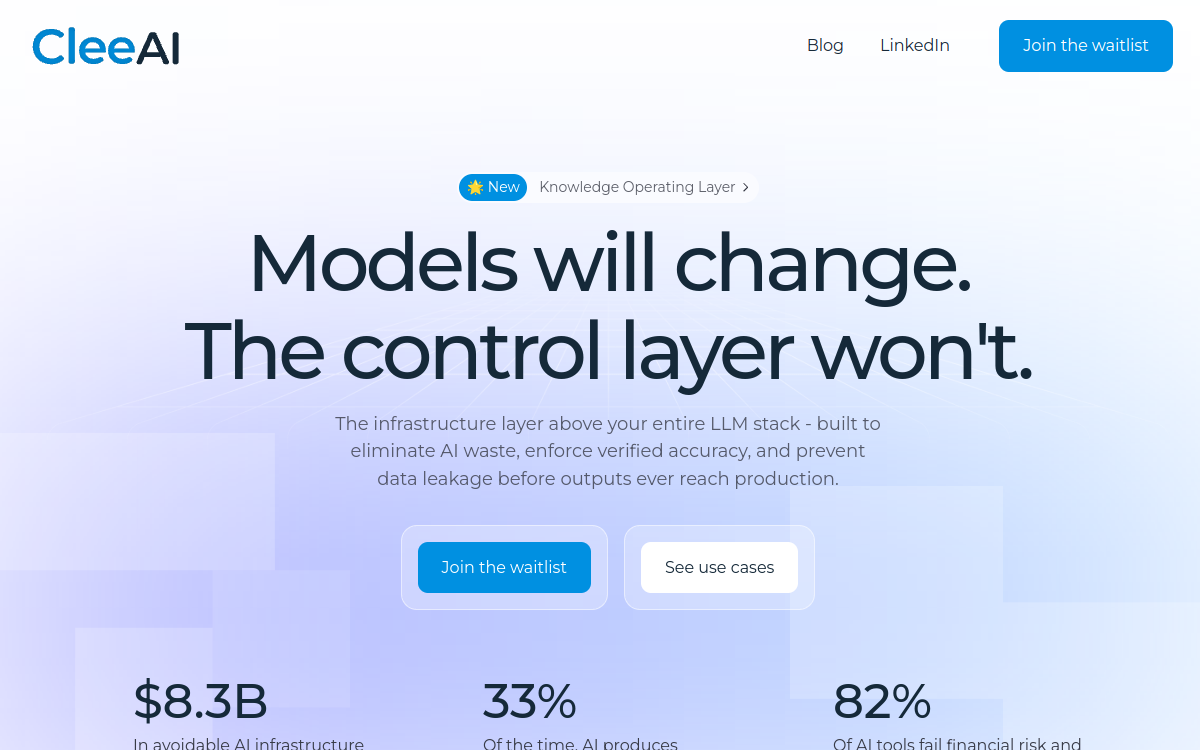
The rise of language models has opened immense possibilities, but it has also created very real risks for enterprises: fabricated responses, sensitive data leaks, regulatory compliance failures. In regulated sectors like healthcare, pharmaceuticals, or finance, these errors are not mere inconveniences—they can result in heavy penalties and loss of trust. This is precisely the problem CleeAI LKM seeks to solve. Rather than offering yet another language model, the tool takes a different approach: positioning itself as an intermediate layer between an organization’s applications and the foundation models it uses. This layer orchestrates requests, verifies responses, and applies compliance rules before the model is even called upon. In this overview, we examine what CleeAI concretely offers, how it works, who it addresses, and what its pricing tiers reveal. The goal is to understand how this infrastructure approach distinguishes itself from standard AI assistants and in what contexts it delivers real added value.
What is CleeAI LKM?
The essentials
CleeAI LKM, for Large Knowledge Model, defines itself as a knowledge exploitation layer. Concretely, it is an infrastructure building block that sits between an enterprise’s applications and foundation models like those from major AI providers. The publisher sums up its position in a simple formula: it is not another LLM, but a layer above them. Its role is threefold. First, it manages request routing toward the most relevant and most cost-effective model according to need. Second, it verifies the responses produced by anchoring them in confirmed sources, in order to block hallucinated content. Finally, it enforces compliance policies by intercepting requests before they reach the model. This logic makes it more a governance tool than a content generator.
Key features
CleeAI rests on several named functionalities that structure its offering. Request routing directs each query toward the most cost-effective model, allowing you to optimize AI usage costs without sacrificing relevance. The verification layer anchors responses in reliable sources and blocks hallucinations, a critical point for high-stakes use cases. Compliance safeguards are applied upstream of the model, not slipped into the prompt: this means rules are enforced at the infrastructure level, making them more robust and harder to circumvent. The tool also evaluates the intent and context of each request against compliance policies defined by the organization. Data exfiltration prevention intercepts sensitive requests before any model access. Finally, comprehensive audit logs record all requests, providing the traceability essential for meeting regulatory requirements. This coherent set aims to make AI deployment simultaneously secure, cost-effective, and compliant.
Use cases
The highlighted use cases illustrate the tool’s orientation toward high-stakes environments well. In clinical research, CleeAI aims to prevent the production of hallucinated medical evidence, which could mislead healthcare decisions. In financial research, it blocks the fabrication of non-existent metrics or fictitious analyst reports, errors that could skew investment decisions. In banking and finance, the tool intercepts requests attempting to circumvent regulatory rules. On the banking compliance side, it seeks to eliminate rule drift in anti-money laundering and know-your-customer processes. These scenarios share a common denominator: sectors where an incorrect response or regulatory failure has serious consequences, and where a systematic control layer delivers real peace of mind.
Advantages
CleeAI’s primary benefit lies in its ability to reconcile three often-competing objectives: cost control, response reliability, and regulatory compliance. By routing requests to the most cost-effective models, it avoids overpaying for premium model calls when unnecessary. By verifying responses, it reduces the risk of costly hallucination-related errors. By enforcing rules at the infrastructure level, it offers stronger compliance guarantees than a simple instruction in a prompt. For organizations subject to frameworks like the EU AI Act, the FCA, or the FDA, comprehensive audit logs facilitate compliance demonstrations. This approach thus enables AI deployment in sensitive contexts while maintaining control over risks.
Pricing
The site displays three pricing tiers. The Basic plan is free and allows up to five users, which lets you test the approach at small scale. The Pro plan costs $199 per month for a maximum of twenty users, suited for growing teams. The Enterprise plan is $399 per month for up to fifty users, intended for larger deployments. The product is also offered in early access, with waitlist registration and individual candidate selection. It is worth noting that these tiers still appear relatively generic and could evolve to more precisely reflect the LKM offering as commercialization progresses.
Conclusion
CleeAI LKM offers a pragmatic answer to a concrete problem: how to deploy AI in regulated sectors without sacrificing reliability or compliance. By positioning itself as a governance layer between applications and models, it combines cost-effective routing, anti-hallucination verification, and regulatory safeguards. This infrastructure orientation clearly reserves it for technical teams in enterprises facing strong constraints, rather than for mainstream users. With the product still in early access, it merits close attention from any organization that must combine AI adoption with strict regulatory requirements.