


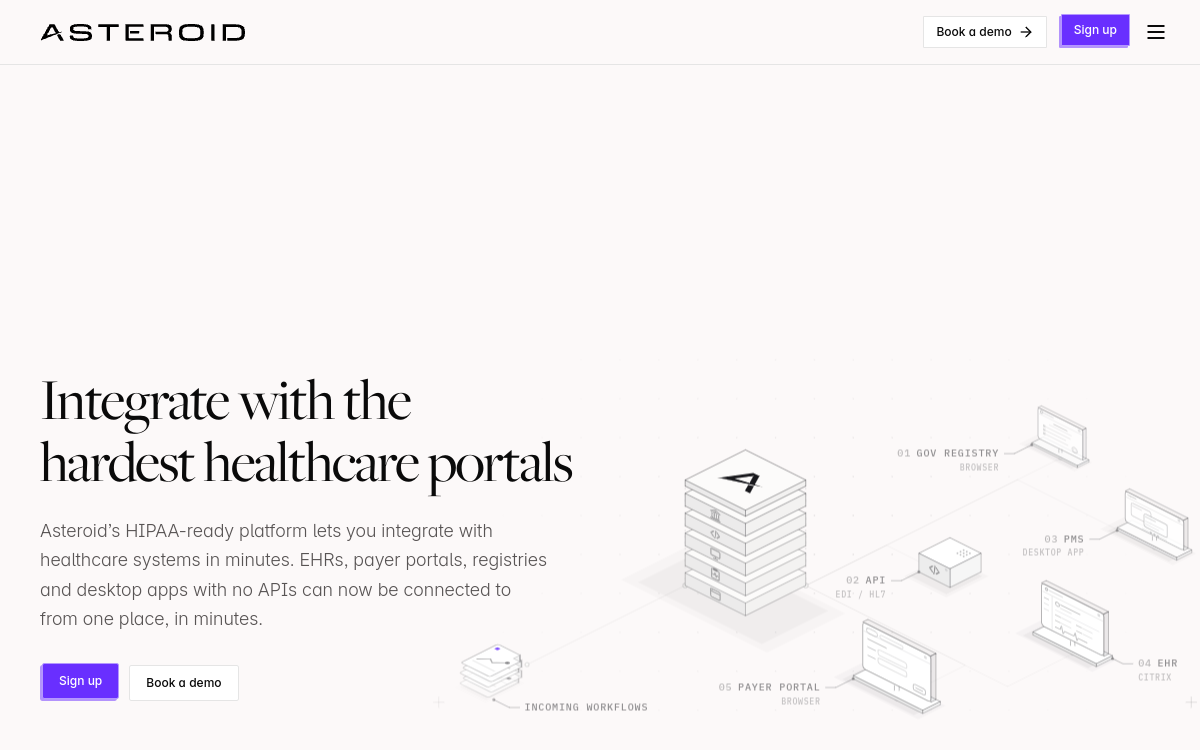
Automating a workflow that goes through a complex web portal is often a headache. APIs don’t always exist, traditional RPA breaks at the slightest interface change, and outsourcing to offshore providers is expensive and slow. Asteroid offers a third way: deploy AI agents capable of navigating web portals as a human would, to execute repetitive business tasks end-to-end. The platform particularly targets healthcare and insurance sectors, where processes pass through dozens of carrier portals, EHR systems, and eligibility forms. By relying on existing interfaces rather than custom integrations, Asteroid promises faster and more robust deployment. In this overview, we detail what the tool actually does, its features, real-world use cases, benefits, pricing, and who it makes the most sense for.
What is Asteroid?
The essentials
Asteroid is a browser-oriented AI agent platform designed to automate enterprise workflows without resorting to classic RPA, custom connectors, or outsourcing. Concretely, you describe an operating procedure and the platform transforms it into an agent capable of executing it in a browser. Agents also work on Windows and Linux, which expands their reach to desktop software. Asteroid positions itself in regulated and demanding sectors: healthcare, insurance, and post-call automation for AI voice solutions. Its HIPAA compliance and SOC 2 Type II certification make it a serious candidate for environments where data security is critical.
Key features
Asteroid structures its operation around four pillars. The first, Build, converts standard operating procedures into functional agents, accessible via an AI agent builder. The second, Run, deploys these agents on browser, Windows, and Linux as needed. The third, Supervise, offers real-time supervision: you can monitor execution, intervene, and guide the agent live, which reduces the risk of error on sensitive tasks. The fourth, Connect, ensures integration with already-in-place systems. The platform also offers API and MCP access, concurrent browsers (5 on the base offering to 100 on the Scale offering), and compliance functions like BAA for HIPAA. On the security side, Asteroid displays HIPAA compliance, SOC 2 Type II certification, and third-party penetration testing, all guarantees sought by healthcare and insurance organizations.
Use cases
The highlighted use cases are very operational. In healthcare, Asteroid handles prior authorization submission and tracking, data entry and integration with electronic health records (EHR), as well as eligibility verification. In insurance, agents generate quotes and handle renewals on various carrier portals. The platform also handles post-call workflow automation for AI voice solutions, invoice retrieval from supplier portals, reporting in Google Sheets, and processing grant applications. The common point of these uses: repetitive tasks, heavily based on web portals, where direct integration is difficult or impossible. Teams like Moonset Health, Thyme Care, Vitable, and CollegeVine are among over 100 user teams.
Advantages
The primary benefit of Asteroid is automating processes that have resisted automation until now, due to lack of APIs or unstable interfaces. By working directly in the browser, agents avoid the cost and fragility of custom integrations. Real-time supervision provides a valuable safety net for regulated operations, allowing a human to take over if needed. HIPAA and SOC 2 Type II compliance lifts a major obstacle for healthcare actors. Finally, replacing offshore teams with agents allows you to gain speed and consistency while freeing business experts from repetitive, low-value-add tasks.
Pricing
Asteroid offers four tiers. The Individual plan starts at $30/month on a pay-as-you-go basis, with 5 concurrent browsers, unlimited members and agents, plus access to the builder and API/MCP. The Startup plan is $300/month (with $300 credits included), 25 concurrent browsers, a BAA for HIPAA, and agent minutes at a reduced rate ($0.15/min vs. $0.20/min). The Scale plan is $3,000/month with 100 browsers, a dedicated AI engineer, SLAs, and minutes at $0.12/min. The Enterprise plan offers custom credits and pricing. Per-minute pricing covers runtime, agent actions, and LLM costs.
Conclusion
Asteroid is for organizations that lose hours on web portals and want to automate these tasks without a heavy integration project. Its approach with supervised browser agents, multi-environment coverage, and HIPAA and SOC 2 Type II compliance make it particularly relevant for healthcare and insurance. The per-minute agent cost requires careful monitoring at scale, and the tool is clearly intended for professional use. For the teams it targets, it’s a modern and credible solution versus traditional RPA and outsourcing.