



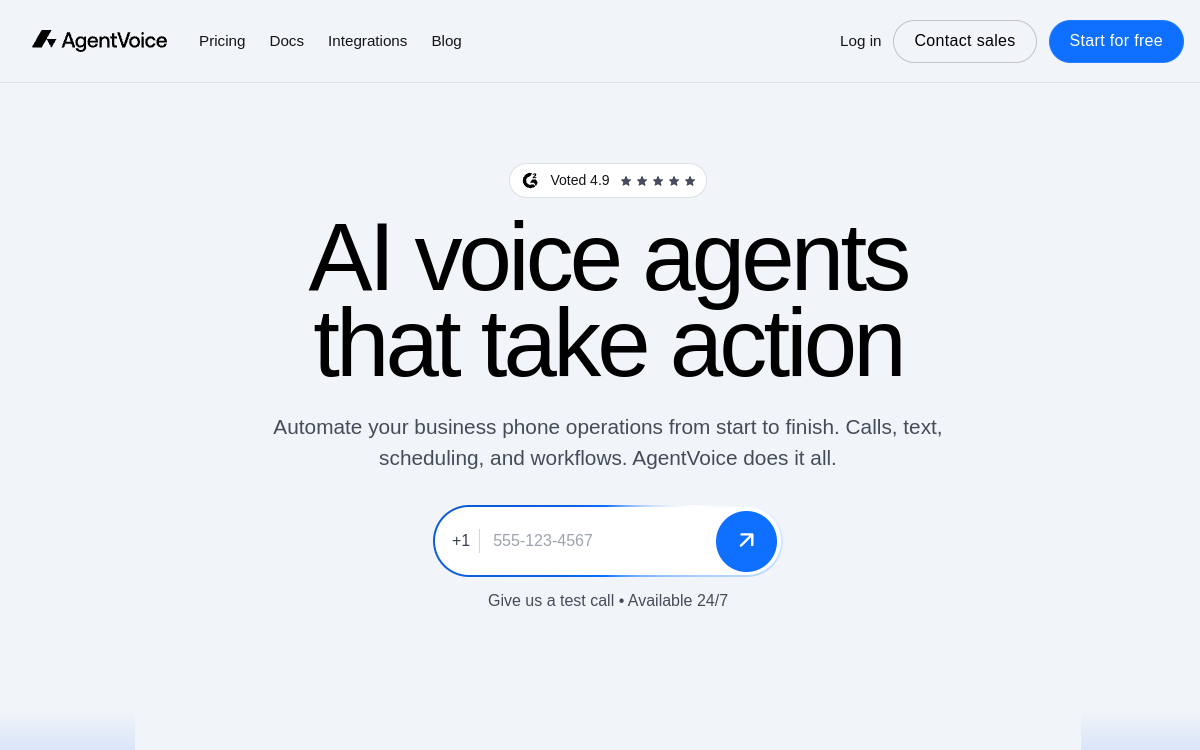
Answering the phone, qualifying a lead, scheduling an appointment, then updating the CRM: these repetitive tasks consume considerable time in operational teams. AgentVoice proposes delegating them to AI voice agents capable not only of holding a natural conversation, but also of taking concrete action on your tools. The platform positions itself as a complete telephony automation layer, covering both inbound and outbound calls, without requiring a developer. With sub-second latency and interruption handling, the stated objective is to deliver an experience close to human interaction. In this overview, we detail what AgentVoice actually is, its named features, concrete use cases, benefits, and its usage-based pricing model, to help you judge whether the tool fits your context. The focus is on facts observed on the official site, from available integrations to actual price tiers, for a factual view of this action-oriented AI voice platform.
What is AgentVoice?
The essentials
AgentVoice is an AI voice agent platform designed to automate a company’s telephony operations. Concretely, you configure agents that make and receive calls, engage in natural language dialogue, and trigger actions: appointment scheduling, SMS sending, CRM updates, or structured data extraction. The promise is summed up in its slogan: a voice platform that acts and sounds like your best employee. Unlike a simple voice synthesis engine, AgentVoice combines speech recognition, language models, and synthesis in a single stack, while orchestrating workflows before, during, and after the call. Agents have memory that persists from one call to the next and can invoke external tools, allowing them to conduct complete business scenarios without human intervention.
Key features
AgentVoice highlights a set of action-focused features. Natural conversation relies on sub-second latency and interruption handling for smooth exchanges. Agent memory persists across multiple calls and comes with tool usage, allowing you to resume contact context. On the telephony side, you find intelligent routing with queues and transfers, dynamic greeting adaptation based on caller context, and spam and robocall filtering. For prospecting, campaign management orchestrates outbound calls in bulk, with automatic follow-ups and timezone handling. Workflows execute before, during, and after each call, and collected data is structured and sent to your CRM. Real-time analytics provide transcripts and recordings. Finally, connectivity is broad: over 200 tools via Zapier, Make, and n8n, native connectors like Notion, Google Calendar, Airtable, HubSpot, Slack, Twilio, Cal.com, ElevenLabs, Claude, and OpenAI, plus webhooks, REST API, and SIP trunking.
Use cases
The use cases covered by AgentVoice are concrete and varied. An agent can manage appointment scheduling by checking a calendar like Cal.com or Google Calendar, then send confirmation via SMS. For prospecting, it qualifies inbound leads and launches targeted outbound campaigns with automatic follow-ups. On the customer service side, it handles voicemails, filters unwanted calls, and routes requests to the right person. The platform cites specific sectors: e-commerce, home services, car dealerships, property management, legal intake, and education. For an agency, the white-label option allows reselling these agents under your own brand. Operations teams, founders, and marketers find a way to manage high call volumes without hiring, while preserving transcripts and actionable data in their existing tools.
Advantages
The main benefit of AgentVoice is the permanent availability of agents capable of acting, not just answering. By automating appointment scheduling, qualification, and follow-ups, teams free up time for high-value tasks. Usage-based pricing with no fixed subscription avoids paying for unused capacity and eases onboarding via offered credit. The broad integration coverage means agents fit into an existing stack without overhaul, whether it’s your CRM, calendar, or ticketing tools. Memory between calls improves customer follow-up quality, while transcripts and recordings offer useful traceability for quality control. Finally, no development requirement lowers the barrier to entry for small organizations.
Pricing
AgentVoice operates on a usage-based model. The Pay As You Go plan charges $0.10 per minute, a rate that covers the language model, voice, speech recognition, and text-to-speech synthesis for the United States and Canada. Upon signup, a $10 credit is offered to test the platform. Five concurrent lines are included; each additional line costs $10, and phone numbers start at $3 per month. The number of agents is unlimited. For advanced needs, a Custom Build plan is negotiated with the sales team and adds dedicated onboarding, solutions architect, enterprise security, SLA, and committed usage pricing. A white-label option at $1,000/month is available on both plans.
Conclusion
AgentVoice stands out as a serious solution for automating professional telephony with action-oriented AI voice agents. Its transparent $0.10/minute model with no subscription, combined with over 200 integrations and persistent memory, makes it a tool suited for operations teams, agencies, and North American SMBs. The main concerns center on cost predictability at high volume and voice optimization centered on North America. For those looking to delegate inbound and outbound calls to an AI capable of scheduling, qualifying, and updating their tools, the offered credit allows quick testing of relevance in your own context.