



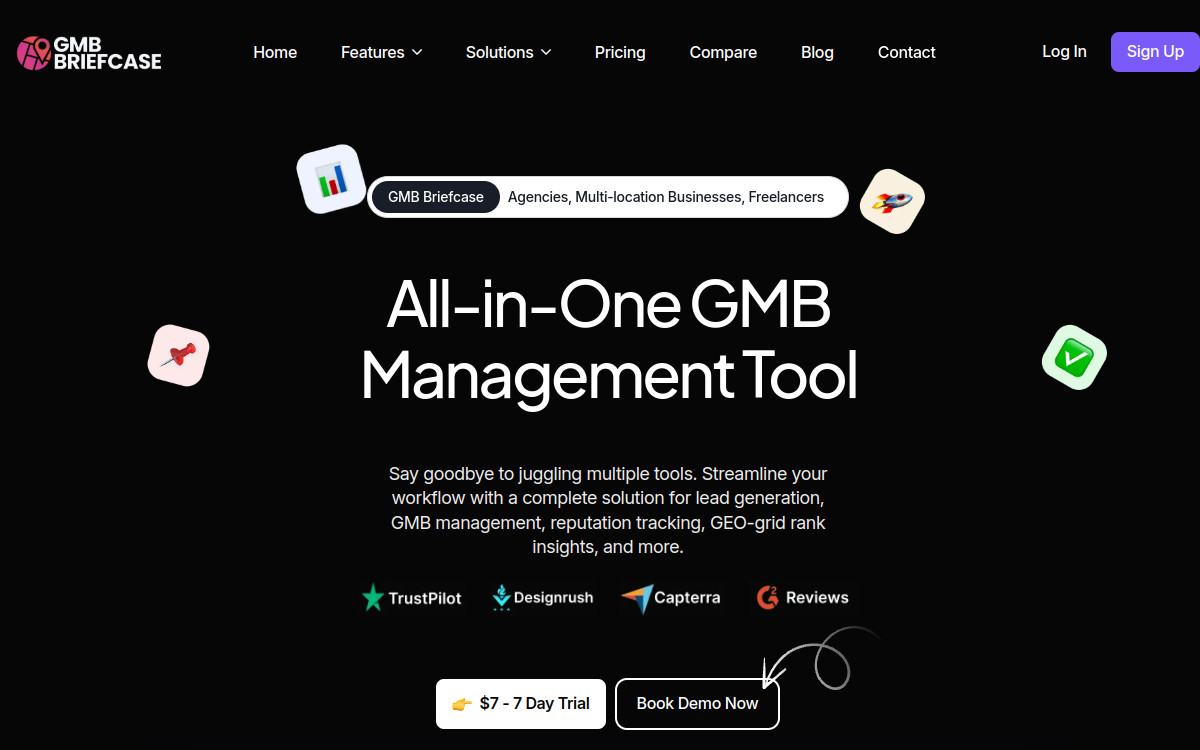
Local SEO has become a central concern for neighborhood businesses, franchises and service providers. Appearing in a good position on Google Maps and in the local pack determines a significant share of traffic and incoming calls. For agencies and freelancers managing multiple locations at once, manually tracking each Google Business Profile listing quickly becomes unmanageable: positions to monitor, reviews to moderate, posts to schedule, reports to generate for each client. GMB Briefcase was designed to address this centralization need. The platform brings together in a single dashboard all actions related to managing Google Business Profile listings, from tracking rankings to communicating with clients. Its positioning is clear: offer a complete and affordable local SEO toolkit, capable of scaling up to 200 listings. In this overview, we detail what GMB Briefcase really is, its features, concrete use cases, its benefits and its pricing model to help you determine if it matches your business.
What is GMB Briefcase?
The essentials
GMB Briefcase is software for managing Google Business Profile listings, the tool formerly known as Google My Business. Its name directly references this historical designation. Concretely, it is an online platform that allows you to oversee many business listings from a single interface. It is primarily aimed at marketing agencies, local SEO freelancers and retail networks such as franchises. The software covers the entire cycle of managing a local presence: analyzing listing completeness, tracking positions on Google Maps, managing reputation through reviews, publishing content and reporting. Accessible via the web as well as mobile applications, it includes shared access between team members and end clients.
Key features
GMB Briefcase brings together several complementary features. GeoGrid position tracking is its main strength: it maps a listing’s ranking on a grid of GPS coordinates, revealing how a business’s visibility varies from one geographic area to another and against competitors. Review management allows you to centralize reading and responding to customer comments across all listings. Publication scheduling covers posts, offers, events and product promotions, plannable in advance and in bulk. The automated reporting module generates summaries that can be sent directly to clients. Added to this are a Q&A chatbot deployable on the listing, a lead generator, an AI-powered assistant, citation tracking and competitor monitoring. Higher-tier plans offer white-label with custom subdomain, useful for agencies wanting to present the tool under their own brand. Listing optimization evaluates completeness and suggests concrete improvements.
Use cases
GMB Briefcase use cases vary by profile. A local marketing agency uses it to manage listings for dozens of clients, track their rankings neighborhood by neighborhood using GeoGrid and send them automated reports at regular intervals. A freelancer specializing in local SEO uses it to manage a portfolio of businesses without multiplying tools or manual connections. A franchise centralizes communication across its locations by scheduling consistent posts across the entire network and monitoring the reputation of each address. Teams can respond to reviews from a single interface, identify poorly positioned listings and prioritize optimization actions. The Q&A chatbot also serves to capture prospects directly from Google’s Q&A section. In all these cases, the common goal is saving time on repetitive tasks multiplied by the number of listings managed.
Advantages
The main benefit of GMB Briefcase is centralization. Rather than juggling multiple Google accounts and third-party tools, the user finds all local SEO actions in one place. GeoGrid tracking provides fine visibility into actual positions, where manual checks give a biased view based on the searcher’s location. Report automation saves agencies precious time, allowing them to demonstrate the value of their work to clients without repeated effort. White-labeling enhances the professionalism of this reporting. The ability to manage up to 200 listings on a single account allows cost sharing and accommodates portfolio growth. Finally, the combination of review management, publishing and lead generation covers reputation, visibility and acquisition—three essential levers of local SEO.
Pricing
GMB Briefcase operates on a monthly subscription basis, with a free trial to test the platform. The Business plan starts at $99 per month and covers 40 listings, with unlimited posts, lead generator, review automation and chatbot. The Pro plan, at $199 per month, manages 100 listings and adds white-label with custom subdomain. The Agency plan, at $299 per month, scales up to 200 listings. All tiers include automated reporting, AI assistant, GeoGrid tracking, website position tracking, review generation, team and client access, citation tracking and competitor monitoring. Monthly credits govern usage of GeoGrid and lead generation functions depending on the plan selected.
Conclusion
GMB Briefcase is primarily aimed at local SEO professionals managing multiple locations. Its GeoGrid tracking, centralized review management and automated white-label reports make it a coherent toolkit for agencies and freelancers. The scope remains focused on Google Business Profile, making it less relevant for a single business or broader web SEO strategy. For those managing local SEO at scale and looking to streamline recurring tasks, the tool offers solid feature-to-price value, starting at $99 per month after a free trial.