


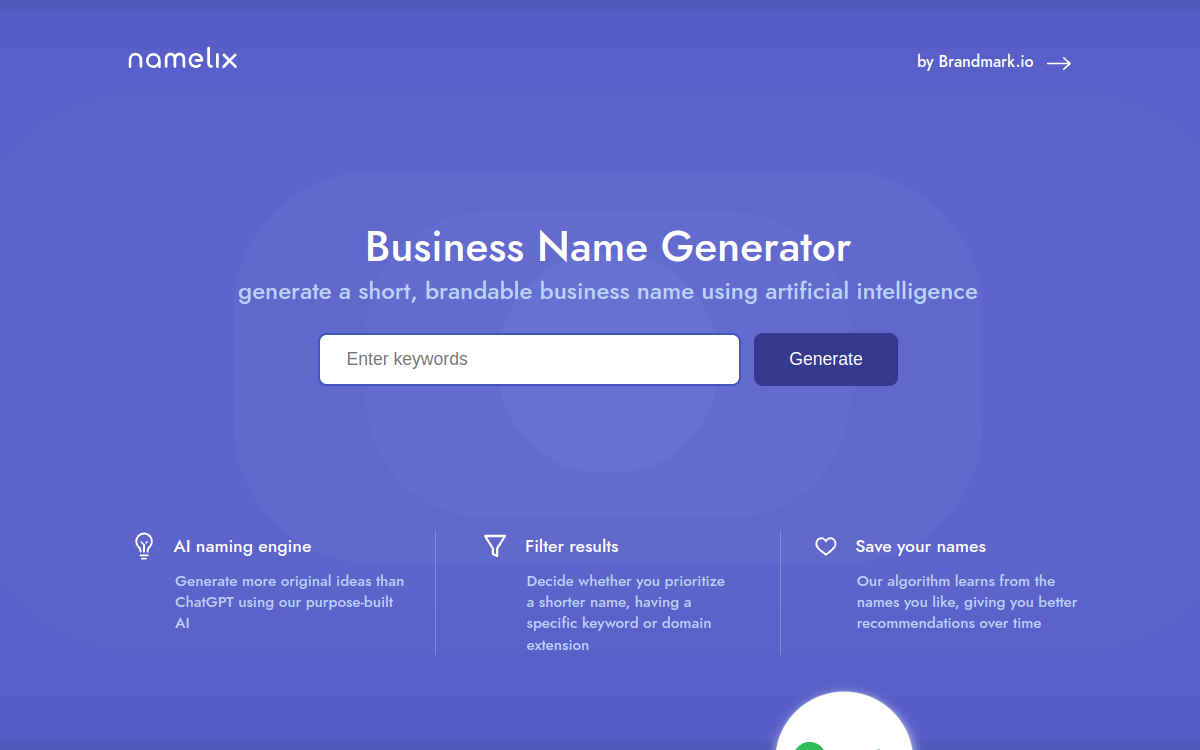
Finding the right name is one of the first decisions, and one of the most lasting, in the life of a company. A name should be short, memorable, available as a domain and distinctive enough to carry a brand. That’s exactly the ground Namelix covers, a company name generator powered by artificial intelligence. Unlike many tools that simply stick two dictionary words together, Namelix relies on an engine designed to produce genuinely brandable names — original, sonorous and suited to an identity. The tool is aimed first and foremost at startup founders, small-business creators and freelancers launching a project and quickly looking for dozens of credible options. Its promise fits in one sentence: generate short, brandable names with a dedicated AI, for free. In this article, we detail how it works, its concrete features, its use cases and its limitations, to understand where Namelix excels and when it should be complemented by other tools.
What is Namelix?
The essentials
Namelix is a free online service that generates brand names from a simple idea or a few keywords entered by the user. At its core is an AI dedicated to naming, which the tool presents as producing more original ideas than a generalist assistant, because it’s trained specifically for branding. The result isn’t a list of concatenated words, but short, inventive and easy-to-remember suggestions. Namelix is made by the same team as Brandmark, a logo creation service, which lets it naturally extend the journey from name to visual identity. The tool thus positions itself as a quick ideation step in the brand creation process.
Key features
Namelix is organized around three key features. The first is the AI generation engine: from your idea, it continuously suggests short, brandable names designed to stand out. The second is the filter system, which lets you prioritize what matters to you: the length of the name, the inclusion of a specific keyword, or the desired domain extension. This customization strongly shapes the results and saves you from sifting through hundreds of off-topic ideas. The third feature is saving favorite names: each save feeds a learning algorithm that gradually refines recommendations and brings them closer to your tastes. On top of these building blocks comes a preview tied to domain availability, useful for quickly spotting workable options. Finally, a gateway to Brandmark lets you, once a name is chosen, switch to creating a matching logo, extending the brand work without starting from scratch.
Use cases
Namelix is particularly suited to the launch phase. In a few minutes, a founder can generate around thirty candidate names, filter those containing a keyword central to their industry, then save their favorites to refine the suggestions. A local small-business creator uses it to find a short, domain-available name that’s easier to communicate than a lengthy legal name. Freelancers and independents use it to build a personal brand or name a new service offering. Agencies and project leads also use it in brainstorming workshops, as a trigger for ideas to present to a client. In all these cases, the goal is the same: to move quickly from a vague idea to a list of credible, testable names.
Advantages
Namelix’s first benefit is that it’s completely free and unlimited to use, which removes any barrier to experimentation. You can generate as many names as needed with no commitment. The second is naming quality: by aiming for brandable names rather than stuck-together words, the tool produces results closer to a real brand. The third is customization, thanks to the filters and the algorithm that learns from your choices, which makes the search increasingly relevant. Add to this the considerable time savings over manual brainstorming, and the continuity offered by the gateway to Brandmark for the logo part. Overall, Namelix reduces the friction of a step that often blocks a launch.
Pricing
Namelix is presented as a free naming tool: generating names, applying filters and saving favorites require no payment or subscription. That’s one of its major strengths for entrepreneurs on a tight budget. Logo creation, on the other hand, goes through Brandmark, the partner service made by the same team, which has its own paid offers to download and use a complete visual identity. Likewise, actually buying a domain name and any trademark checks fall to external services. So you should budget for going beyond the name itself.
Conclusion
Namelix effectively fills a specific role: helping entrepreneurs quickly find a short, original and available brand name, thanks to an AI designed for branding. Its free access, relevant filters and learning algorithm make it a solid starting point for any business creation. It replaces neither a trademark filing nor in-depth visual identity work, but it prepares for them ideally, especially with the gateway to Brandmark for the logo. For a founder seeking credible options without spending a cent, Namelix clearly deserves a place in the launch toolkit.