



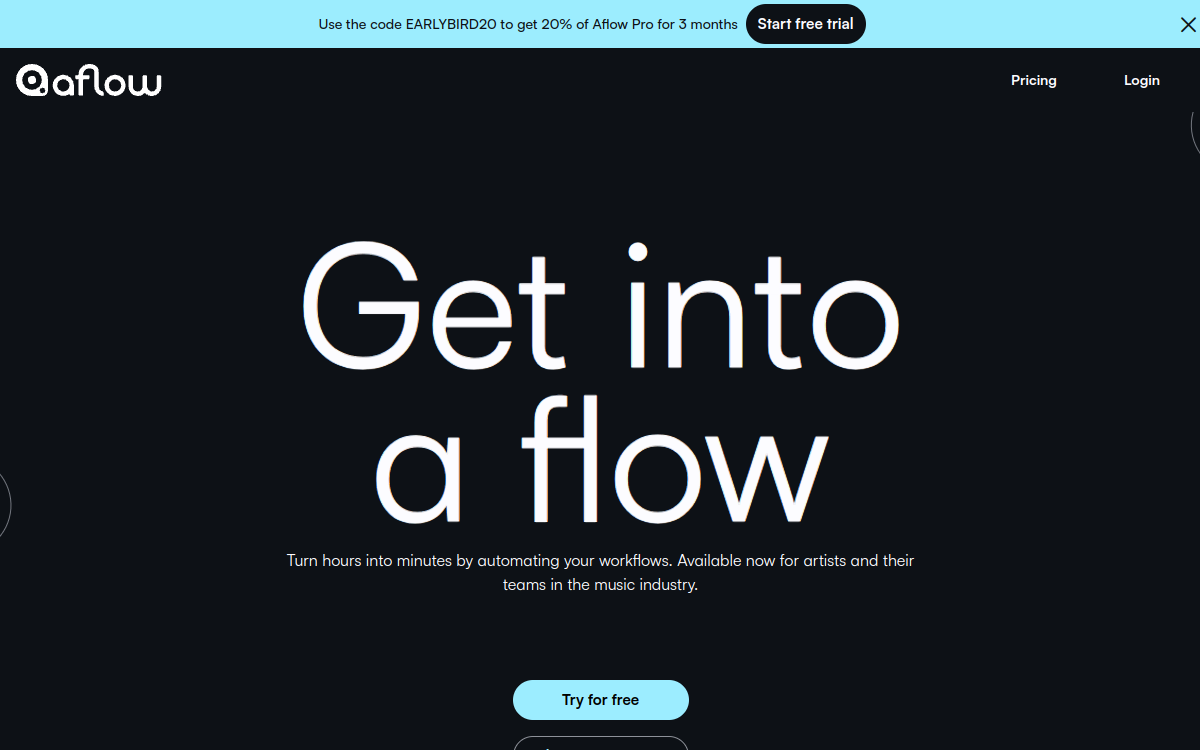
Automation platforms have profoundly changed the way teams work over the past ten years. With the rise of generative AI, a new wave is emerging: tools designed to orchestrate models, data sources and actions, without being limited to simple SaaS connectors. Aflow positions itself in this new wave with a simple promise: enabling non-technical teams to build genuinely useful AI workflows. Where Zapier or Make evolve from their connector core, Aflow takes AI as a starting point and builds around it. In this article, we look at what the platform brings, its use cases and its limits.
What is Aflow?
The essentials
Aflow is a no-code automation platform centered on artificial intelligence. The user composes workflows by visually connecting blocks: trigger, model call, data manipulation, output to a third-party tool. The tool supports several AI models and different types of sources, making it an orchestrator rather than a simple wrapper. Its main target is operational or marketing teams who want to automate repetitive tasks without calling on a technical team. The experience is designed to stay lightweight, with a deliberate focus on modern AI use cases rather than legacy integrations.
Key features
Aflow offers a visual editor to assemble workflows. The blocks typically include triggering (manual, scheduled or via webhook), the call to an AI model (generation, classification, extraction), data manipulation (filtering, transformation), and distribution to third-party tools (email, database, CRM, messaging). The ability to chain several models in the same workflow brings useful flexibility, for example to summarize a document, classify it, then send a suitable notification. Workflows are reusable and can be shared internally, which encourages a modular approach. On the connector side, the ecosystem is still being built, but covers the most common SaaS tools and remains extensible via API. The editor integrates error handling, logs and retries, which brings the tool closer to a true production orchestrator.
Use cases
Aflow addresses very concrete use cases. A support team can automate the sorting and prioritization of incoming tickets using a classification model. A marketing team can generate content summaries, enrich them and push them into a CMS or a newsletter. An ops team can clean and structure files received regularly, or orchestrate personalized sales follow-ups. Freelancers and agencies can sell the setup of AI workflows to their clients, without going through custom development. Startups can quickly prototype an AI feature before integrating it durably into their product.
Advantages
Aflow’s main contribution lies in the combination of simplicity and AI focus. Instead of stacking integrations on a general-purpose tool, the user has a platform designed from the start to orchestrate AI. The learning curve is short, which opens automation to non-technical profiles. The ability to chain several models offers flexibility that single-AI tools do not provide. Finally, native error and log handling allows scaling without losing visibility into what is happening.
Pricing
Aflow usually offers a freemium plan to get started, with paid plans aligned on the volume of executions, the number of workflows and advanced features. The logic remains flexible to suit a freelancer as well as a full team. Compared to the cost of a dedicated development team or several stacked SaaS subscriptions, the value for money proves interesting for organizations looking to structure their use of AI.
Conclusion
Aflow embodies a new generation of AI-centered automation tools. Its simplicity, its ability to orchestrate several models and its openness to non-technical profiles make it a relevant option for teams that want to industrialize their use of AI without transforming their stack. A tool to watch, especially if the ecosystem of templates and connectors keeps growing.