


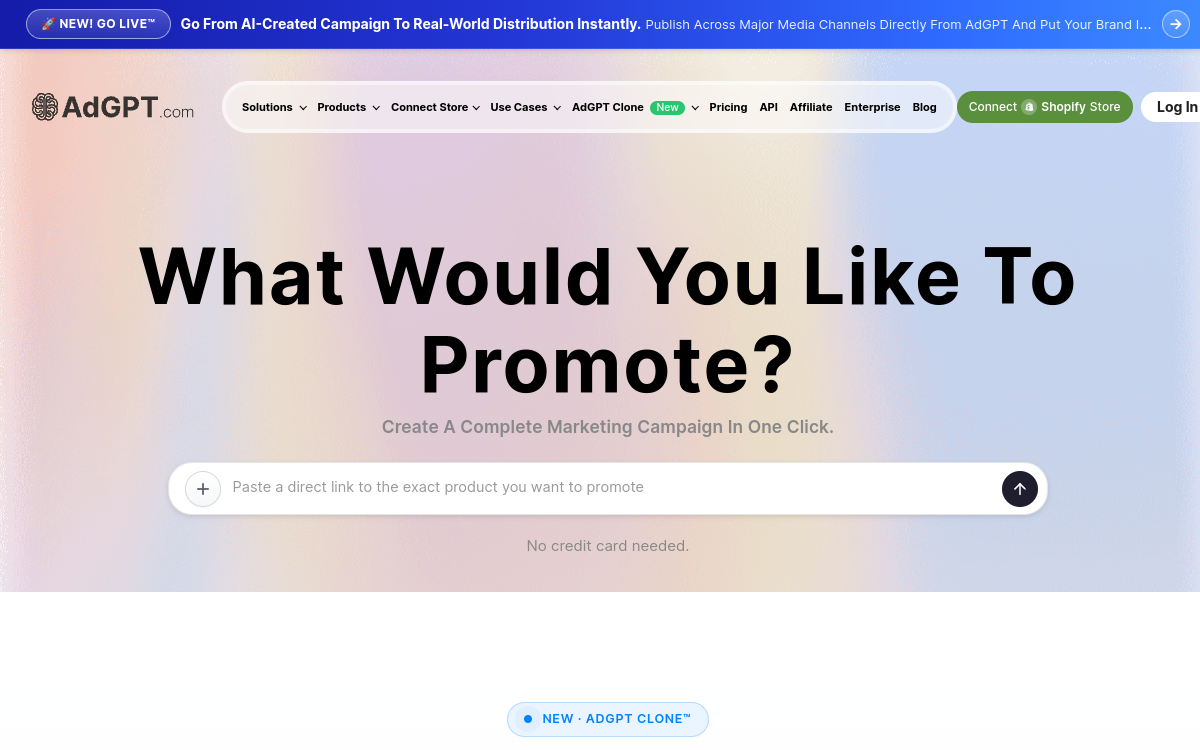
The online advertising market has become a race for industrialized creativity. The algorithms of Meta, TikTok and Google reward the diversity of creatives, the freshness of visuals and the speed of iteration. In these conditions, it’s hard to keep pace with a classic creative team. AdGPT fully fits this trend with an AI platform able to generate, launch and optimize hundreds of ad creatives from a simple brief or a product URL. The tool primarily targets performance marketers, agencies and e-commerce brands that want to move from a few tests per month to several dozen per week. In this article, we concretely examine what AdGPT offers, its flagship features, its pricing model and the cases where it makes the difference in 2026.
What is AdGPT?
The essentials
AdGPT is a SaaS platform that combines AI ad creative generation, multi-platform distribution and continuous ROAS optimization. The user connects their ad accounts and product catalog, then launches creative production by providing a product URL, a prompt or both. The AI generates headlines, copy, visuals and even short videos adapted to each platform. Campaigns are deployed on Meta, TikTok and Google, with performance tracking by variant. An optimization engine arbitrates between creatives based on the observed results, without systematic manual intervention.
Key features
AdGPT relies on several strong building blocks. Creative generation can produce more than 100 variants in one click from a single product or a single brief. The platform covers Meta, TikTok, Google and UGC ad formats, with particular effort on the ratios and visual codes specific to each network. The tool knows how to turn a simple product image into a short ad video with transitions, movements and on-brand messages, which proves valuable given the platforms’ appetite for vertical video. On the management side, a real-time dashboard tracks performance by creative, ROAS, CPA and spend, with the ability to quickly identify winning variants. The Shopify integration lets DTC brands sync their products, track conversions and close the chain between catalog, creative and campaign. For more advanced accounts, AdGPT offers enterprise plans with support, custom integrations and SLA guarantees.
Use cases
AdGPT primarily addresses e-commerce brands that want to multiply their tests without hiring a creative team. A DTC brand can, for example, release several variations per product each week to identify those that resonate best with its audience. Performance agencies use the tool to deliver faster to their clients, industrializing the production phase while keeping control over strategy. Advertisers looking to enter TikTok benefit from ready-to-use video templates for this specific format. Marketplaces and multi-category retailers can also leverage the tool to quickly generate creatives by segment or season, without starting from a blank page for each campaign.
Advantages
The main contribution is the combination of volume and optimization. Where a creative team produces a few iterations per week, AdGPT produces dozens, even hundreds, which multiplies the testing possibilities. Automatic ROAS optimization avoids human biases and quickly concentrates spend on the creatives that perform. The cost saving is notable: at $29/month to start, the tool costs a fraction of an in-house creative team or a high-end agency. Finally, the centralization of the workflow, from the product catalog to the reports, reduces back-and-forth and facilitates decision-making.
Pricing
AdGPT starts at $29/month for performance marketers, with higher plans depending on the volume of accounts and the depth of features. For organizations managing several brands, custom enterprise plans include an account manager, dedicated integrations, service commitments and priority support. The pricing grid remains competitive against the cost of an in-house creative team or a performance agency, especially for brands that run a large volume of ad tests each month.
Conclusion
AdGPT meets a real market need: being able to quickly test, at scale, hundreds of ad creatives without blowing your creative budget. For performance marketers, agencies and e-commerce brands, it’s a powerful lever for productivity and ROAS. Provided you brief the tool well and supervise quality, it becomes a true copilot for media teams.