


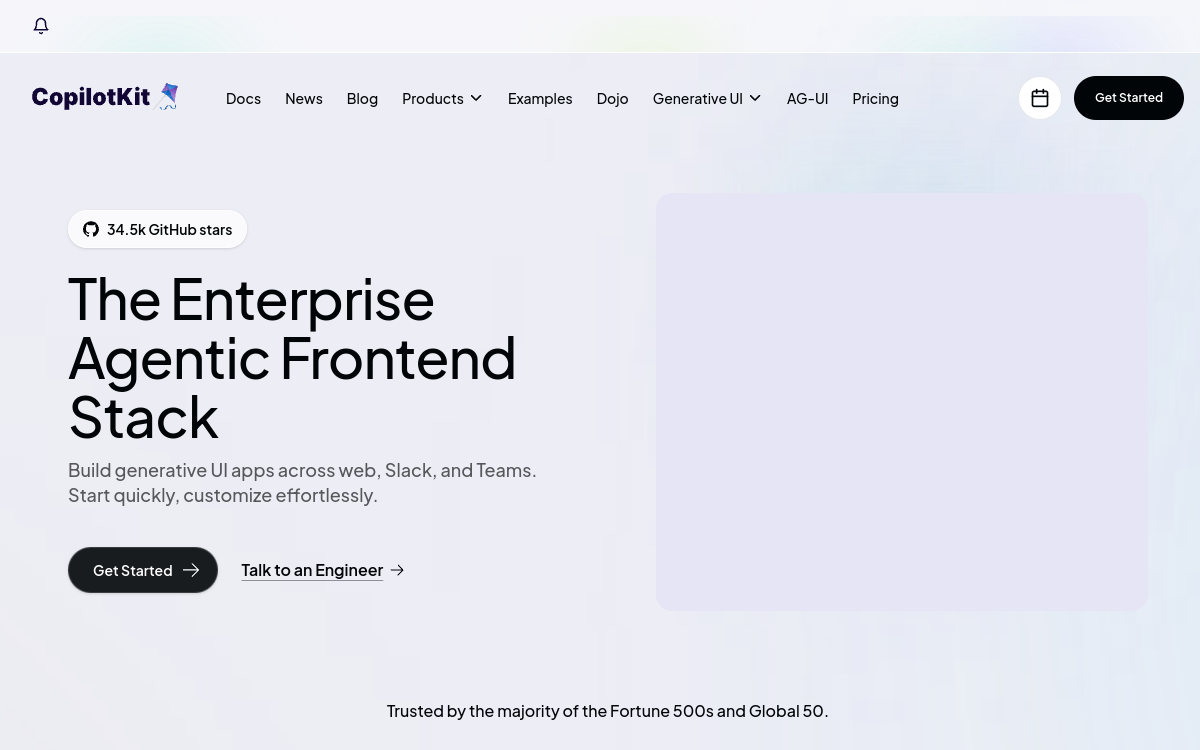
The new generation of SaaS applications now natively integrates a conversational layer, like Notion AI, Linear AI or Stripe AI. For software vendors who want to follow this trend, integrating an AI copilot into their product is, however, a technical challenge: handling streaming, tool calling, state persistence and UI rendering. CopilotKit stands out as the most accomplished open-source answer to this need. The framework provides ready-to-use React components, a standardized interaction protocol (AG-UI) and compatibility with all the main LLMs. With $27M raised and adoption confirmed by major brands, CopilotKit establishes itself as a market standard. For product teams that want to enrich their SaaS with a credible AI layer without reinventing the wheel, it’s probably the right starting point today.
What is CopilotKit?
The essentials
CopilotKit is an open-source framework written in TypeScript and React that makes it easy to integrate AI copilots into web applications. It provides UI components (chat, sidebar, suggestions), a client to communicate with an agent, an interaction protocol (AG-UI) and integrations with the main LLMs. The framework is cloud-agnostic and can be self-hosted or used via the Enterprise platform to benefit from advanced features.
Key features
CopilotKit offers an impressive toolkit. The React components let you integrate a copilot into an existing app in minutes with a modern, customizable UI. The AG-UI protocol handles response streaming, tool calls, state persistence and communication between the agent and the interface. The framework integrates natively with OpenAI, Claude, LangChain, Google ADK, Mastra and all MCP-compatible tools. The MCP-Apps feature lets an agent dynamically generate UI (buttons, forms, tables) instead of being limited to text. The Enterprise edition brings advanced features such as fine-grained session management, multimodal support, file upload, voice transcription and session continuity between mobile and web. Compatibility with MCP and A2A guarantees maximum interoperability with the fast-evolving agent ecosystem.
Use cases
CopilotKit is used by SaaS vendors of all sizes. A startup integrates it from the start to offer a conversational experience to its users. A mature vendor adds a copilot to its existing product to boost engagement and adoption. A bank or insurer uses it to deploy a secure internal assistant on its intranet. IT services firms offer custom copilots to their clients based on the framework. Internal IT teams use it to build business assistants quickly, with a consistent and professional UI. The framework’s flexibility covers a wide spectrum of cases, from a simple support chat to complex agents able to act on the application.
Advantages
CopilotKit brings several distinctive benefits. First: a major time saving thanks to ready-to-use components and a standardized protocol. Second: a high quality of user experience, aligned with the standards of modern products. Third: great flexibility thanks to compatibility with all the main LLMs and agent frameworks. Fourth: the ability to evolve from a simple chat to more complex copilots over time. Finally, open source guarantees the durability and transparency of the technology choice, and the Enterprise edition meets critical security and scalability needs.
Pricing
The CopilotKit framework and the AG-UI protocol are entirely open source and free. The Enterprise platform, designed for organizations with critical needs, is priced on quote and includes support, managed hosting, SLAs, advanced features and dedicated assistance. This dual approach is consistent with a strategy of massive open-source adoption and monetization on critical organizations.
Conclusion
CopilotKit stands out as a de facto standard for integrating AI copilots into modern React applications. Its engineering quality, growing ecosystem and openness make it an excellent choice for SaaS vendors. Worth watching closely as agent protocols evolve rapidly.