


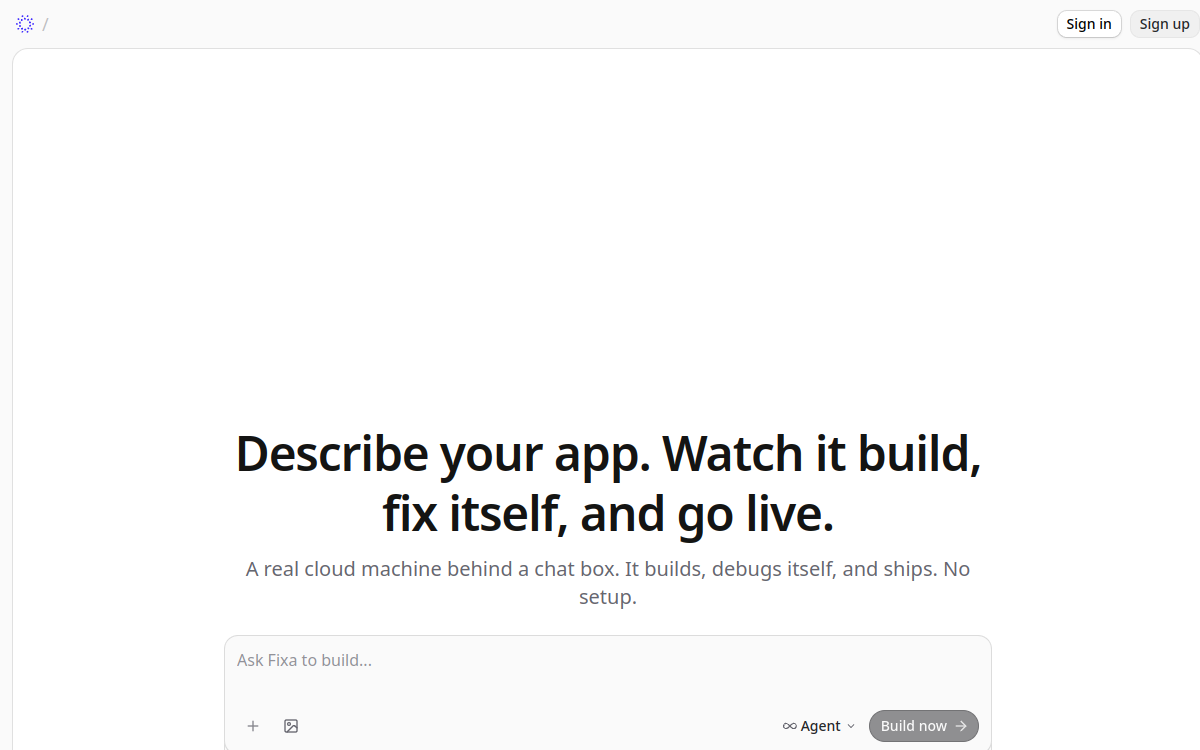
AI voice agents are transforming customer service, appointment booking, phone reception and many other use cases. But testing them remains a challenge: a voicebot may work perfectly on 95% of calls and fail badly on the remaining 5%, with a direct impact on the customer experience. Fixa brings an original and powerful answer to this problem with an open-source platform that simulates real calls with other voice agents and uses an LLM to evaluate the conversation. The approach is radically different from classic unit tests and covers a wide range of scenarios. Backed by Y Combinator, the platform established itself in a few months as a standard for teams that industrialize their voicebots and want to avoid silent regressions.
What is Fixa?
The essentials
Fixa is an open-source platform that industrializes the testing of AI voice agents. Instead of unit-testing each response, Fixa triggers real phone calls with an automated voice agent that plays a predefined scenario. Once the call is over, an LLM analyzes the transcript and evaluates whether the tested voice agent properly collected the expected information, complied with internal policies and delivered a smooth experience. Results are available in the terminal, the UI or pushed to Slack in case of an alert.
Key features
Fixa offers a rich set of features for teams building voice agents. The testing engine lets you define complete scenarios with a script and evaluation criteria. Tests can be run manually, via API or directly from a CI/CD pipeline with GitHub Actions. The LLM evaluation produces a quality score, identifies gaps versus expectations and provides detailed feedback. Latency detection measures the agent’s response time in real conditions, which is crucial for user perception. Slack alerts let you be notified in case of a regression, for example when an agent no longer collects a key piece of information. The platform is open source, allowing each team to understand the mechanisms and contribute if needed.
Use cases
Fixa targets several profiles. A startup building a voicebot uses it to continuously test its product before each production release. A SaaS exposing callbots to its customers uses it to monitor service quality and detect regressions. An IT team in charge of an AI phone system uses it to validate changes to the call flow. QA teams use Fixa to automate complex scenarios impossible to test manually at scale. Finally, some integrate the platform into their CI/CD to guarantee constant quality on every deployment.
Advantages
Fixa’s benefits are concrete. First: test coverage on realistic scenarios that unit tests cannot reproduce. Second: automatic regression detection, which avoids unpleasant surprises in production. Third: objective measurement of conversational quality, essential to steer an agent. Fourth: open source, which ensures transparency, security and extensibility. For teams that take AI voice seriously, Fixa is a high-impact investment that translates into fewer production bugs and a better user experience.
Pricing
Fixa offers a pay-as-you-go model with a free plan to get started. Costs are essentially tied to the voice minutes consumed during tests, making the bill proportional to actual usage. Enterprise plans are available for large organizations with SOC 2 or HIPAA compliance needs or custom integrations. This flexibility lets a small team start without commitment and scale gradually.
Conclusion
Fixa illustrates a new category of tools essential for the age of AI voice agents. For any team industrializing a voicebot, it’s a near-indispensable tool to make its product reliable. Its open-source nature, flexible pricing model and the innovation of its approach make it an excellent investment in 2026.