



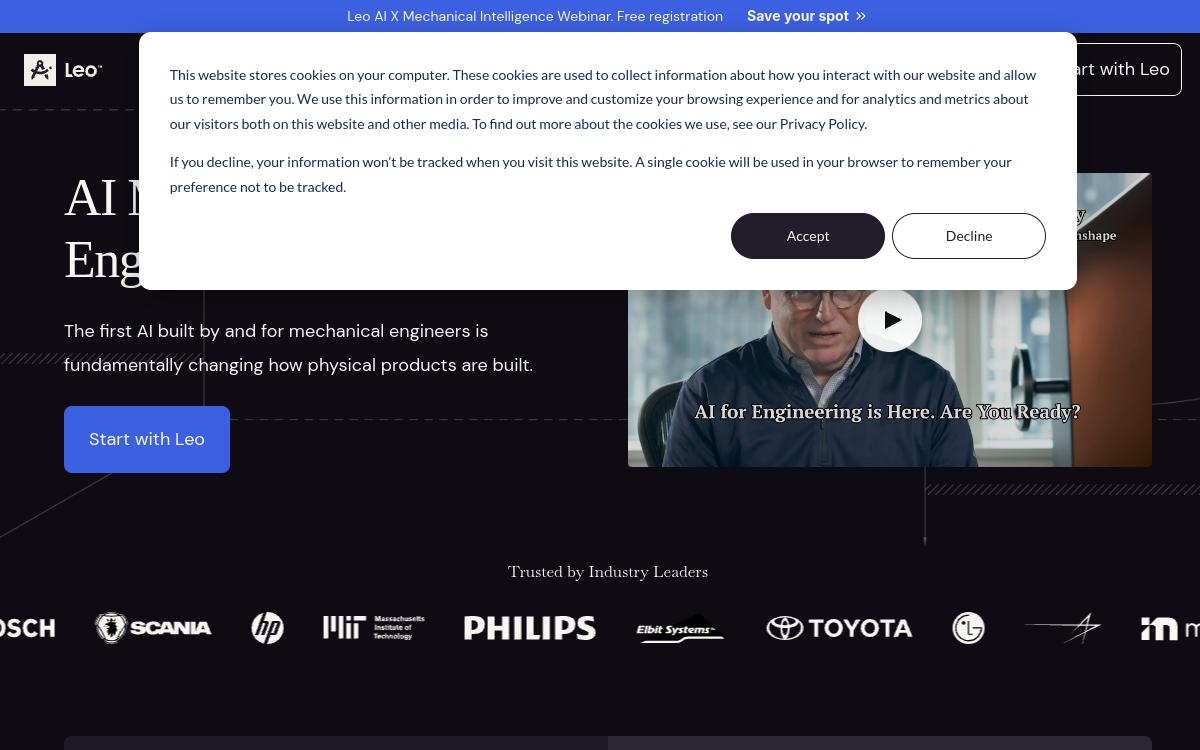
Mechanical engineering is one of the last major fields to get its own dedicated AI. With Leo AI, the publisher delivers an assistant designed for design offices, designers and mechanical engineers. Where ChatGPT answers general queries, Leo focuses on a precise field: industrial mechanics. It cross-references technical databases, supplier catalogs and a company’s internal documentation to deliver directly usable answers. Adopted by 55,000 engineers and by groups like HP, Scania or Intel, it stands as one of the most accomplished vertical AI tools on the market. This specialization lets it avoid the hallucinations of general-purpose AIs, relying on verified and traceable technical sources. For teams facing complex calculations, the search for standardized components or design constraints every day, Leo AI promises a real productivity gain within the design office and beyond.
What is Leo AI?
The essentials
Leo AI is an intelligent assistant designed to support mechanical engineers throughout the design cycle. It combines a specialized knowledge engine, a natural-language component search engine and technical calculation capabilities. Connected to PLM systems, ERPs and a company’s internal databases, it provides contextualized answers in a few seconds. The tool doesn’t position itself as a replacement for the engineer but as a copilot that eliminates wasted time, design errors and poorly relevant component choices. Its promise is clear: saving several hours a week on low-value tasks.
Key features
Leo AI’s features cover all the daily needs of a design office. The knowledge engine lets you ask technical questions in natural language and receive precise, sourced and usable answers. The component-search module explores in seconds catalogs rich with over 100 million parts from recognized suppliers. The calculation engine handles conversions, parameter multiplications and the multi-step equations typical of a mechanical calculation. Concept visualization turns an idea into an image and a usable three-dimensional model. Finally, integration with PLM systems and internal documentation databases ensures perfect alignment between the company’s internal knowledge and the assistant’s answers. This integration is essential to preserve the standards, norms and lessons learned accumulated by teams over the years.
Use cases
Leo AI’s use cases are many. A design-office engineer can quickly search for a standard component meeting precise constraints of torque, material or footprint. An R&D project manager can validate the consistency of a sizing calculation before a technical review. A quality department can query the internal database to verify that a part choice respects already-validated standards. Technical purchasing managers use it to quickly identify several alternatives to a component that’s out of stock or too expensive. The tool also finds its place in training new hires, giving them immediate access to the company’s technical memory.
Advantages
The benefits Leo AI brings are tangible and measurable. Users report on average 12 hours saved per week, nearly 30% of work time devoted to repetitive tasks. The platform reduces design errors by 34% by validating technical choices upstream. The increase in component reuse reaches 32%, which reduces purchasing costs and simplifies the supply chain. Beyond the numbers, Leo AI standardizes practices within teams, secures decision-making and accelerates the upskilling of new engineers.
Pricing
Leo AI’s pricing isn’t public. The publisher offers a model tailored to each organization, based on the number of users, the volume of indexed data and the desired level of integration with existing PLM systems. A personalized demo is available on request to assess the value generated before any commitment. This quote-based model mainly targets medium and large industrial companies, rather than freelancers or very small structures.
Conclusion
Leo AI illustrates the new generation of vertical AIs designed for precise professions. By focusing exclusively on mechanical engineering, it delivers an answer quality, reliability and depth of integration that general-purpose assistants can’t offer. For a structured R&D department, it’s an investment to consider seriously.