



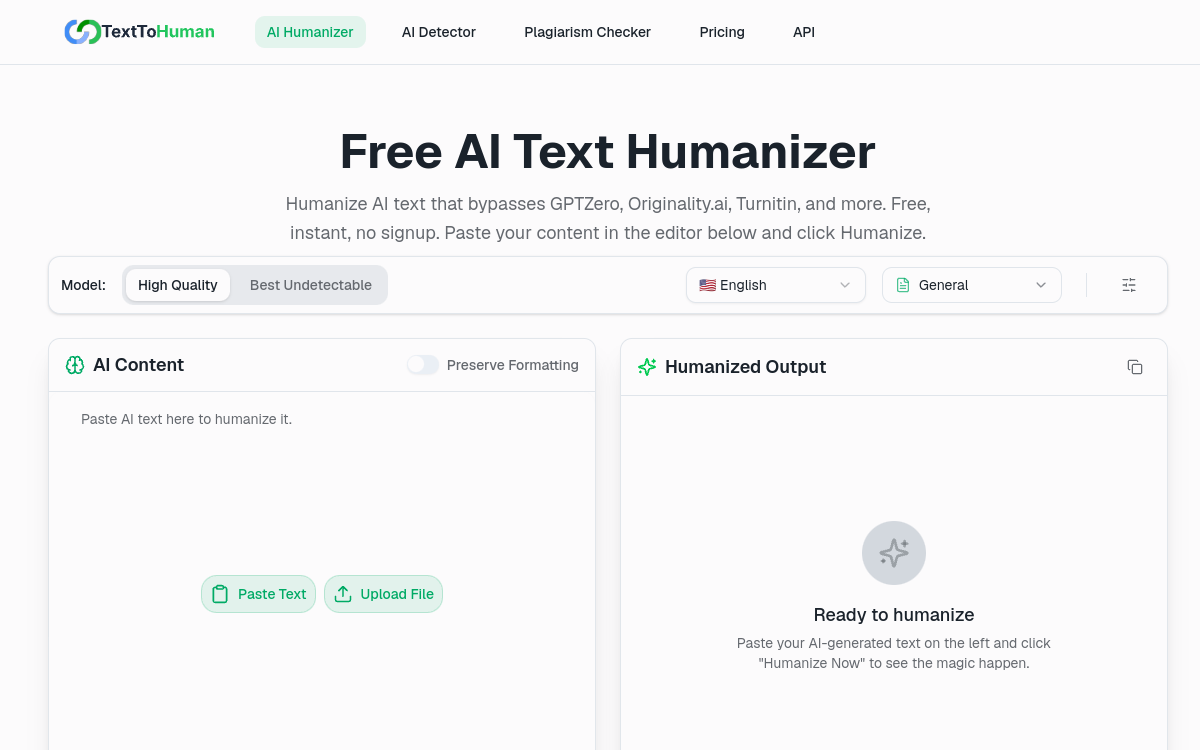
TextToHuman is a totally free AI humanizer that rewrites content generated by models so it appears written by a human. The tool supports up to 1,000 words per run and allows you to choose between several modes, including Stealth for undetectable output or Premium for writing quality. Several styles are offered, such as General, Academic or Blog. The engine is based on a training database of over 30 million human samples. An API is also available for large-scale integrations, making it a very versatile tool.
What is TextToHuman?
The essentials
TextToHuman is an online rewriting service that takes AI content as input and produces humanized text as output. The tool offers several operating modes: Stealth for output designed to pass detectors, Premium for editorial quality, and an Autopilot mode that repeats passes until an acceptable score is reached. Several writing styles are available, including General, Academic or Blog. The service works on the web without registration and can be called via API for large-scale integrations. According to the publisher, the engine has been trained on over thirty million human samples to reproduce natural syntactic structures.
Key features
The main engine rewrites the source text while preserving meaning and tone while replacing structures recognized by detectors as typically AI. Stealth mode prioritizes undetectability, Premium mode prioritizes stylistic elegance, and Standard mode offers a single fast pass. Autopilot chains rewrites until reaching a human score threshold. Users can click on a sentence to get alternatives or manually edit the output. Integrated checking displays an AI probability score to guide the user. Multilingual mode covers several major languages, which is rare among free humanizers currently present on the public market, for both personal and moderate professional uses.
Use cases
Several user profiles use TextToHuman. Web writers humanize drafts generated by models to make them more natural before publication. Marketers adjust the tone of their emails or landing pages to avoid a robotic impression. Agencies manage multiple editorial accounts and run content in series to maintain a human editorial signature. Developers integrate the API into their own tools to automatically add a layer of humanization. Students, which is more debatable, sometimes use it to escape academic detectors, raising major ethical questions that most institutions now address by revising their evaluation policies and benchmarks applied to written work.
Advantages
The main benefit is the immediate fluidity of AI texts, which avoids the overly formal or overly standardized turns of models. Zero cost and lack of registration make the tool accessible to all, which is a strong differentiating argument compared to the majority of humanizers on the market. The presence of multiple modes and styles allows you to calibrate the rendering based on context. The API opens the door to massive automations. For agencies and writers producing in volume, it’s a real accelerator. For academic or professional publishers, the tool can help transform a raw AI note into text that’s more engaging for readers, provided you fully assume the ethical choices associated with this use.
Pricing
TextToHuman positions itself as a completely free service, without registration, without email or credit card required, which clearly distinguishes it from the majority of its competitors. The limit per run is set at 1,000 words, but no global cap is imposed on the number of executions. For advanced professional uses, the publisher offers an API to which specific pricing conditions can apply depending on the monthly volume requested and the integration context. Users interested in this option are invited to contact the team directly to obtain suitable terms. The overall model remains very advantageous and accessible as a first choice for the majority of individual and moderate professional cases on low to medium volumes.
Conclusion
TextToHuman is a particularly interesting AI humanizer thanks to its free and unlimited positioning. Its engine trained on tens of millions of human samples and the availability of an API make it a useful tool for writers and marketers. To be used responsibly, keeping in mind that AI detection is constantly evolving and ethics is particularly important in academic contexts.