


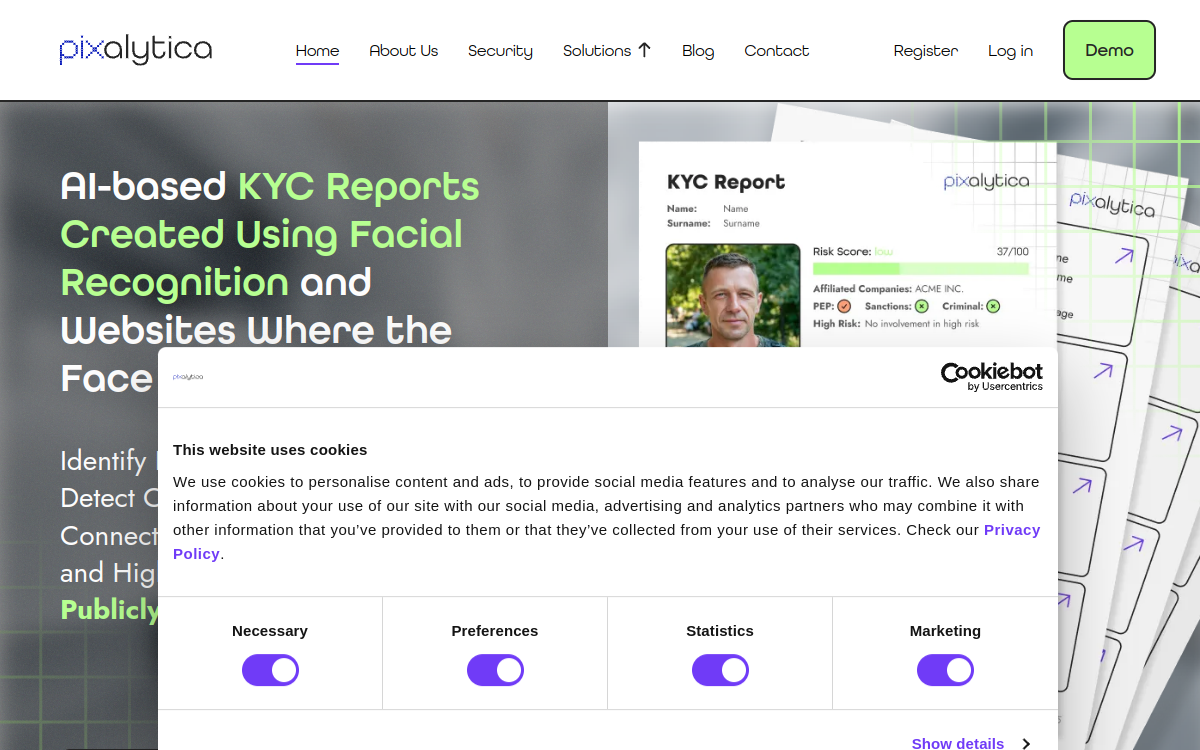
Pixalytica is an identity verification tool powered by AI, which combines facial recognition and large language models to generate complete KYC reports in less than twenty seconds. From a simple photo, the platform searches for associated public images online, cross-references press mentions, sanctions, possible criminal records and PEP statuses, then produces a structured report with a risk score. A REST API allows integrating the service into onboarding platforms, compliance dashboards and professional due diligence tools.
What is Pixalytica?
The essentials
Pixalytica is a professional identity verification platform that relies on AI to generate KYC reports from a simple photo. The tool performs facial search across publicly accessible image databases and attempts to link the individual to indexed online content. An LLM analysis then reviews press mentions, international sanctions, PEP statuses, possible criminal histories and known associations. The final report is structured, readable and accompanied by a risk score, allowing decision-makers to act quickly. The platform has a REST API suited to professional integrations in user onboarding flows.
Key features
The facial recognition engine is the first technical building block. It explores public sources to link a face to accessible profiles, providing a solid starting point for identifying a person’s digital environment. The large language model analysis layer exploits found documents to produce a synthesis, distinguishing factual elements from allegations. The search covers international sanctions, PEP statuses and press mentions to identify sensitive profiles. A risk score aggregates these signals into a comparable score. The REST API exposes these functions modularly, allowing integration of verification step within existing onboarding flow or due diligence workflow with automatic escalation rules.
Use cases
Pixalytica is useful for several profiles. Law firms exploit the tool in due diligence contexts to evaluate a potential partner or transaction counterparty. Private investigators have a quick starting point before more thorough research. Compliance teams at banks, fintechs or crypto can use it to strengthen KYC onboarding, especially on little-known international profiles. Matching platforms, like some premium marketplaces, use this type of verification to reassure their users. Finally, HR departments specialized in sensitive positions rely on these reports to supplement standard screening with public insight specific to foreign candidates, in strict compliance with applicable legal framework.
Advantages
Pixalytica’s benefits lie in speed, report clarity and possible integration. Verification delivered in less than twenty seconds allows taking rapid operational decisions, crucial for onboarding flows or adversarial processes. The synthetic report reduces analysis time on the team’s side and limits the risk of oversight. REST API simplifies integration and automates verifications at scale. Combined coverage of press sources, sanctions and PEP gives a structured overview of risk, securing decision-making. Monthly cost remains competitive compared to manual verification performed by an investigator or firm, especially for organizations that must verify hundreds or thousands of profiles monthly.
Pricing
Pixalytica offers an entry plan at 79.99 USD per month suited to regular use by small organizations, law firms, private investigators and researchers. Higher plans and enterprise rates exist for high volumes and intensive API use, with customized sizing based on query frequency and scope of sources consulted. A free demo is available and allows generating a complete report by sending an image and professional email. The pricing grid is documented on the site and the editor also provides dedicated support to enterprise customers. Transparency remains decent but you should anticipate total cost based on expected monthly verification volume and end user’s country.
Conclusion
Pixalytica is a relevant professional tool for organizations that need to industrialize identity verification with a quick and actionable report. Provided you respect the applicable legal framework, the combination of facial recognition, LLM analysis and REST API makes it a serious asset for compliance and due diligence in 2026.