



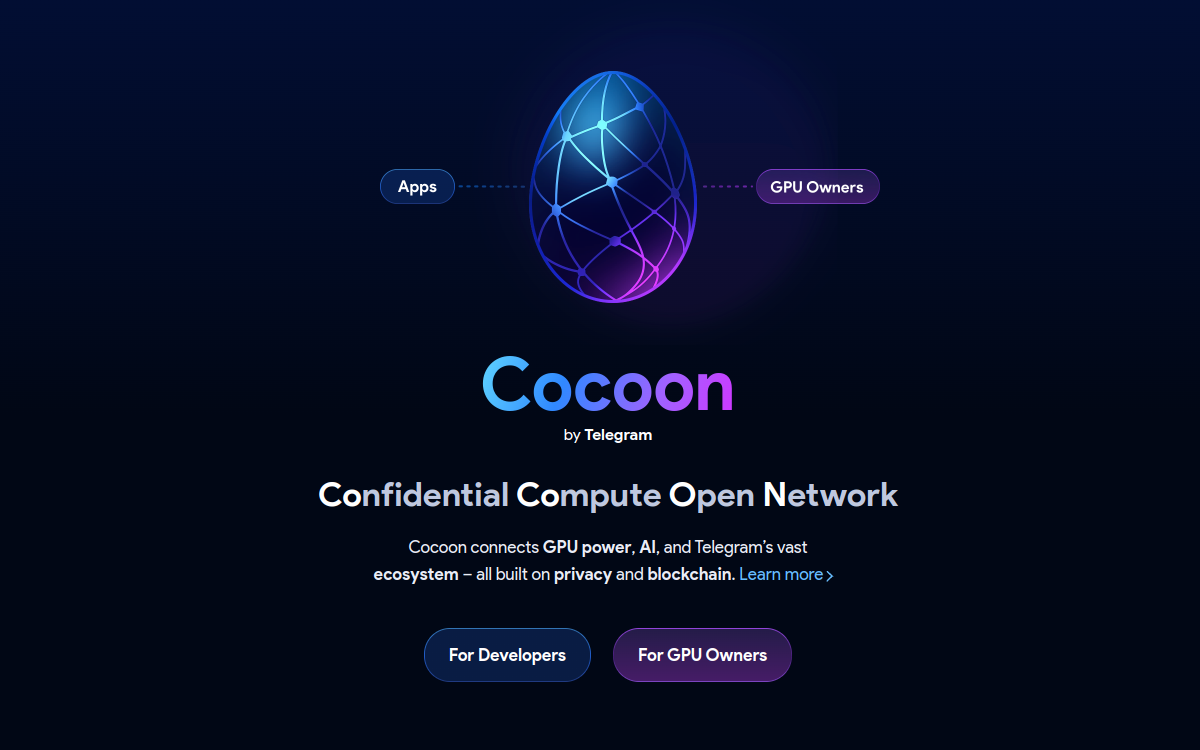
Cocoon is an AI platform dedicated to decentralized confidential compute that helps AI developers, Web3 founders, data teams and GPU owners decentralized confidential compute network to execute AI models privately without heavy technical investment. The solution offers execution in confidential environment, GPU marketplace, open source models like DeepSeek and Qwen, on-chain payment in TON, with an experience designed for collaborative work and volume production. Its approach aims to industrialize a task that was previously slow, expensive or reserved for specialists, by placing artificial intelligence at the heart of daily workflow.
What is Cocoon?
The essentials
Cocoon is a platform specialized in decentralized confidential compute, accessible via https://cocoon.org/. The tool targets AI developers, Web3 founders, data teams and GPU owners and proposes a decentralized confidential compute approach centered on speed, flexibility and ease of use. The main promise is simple: enable users without advanced technical expertise to obtain professional results in just a few steps. The platform relies on modern artificial intelligence models to automate the most repetitive or technical tasks, leaving the user to pilot the creative or strategic direction. This hybrid philosophy, where humans remain in control but delegate mechanical work, aligns with the dominant trend of current AI SaaS tools. Cocoon is accessible directly from the browser without local installation, and offers an experience designed equally for one-off testing and volume production within structured and demanding teams on a daily basis.
Key features
The functional core of Cocoon is based on execution in confidential environment, GPU marketplace, open source models like DeepSeek and Qwen, on-chain payment in TON. This foundation is complemented by an interface designed to reduce the learning curve and allow a novice user to produce their first results in just a few minutes. The AI engine automatically handles technical tasks while the interface guides the user in configuration. The platform also offers export options adapted to main professional uses, which facilitates integration into existing production chains. On the collaboration side, Cocoon allows easy project sharing, asset centralization and maintaining an iteration history, which proves useful for teams working in pairs or larger. The multi-language dimension, when relevant, broadens the geographic reach of produced content, and possible API availability opens the door to advanced integrations in automated workflows. The whole forms a coherent suite, which deserves to be explored plan by plan to identify the one that best matches your production volume. The learning curve remains reasonable and support resources are there to support the first steps.
Use cases
Cocoon’s use cases are varied and cover multiple user profiles. Typically, the tool is used by AI developers, Web3 founders, data teams and GPU owners who want to industrialize their production. Concretely, we find scenarios such as rapid prototype creation, variant declination for A/B tests, enrichment of existing catalogs or acceleration of repetitive business tasks. Freelancers appreciate the ability to serve more clients without hiring, while structured teams see it as a way to unburden their internal resources. Solo entrepreneurs and startup founders often use the tool to quickly validate product or marketing hypotheses, where a full team would take several weeks. Finally, some educational and training uses are emerging, benefiting from the accessible nature of the interface to democratize traditionally complex skills among learners.
Advantages
The most immediate benefit of Cocoon is time savings. Where a traditional approach requires several hours or even days of work, AI provides a first result in minutes, freeing the user for higher-value tasks. The second benefit is accessibility: no advanced technical skills are required, which democratizes a discipline previously reserved for specialized profiles. The third advantage is financial: for the price of an hour of external service provider, the user has an entire month of usage, which transforms the unit economics of each project. To this are added reproducibility, the ability to iterate quickly and consistency of results when parameters are well defined. For teams, these benefits translate into greater agility and increased capacity to explore leads without fear of additional costs.
Pricing
Cocoon’s pricing follows the Pay-as-you-go model. This structure is designed to adapt to different usage volumes, from one-off testing to intensive production. Occasional users can generally explore main features without commitment, while advanced users benefit from extended quotas, exclusive features and sometimes priority support. The price-to-quality ratio remains competitive compared to equivalent solutions, especially when accounting for time saved on automated tasks. It is recommended to start with the most accessible plan to evaluate the real value of the tool in your workflow before upgrading. Billing conditions, payment options and any commitments deserve to be verified directly on the editor’s pricing page, which may evolve its rates over time.
Conclusion
Ultimately, Cocoon positions itself as a relevant tool for anyone wanting to accelerate their AI infrastructure tasks without burdening their budget or technical stack. It does not replace all high-end needs, but is an excellent entry point for AI developers, Web3 founders, data teams and GPU owners. Testing the tool on a real case remains the best way to judge its value in your specific context. Its hybrid philosophy and price-to-quality ratio make it a useful daily companion.