



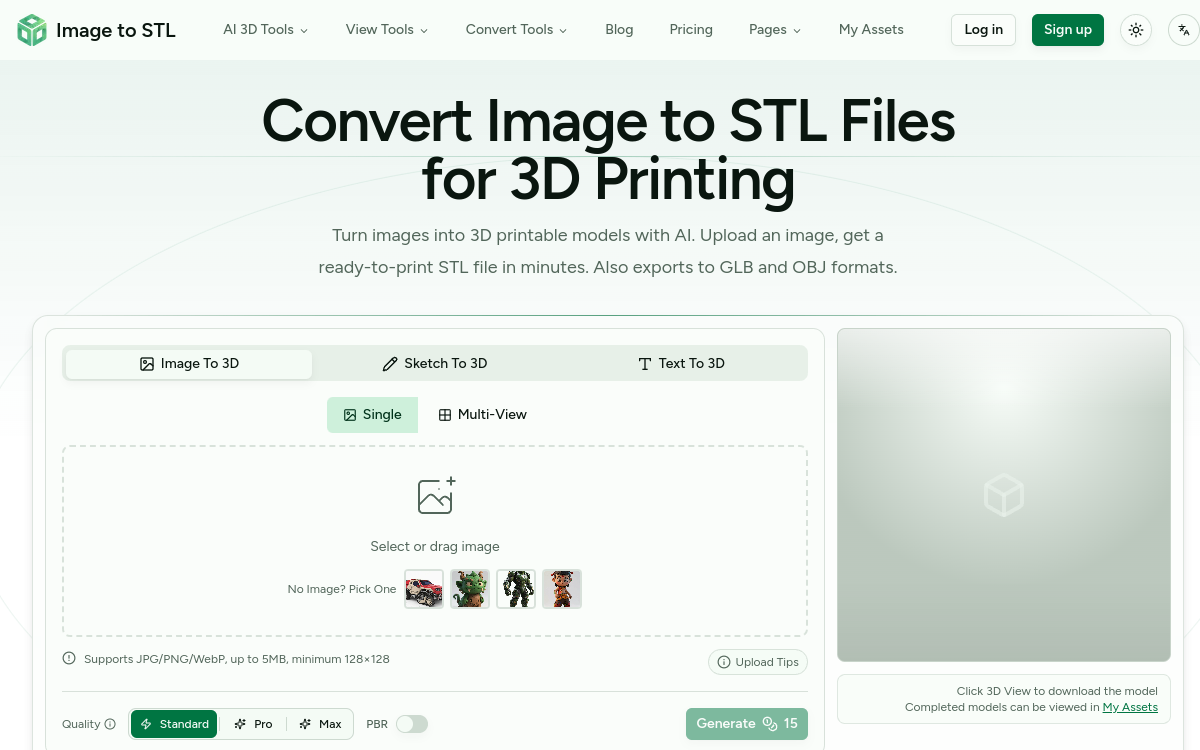
Image to STL is an AI tool for 2D to 3D conversion that transforms a photo, sketch or text description into a 3D mesh ready to print or integrate into a game engine. The platform exports to STL, GLB and OBJ formats, supports Standard, Pro and Max modes up to 1.5 million triangles with clean geometry and PBR materials. Designed for makers, designers and game developers, it includes an interactive viewer, flexible credit system, creative styles like Bust or Scale Figure and offers multi-view modes to improve result fidelity.
What is Image to STL?
The essentials
Image to STL is a web app that transforms 2D content into 3D mesh. The user can submit a regular image, multiple views of the same object in multi-view mode, a sketch or even a text prompt. The AI reconstructs the shape, generates a mesh and exposes simple quality controls. The integrated viewer lets you rotate around the model, zoom, compare multiple results. Generated files are stored in a personal My Assets space and can be downloaded or shared. The platform covers 3D printing needs as well as game engines and AR/VR applications, without requiring dedicated software.
Key features
The main engine rests on three quality modes. Standard mode produces meshes up to 80,000 triangles, sufficient for preview and rapid prototyping. Pro mode reaches 1.5 million triangles, with cleaner topology and the ability to use creative modes like Scale Figure, Bust or Badge. Max mode adds PBR material support for renders close to real-time production quality. The multi-view feature improves reconstruction fidelity by crossing multiple angles of the object. Export covers STL for 3D printing, GLB for Unity, Unreal and web, as well as OBJ for broader pipelines. The platform includes an interactive viewer, generation history, flexible tagging and credit system, and predefined creative styles that guide transformation. The promise is clear: from visual to 3D object, printable or integrable, without heavy expertise required.
Use cases
Image to STL addresses several concrete cases. Makers in 3D printing can transform an illustration or character into a personalized figurine in minutes, opening opportunities for gifts, merchandising or prototypes. Independent game developers can generate assets, scenery or secondary characters without hiring a 3D sculptor. Designers can prototype packagings, objects or concepts in a few iterations. Architects can quickly create simplified models from plans, photos or renders. AR/VR studios use the tool to generate test scenery and objects, and e-commerce businesses see it as a way to produce 3D previews to boost product page conversions. The multi-view mode is particularly useful for objects with complex shapes where a single view wouldn’t suffice.
Advantages
The first benefit is speed. A generation that would take hours in Blender wraps up in minutes. The second benefit is accessibility. Users without 3D skills get exploitable results, democratizing asset production. The third benefit is export flexibility, covering 3D printing, game engine and classical modeling pipeline needs. The fourth benefit is extended creativity thanks to integrated styles and multi-view mode. Finally, the credit system offers granular cost without heavy commitment, which suits one-off projects as well as more regular uses.
Pricing
The pricing grid offers a free plan with fifteen credits per month, perfect for testing without commitment. The Pro plan at $16.90 per month opens 500 credits, two simultaneous tasks, unlimited downloads and private asset ownership. The Max plan at $26.90 per month moves to 1,000 credits, three simultaneous tasks and maximum queue priority. Additional credit packs are available for one-time purchase to absorb usage spikes, and an annual mode offers fifteen percent discount. The grid remains competitive against traditional 3D tools and equivalent AI solutions.
Conclusion
Image to STL embodies the spirit of new productivity-oriented AI tools: simple promise, rapid execution, quality sufficient for common needs. It doesn’t replace a professional tool for AAA pipelines, but for most makers, designers and indie game developers, it brings considerable time savings and lowers entry to 3D. With universal exports and flexible credit system, it’s an excellent option for experimenting with and industrializing workflows.