



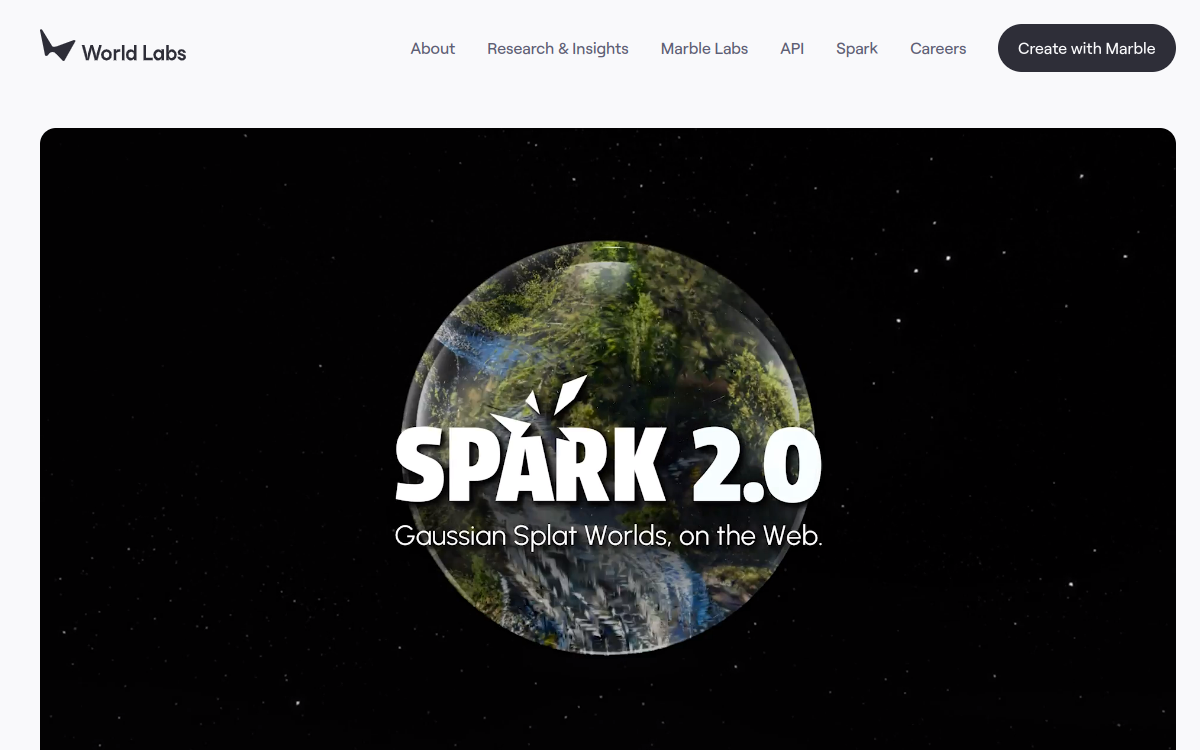
Spark 2.0 is an open source 3D Gaussian Splatting rendering engine published by World Labs and designed for the web. It allows streaming and displaying massive 3D worlds with over 100 million splats on any device with a browser. The new version integrates a level of detail (LoD) system, progressive transmission and virtual memory techniques, all integrated with Three.js via WebGL2 for desktop, mobile and VR uses.
What is Spark 2.0 (World Labs)?
The essentials
Spark 2.0 is an open source 3D Gaussian Splatting rendering engine dedicated to the web. It’s part of the tools family published by World Labs, the lab founded by Fei-Fei Li, and fits into an open strategy for spatial models to the community. Where early Gaussian Splatting engine versions struggled to exceed a few million splats on browser, Spark 2.0 introduces a level of detail system, virtual memory techniques and a dedicated .RAD format enabling progressive scene streaming. The result is a cinematic experience available on desktop, mobile and VR without plugin.
Key features
Spark 2.0 is organized around several innovations. The level of detail system automatically adjusts the quantity of splats displayed based on viewpoint, enabling smooth rendering even on modest devices. Progressive streaming first loads a coarse silhouette of 64,000 splats, then adds details as you navigate. The .RAD format, designed specifically for Spark 2.0, authorizes random access to content and incremental transmission. Native Three.js integration allows web developers to incorporate 3DGS scenes into existing projects in just a few lines of code. WebGL2 serves as the foundation for cross-platform compatibility, including iOS, Android and major VR browsers. Optimized memory management avoids saturation on mobile, opening the door to demanding AR/VR experiences on smartphones. The engine can also load multiple scenes simultaneously, facilitating creation of complex narrative experiences or interactive environments with multiple explorable zones.
Use cases
Spark 2.0 addresses several profiles. VR and AR studios use it to publish their experiences directly to the web without imposing native applications on their audience. Three.js developers integrate the engine into existing projects to add cinema-quality Gaussian Splatting scenes. Brands producing immersive showcases or 3D configurators benefit from the ability to offer rich environments accessible from any terminal. SaaS publishers adding spatial features, for example in virtual retail or real estate, gain a reliable and performant engine. Research labs finally use Spark 2.0 to publicly share their 3D scenes without imposing technical prerequisites on visitors.
Advantages
Adopting Spark 2.0 brings several key benefits. Rendering performance is greatly improved compared to standard 3DGS engines, enabling immersive experiences on standard devices. Cross-platform compatibility opens the audience to people who wouldn’t download a dedicated application. Open source authorizes deep integrations and custom optimizations for specific use cases. The .RAD format improves speed of access to streaming scenes, reducing friction at first load. For brands, it’s an opportunity to differentiate customer experience through immersive content accessible. For studios, it’s an additional channel to distribute their creations without intermediary.
Pricing
Spark 2.0 is an open source project published free by World Labs. The engine, .RAD format and examples are publicly available, allowing any technical team to adopt it without license cost. Eventual costs concern preparation work for 3DGS scenes (capture, processing, optimization), asset hosting and bandwidth. For stakeholders without internal expertise, World Labs also offers Marble, a complementary product in limited access that helps generate 3D worlds from a prompt or image.
Conclusion
Spark 2.0 marks a major milestone for web 3D. Its openness, performance and Three.js integration make it a reference engine for immersive studios and brands wanting to go beyond traditional video. General public users will need to wait for simpler tools to benefit from the technology, but for developers and advanced creators, it’s a must.