



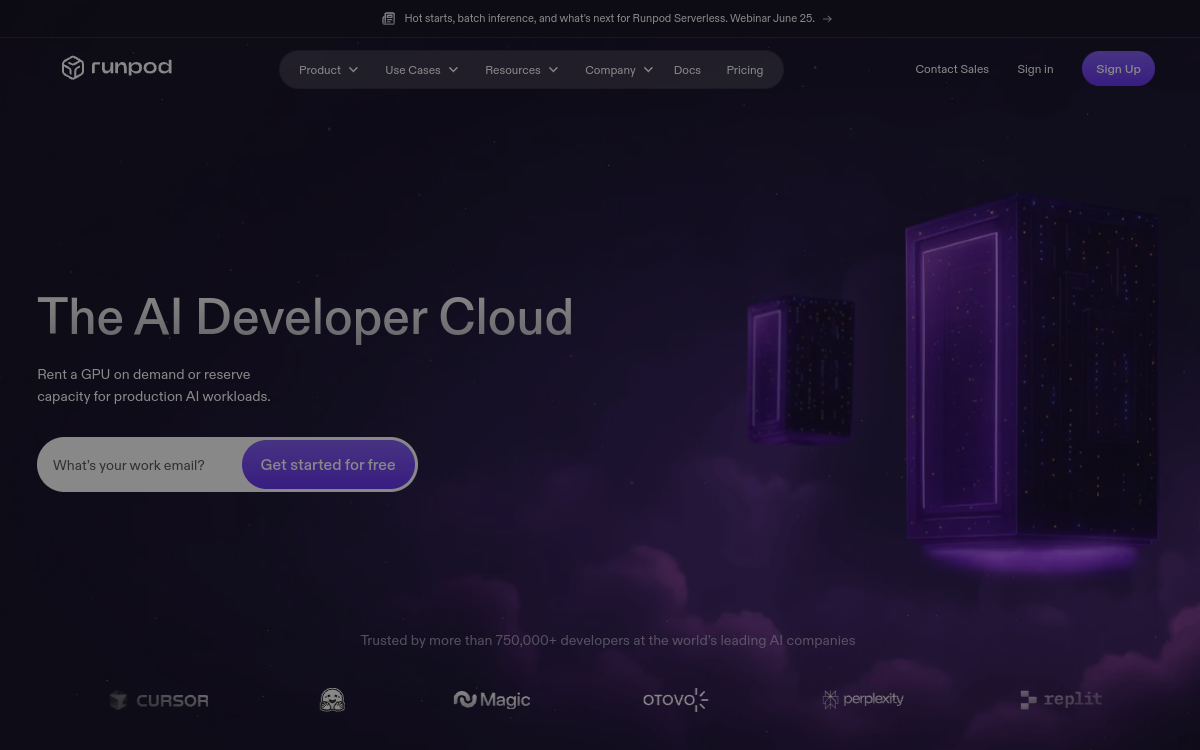
RunPod is a cloud GPU platform designed for AI developers and enterprises. It allows you to provision on-demand high-end GPUs (H100, A100, L40S, RTX) billed by the minute, for training, fine-tuning, and serving models. The platform offers serverless endpoints, ready-to-use Docker images, persistent storage, and a global network. Ideal for AI startups and ML teams who want fast, flexible cloud GPU that’s more affordable than traditional hyperscalers.
What is RunPod?
The essentials
RunPod is a cloud platform specialized in providing on-demand GPUs for AI workloads. It offers two main modes: Pods, which are dedicated instances where users install what they want, and Serverless, which allows deploying endpoints that automatically start and stop based on traffic. Users can choose from a wide catalog of GPUs, including the most powerful ones like H100 and A100, as well as more economical cards like RTX 4090 or L40S. The platform integrates Docker natively and offers a library of ready-to-use images, drastically reducing setup time. RunPod primarily targets AI startups, ML teams, and freelancers who want flexibility without the complexity of a hyperscaler.
Key features
RunPod offers a GPU catalog covering multiple price and performance ranges, from affordable RTX to H100 and beyond. Per-minute billing avoids overspending on unused hours. Pods launch in seconds from a chosen Docker image or community template. Serverless mode automatically handles scaling, which is particularly useful for serving a model in production with variable traffic. Persistent storage ensures data and models don’t disappear when a Pod stops. The API and SDKs cover common languages and allow automating deployments. For collaboration, team workspaces allow sharing resources and managing budgets. Available regions span multiple continents to optimize latency and geographic compliance.
Use cases
RunPod primarily serves AI startups training or fine-tuning models with budget constraints. ML teams use it to iterate quickly on experiments without depending on centralized GPU procurement. Independent developers deploy open source models to offer their own APIs. On-demand inference players use serverless endpoints to serve customers without managing dedicated infrastructure. Open source communities use RunPod to host interactive demos. Creative studios use it to generate images, videos, or music with specialized models. Finally, research labs find in RunPod a competitive alternative to internal clusters for one-off experiments or targeted compute loads.
Advantages
The main benefit is cost: RunPod is significantly more affordable than traditional hyperscalers, at equivalent performance on many GPUs. The second benefit is flexibility: per-minute billing and no commitment allow experimenting without budget risk. The third benefit is speed to market: with Docker images and community templates, a new Pod is operational in seconds. The fourth benefit is automatic scaling of Serverless mode, which simplifies getting models into production. Finally, the open API and SDKs allow engineering teams to fully automate deployments and integrate RunPod into their existing pipelines.
Pricing
RunPod operates on a per-minute usage model with no mandatory subscription. Pricing varies by GPU type, region, and mode chosen. RTX 4090s start around a few tenths of a dollar per hour, while H100s can reach a few dollars per hour depending on availability. Persistent storage is billed separately based on volume used. Serverless mode is billed according to actual compute time consumed, which can be very advantageous for variable loads. For demanding organizations, RunPod offers custom commitments allowing reserving capacity at negotiated rates. The cost-to-value ratio is generally very favorable compared to traditional hyperscalers.
Conclusion
RunPod is today one of the most relevant cloud GPU platforms for modern AI workloads. Its combination of competitive pricing, flexibility, serverless mode, and extensive GPU catalog makes it a reference for AI startups, ML teams, and freelancers. For those who want substance without the weight of a hyperscaler, RunPod deserves to be evaluated as a priority.