


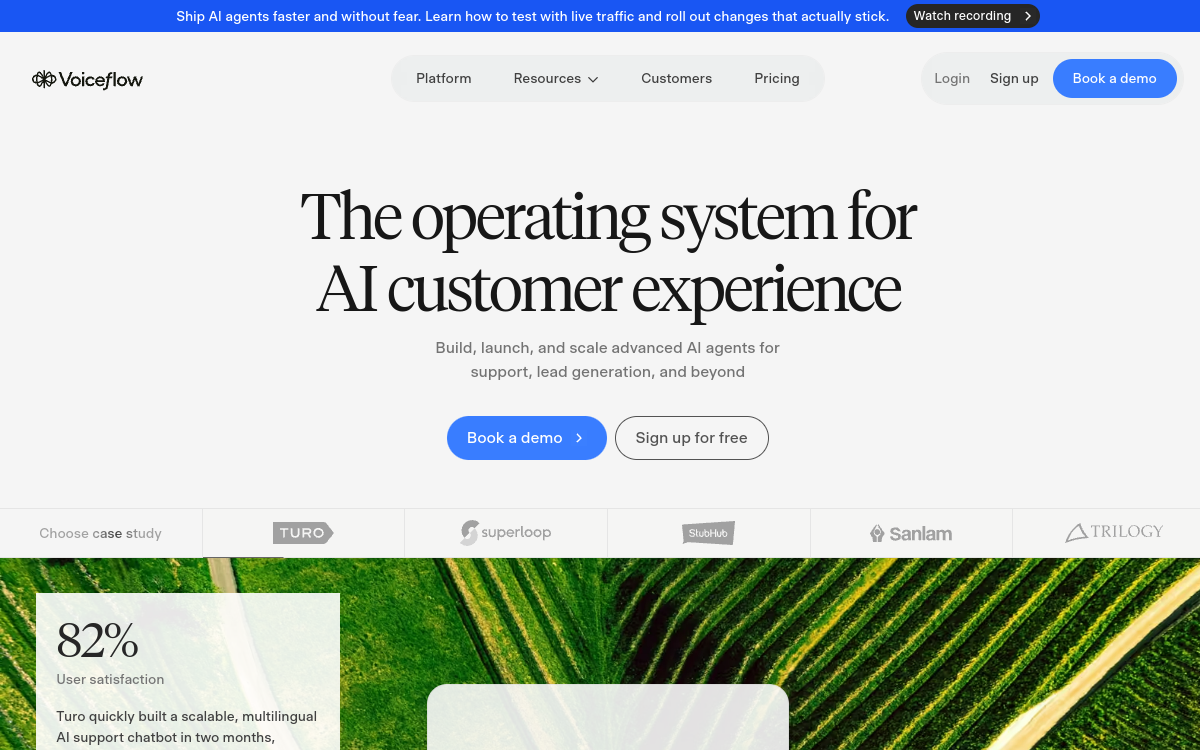
Voiceflow is a no-code platform for designing and deploying conversational AI agents. Its visual editor allows you to model complex conversation flows, integrate knowledge bases (PDFs, websites, documents) and connect external APIs. Compatible with GPT-4, Claude and other LLMs, Voiceflow supports voice and text agents across all channels. Teams collaborate in real time on a shared canvas. The platform targets teams looking to automate customer service or build rich conversational experiences without development skills.
What is Voiceflow?
The essentials
Voiceflow is a no-code platform for building conversational AI agents — chatbots, voice assistants or autonomous agents — without writing code. The tool features a visual canvas editor where teams design conversation flows with blocks: conditions, API actions, LLM responses, data collection, logical branching. Agents can ingest a custom knowledge base (PDFs, URLs, free text) to answer user questions accurately. Voiceflow handles deployment across web, voice and messaging from a single interface.
Key features
Voiceflow’s visual editor is the heart of the product: a real-time collaborative canvas where multiple team members work simultaneously. Available blocks cover all needs: messages, conditions, API calls, LLM integration, slot collection, and custom actions via JavaScript. The AI knowledge base allows ingestion of PDFs, web content and documents to feed agent responses. Integrations include Zendesk, Intercom, Salesforce and other tools via webhooks or API. Versioning allows managing multiple versions in parallel, and prototypes can be shared with password-protected access for client reviews.
Use cases
Voiceflow is primarily used for customer service automation: automatic FAQs, lead qualification, appointment booking, order tracking. Agencies use it to build custom chatbots for their clients. Product teams prototype conversational experiences to test them before development. Startups deploy AI assistants on their site without a dedicated development team.
Advantages
The main benefit of Voiceflow is deployment speed: a functional chatbot can be created in hours versus several days of development. Real-time collaboration accelerates iterations between product managers, designers and customer success. Multi-LLM compatibility allows choosing the best model for each use case and optimizing costs. The integrated knowledge base makes agents contextually more relevant without complex engineering.
Pricing
Voiceflow offers a very limited free plan with 100 credits and 1 agent, sufficient for initial testing. The Pro plan is $60/month for 1 editor, with 10,000 monthly credits included and up to 20 agents. Each additional editor costs $50/month. Annual billing offers a 10% discount. Enterprise plans with SLA and dedicated support are available for large organizations.
Conclusion
Voiceflow is the ideal platform for teams that want to create conversational AI agents without technical expertise. Its collaborative visual editor, multi-LLM compatibility and multi-channel deployment make it a powerful and accessible tool. Cost per editor remains the main friction point for larger teams.