


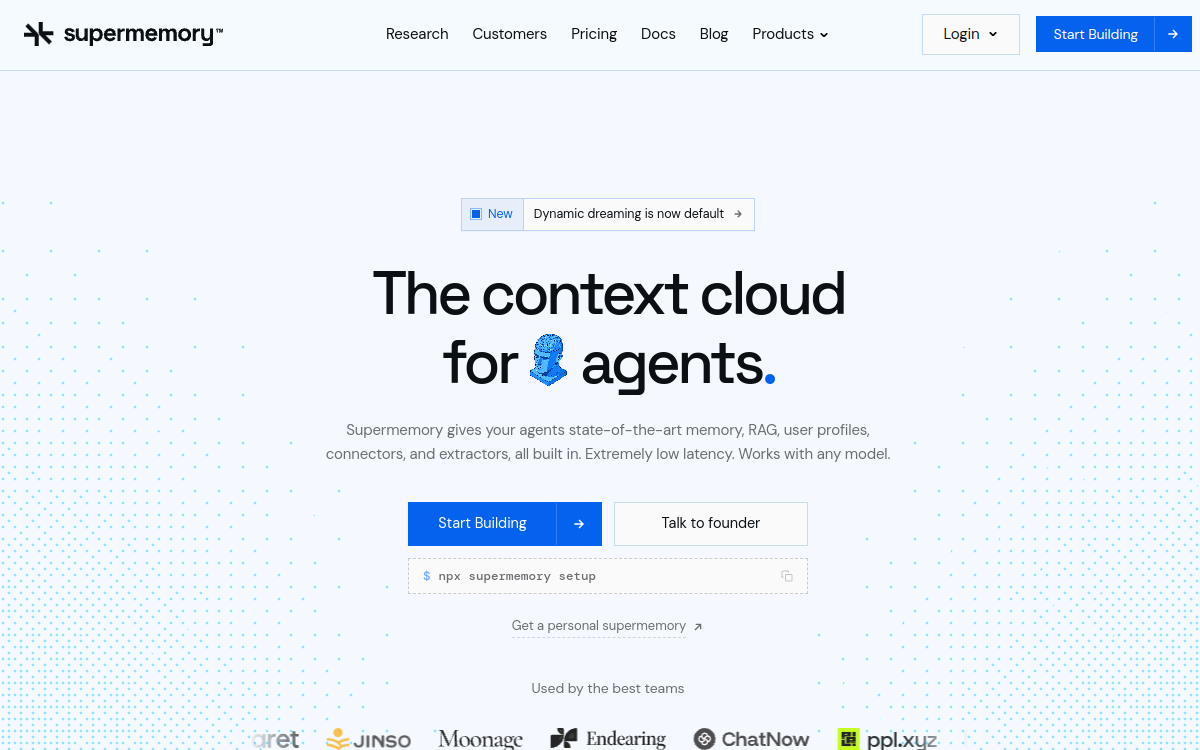
Supermemory is an AI memory infrastructure designed for developers and teams who want to give their agents and applications persistent and contextual memory. The platform exposes a universal API for ingesting, indexing, and retrieving information with extremely low latency, thanks to a proprietary vector engine built on Cloudflare Durable Objects and Postgres. Supermemory automatically handles extraction, chunking, embedding, and indexing of data, and supports up to 50 million tokens per user. It adapts to all language models and covers varied use cases: personal AI assistants, educational agents, customer support, healthcare systems, enterprise knowledge bases, and more. Its free plan lets you get started immediately without a credit card.
What is Supermemory?
The essentials
Supermemory is an AI memory infrastructure exposed as an API. Concretely, it handles ingestion of raw data (documents, chat histories, user profiles), transforms them into vector embeddings, indexes them in a distributed database, and makes them accessible through semantic search queries with very low latency. The platform is built on Postgres and a proprietary vector engine hosted on Cloudflare Durable Objects, guaranteeing enterprise-level performance. It’s compatible with all market LLM models and available as open source.
Key features
Supermemory groups several key components. The ingestion engine automates extraction, chunking, embedding, and indexing of any data source in seconds. The semantic search module allows retrieving contextually relevant information with high precision and minimal latency. User profile management allows building a dynamic representation of each user, their preferences, behaviors, and goals. Integrated connectors facilitate ingestion from varied sources. Finally, a well-documented RESTful API, accompanied by official SDKs, enables quick integration into any tech stack. The platform can process up to 50 million tokens per user and over 5 billion tokens per day at enterprise scale.
Use cases
Supermemory covers great diversity of use cases. Teams developing personal AI assistants use it to give their agents continuous memory between sessions. Educational platforms and AI tutors use it to adapt content to each learner’s progress in real-time. Healthcare companies exploit it to enrich and retrieve patient data securely. Customer support teams build chatbots capable of remembering each past interaction for more relevant responses. Companies set up internal knowledge bases accessible via AI agents.
Advantages
The main advantage of Supermemory is eliminating the infrastructure complexity related to AI memory. Developers no longer need to design, maintain, and scale their own RAG pipeline or vector database: everything is handled by the API. The ultra-low latency of the vector engine ensures a smooth experience even in production at scale. The universal approach, compatible with all LLMs, avoids vendor lock-in. Open source availability strengthens trust and enables security audits. Finally, the generous free plan allows validating a use case without financial commitment.
Pricing
Supermemory offers four pricing tiers. The Free plan (0$/month) includes 1M tokens processed and 10K search queries per month with email support. The Pro plan ($19/month) goes up to 3M tokens and 100K queries, with priority support and advanced analytics. The Scale plan ($399/month) targets enterprise organizations with 80M tokens, 20M queries, dedicated support, and Slack channel. A custom Enterprise plan is available for unlimited volumes with guaranteed SLA and dedicated engineer.
Conclusion
Supermemory is today one of the most solid and accessible solutions for giving AI agents persistent and performant memory. Its universal API, proven scalability, and open source model make it a trusted choice for developers and technical teams seeking to build truly intelligent AI applications. The free plan allows you to start without risk, and scaling is well-managed through the pricing structure.