


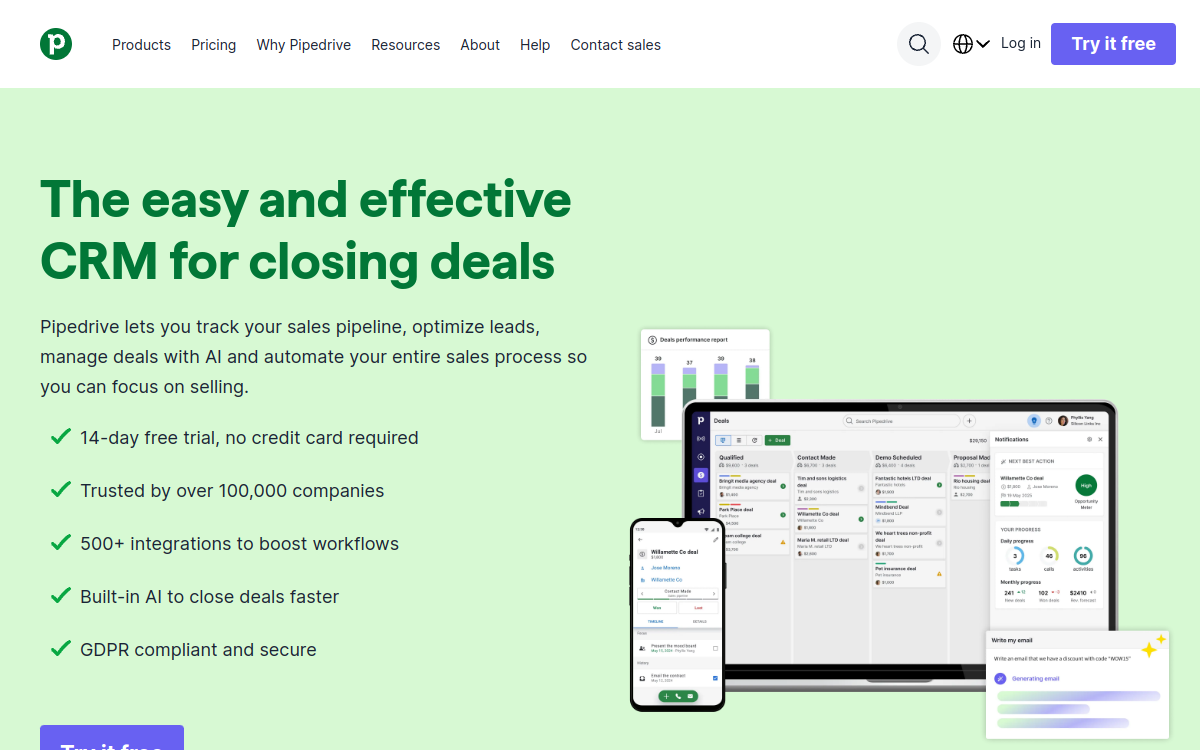
Pipedrive is a sales CRM designed to structure your pipeline, track your deals and automate follow-ups. It combines activity management, email/calendar synchronization and reporting, with AI functions (sales assistant, email generation/synthesis) to prioritize actions and reduce manual work. Ideal for teams who want a lightweight CRM focused on sales execution and visibility of objectives.
What is Pipedrive?
The essentials
Pipedrive is sales-oriented CRM software (Customer Relationship Management) designed to help teams manage opportunities end-to-end: from prospecting to closing. Its core is the visual pipeline: you create your stages, place your deals in them, then track their progress with structured information (amount, probability, close date, contacts, activities).The product is designed to be easy to deploy and adopt, even without a technical team. It offers email and calendar synchronization, activity management, simple automations and reports to drive performance. Additionally, Pipedrive relies on a Marketplace of integrations to connect everyday tools (messaging, video, forms, enrichment, support, etc.).Pipedrive primarily targets SMEs and sales teams who want a clear CRM that works quickly and is action-oriented rather than a complex ERP.
Key features
Pipedrive stands out with a set of features centered on sales efficiency. The customizable pipeline allows you to adapt stages to your actual sales cycle: qualification, discovery, proposal, negotiation, signature. Each deal is associated with activities (call, email, follow-up, meeting) to maintain a steady pace.On the communication side, email and calendar synchronization facilitate exchange tracking and planning. Email templates and tracking (depending on configuration) improve standardization and responsiveness. Automations allow you to chain simple actions: create a task after a stage, trigger a follow-up sequence, assign a deal, or send a notification.Pipedrive also integrates sales-oriented AI functions: email writing assistance, conversation synthesis, action recommendations and simplified app search in the Marketplace. Finally, the reporting section covers dashboards, forecasts and pipeline indicators to help managers detect bottlenecks and better prioritize sales effort.The integration ecosystem (and API) completes the offering to connect the CRM to your forms, marketing tools, signature, support or data enrichment.
Use cases
Pipedrive adapts to several sales scenarios. For prospecting, it serves to centralize leads, organize qualification and plan coherent follow-ups. B2B teams use it to structure multi-stage sales cycles, track meetings and maintain a clear view of pipeline value.Agencies and service companies appreciate the visibility: each opportunity is linked to a contact, a company and context notes, which facilitates handoff between salespeople and managers. For growing teams, Pipedrive helps standardize processes (pipelines, fields, templates, automations) to avoid disparate practices.On the management side, use cases revolve around forecasts and performance tracking: monitoring objectives, analyzing conversion rates by stage, identifying blocked deals, and adjusting follow-up strategy. Finally, with integrations, Pipedrive becomes a hub: a web form creates a lead, an automation assigns the rep, and a task is scheduled for first contact.
Advantages
The first benefit of Pipedrive is clarity: the pipeline makes priorities visible and limits oversights. By attaching each deal to a next action, the team maintains a follow-up rhythm that mechanically increases conversion chances.The second advantage is adoption speed. The interface is designed for salespeople: simple, structured, with obvious actions. This reduces CRM resistance and improves data quality.Third point: automations and AI features help reduce administrative burden. Less copy-pasting, less manual sorting, more time for customer relationships. Finally, reporting provides useful performance tracking: better understand what works, where deals are lost, and how to optimize the sales cycle.In summary, Pipedrive brings productivity gains, better sales discipline and increased visibility for managers.
Pricing
Pipedrive works on a per-user pricing model, with a 14-day free trial. Prices vary by plan and billing (monthly or annual). With annual billing, the entry-level plan starts at €14 per user per month, then increases based on features (advanced automations, lead generation tools, governance, security, etc.).To choose the right plan, start with your usage: a small team will mainly need the pipeline, activities, email sync and some automations. A more structured team will want more complete reports, lead routing capabilities and more customization. Finally, some modules may be offered as add-ons depending on needs (lead generation, documents, projects, etc.).The right reflex: estimate the total cost with the number of users and options really needed, then validate with the free trial.
Conclusion
Pipedrive is a solid solution for teams who want a simple CRM centered on action and pipeline visibility. Its activity-focused approach, accessible automations and AI benefits for sales productivity make it particularly well-suited to SMEs, startups and agencies.If your priority is to accelerate execution (follow-ups, tracking, prioritization) and get clear performance tracking without excessive complexity, Pipedrive checks many boxes. On the other hand, for very “enterprise” needs or extreme customization, you’ll need to evaluate higher plans, add-ons and sometimes heavier alternatives.For most sales teams, Pipedrive remains an excellent balance between simplicity, efficiency and scalability.