



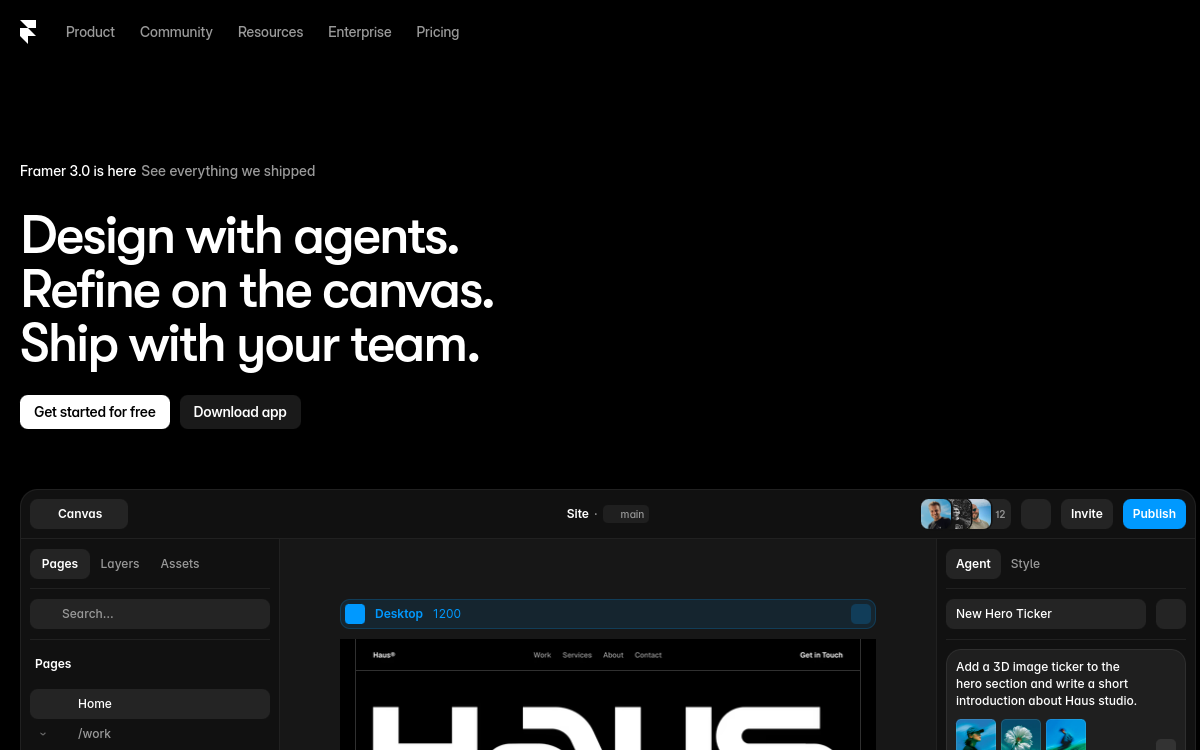
Framer is a no-code platform for designing and publishing modern websites, especially conversion-oriented landing pages. It combines a fluid visual editor, reusable components, a light CMS and optimized hosting. Ideal for prototyping and fast publishing, Framer also helps care for SEO (structure, performance, metadata) without complexity.
What is Framer?
The essentials
Framer is a no-code website creation platform focused on design, interactions and fast publishing. It offers a visual editor allowing you to build pages from sections, components and reusable blocks. The goal: move quickly from an idea to a published site, without sacrificing rendering.Framer includes integrated hosting and useful marketing features: page management, components, styles, animations, and a light CMS to feed collections (articles, case studies, tool pages, etc.). The platform addresses both independent creators and product teams and agencies who want to launch and optimize pages continuously.Unlike a traditional CMS, Framer prioritizes a “design-first” experience: creation is by direct manipulation, with modern constraints (responsive, typography, spacing). You can thus deliver very high-quality pages, often faster than with a mockup + integration + deployment chain.
Key features
Framer stands out through a set of features focused on production speed and visual quality. First, the no-code editor allows you to compose pages with precision: grids, responsive, styles, typographies and spacing can be managed consistently. Reusable components facilitate creation of a simple design system: a modification is reflected across all affected pages, which is essential for maintaining consistency at scale.Next, Framer manages interactions and animations without effort. This allows producing more dynamic marketing pages, useful for capturing attention and improving user experience. Publishing is direct: you can preview, iterate, then publish in one click, without worrying about infrastructure.The integrated CMS covers many use cases: content collections, pages generated from data, template duplication, and content management by a marketing team. Added to this are standard SEO parameters: titles, descriptions, social preview, structure and good performance. Finally, integration possibilities (forms, marketing tools, analytics) allow you to connect Framer to an existing growth stack.
Use cases
Framer is particularly suited to projects where speed and iteration are key. Use case number one: campaign landing pages. A marketing team can create multiple variations, test messages, adjust structure and publish quickly, without relying on a developer.Second case: the launch page for a product or AI tool. You can design a clean page, with reusable sections (features, pricing, FAQ, testimonials) and integrate signup forms, tracking and emailing tools.Framer is also useful for portfolios and design-focused showcase sites: creatives, freelancers and studios can showcase projects with a high-end render and elegant transitions. Finally, with the light CMS, Framer can be used to publish “collection” pages: directories, product pages, case studies, mini-marketing blogs, as long as the architecture remains reasonable and back-end needs are limited.
Advantages
The first benefit of Framer is time savings: creating, adjusting and publishing becomes a continuous process. You reduce back-and-forth between mockup and integration, which accelerates your marketing cycles. The second benefit is visual quality: Framer is designed for modern, consistent and pleasant pages, which strengthens credibility.Third advantage: iteration. In SEO and conversion, the best results often come from progressive improvements. Framer facilitates quick adjustments: sections, CTA, copy, structure, additional pages. Fourth point: consistency through reusable components, useful once your site exceeds a few pages.Finally, Framer offers a “production-ready” framework: integrated hosting, generally solid performance, and accessible SEO settings. For a team that wants to produce many marketing pages without overloading the technical stack, it’s a good compromise between autonomy and quality.
Pricing
Framer generally offers a freemium approach: a free version allows you to test the platform and start a project. Paid plans add publishing options, more features and capabilities suited to professional use.For a marketing site, the switch to paid is often justified as soon as you want finer control over publishing, better project management and team needs. The right choice depends on page volume, CMS needs, and collaboration level. In a SEO and acquisition logic, the goal is to take a plan that allows you to publish cleanly, iterate without friction, and monitor performance.
Conclusion
Framer is a very effective no-code solution for quickly creating and publishing modern sites and landing pages. Its design orientation, reusable components, animations and light CMS make it a particularly suitable tool for marketing teams, startups and agencies that want to iterate fast.If your priority is to launch clean, testable and high-performing pages, Framer offers an excellent balance between speed and quality. For very complex back-end needs or advanced e-commerce, a more specialized platform will often be more relevant. But for the majority of marketing sites and conversion pages, Framer remains a solid and sustainable choice.