


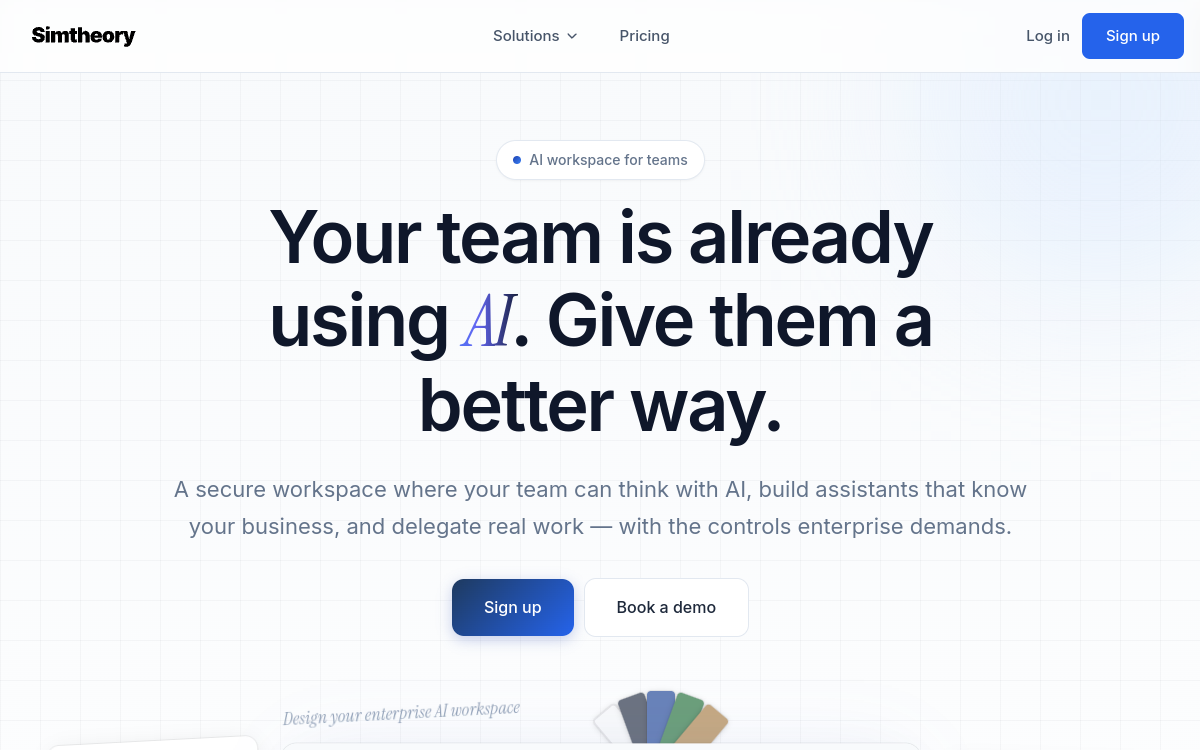
Simtheory is an AI workspace for teams: you create specialized assistants (legal, product, marketing…) with their own sources and instructions. The tool manages context, memory and integrations to execute more complex tasks. For a French-speaking audience in a SaaS or agency environment, it’s a way to industrialize AI usage at the team level rather than for each isolated individual.
Overview of Simtheory
Detailed overview
✅ Strengths
- Multi-agent workspace for entire teams.
- Specialized assistants with dedicated sources and roles.
- Integrations and APIs for advanced workflows.
- Interesting approach to standardize AI usage.
- Suitable for SaaS, agencies and product teams.
⚠️ Limits
- Requires internal governance to deploy effectively.
- English interface, slower adoption in French.
- Requires defining clear AI processes.
- Oversized for very small teams.
❓ FREQUENT QUESTIONS
FAQ — Simtheory
Does Simtheory replace a simple team ChatGPT?
It goes further by allowing you to create multiple specialized assistants, each with their own sources, rules and objectives.
Do you need devs to use it?
Not necessarily for simple uses, but advanced integrations and APIs will require technical skills.
Can you limit access to certain data by assistant?
Yes, the idea is precisely to control which sources are visible by which assistant and which teams.
Does the tool handle French?
Multilingual models work, but configuration and interface are mainly in English. Accompanied adoption is preferable.
Is Simtheory suitable for a very small team?
It can be used by a small team, but its full potential appears mainly in organizations with multiple roles and projects.

Assistants Productivity
Allows you to create dedicated assistants (legal, product, data…) with custom memory and sources.
💰 Rate
Free trial, team plans from ~$29/month
🆓 Free trial
Yes
🌐 Languages
🇬🇧 English
Visit the site →